Tuesday, March 27, 2007

Non-Fiction Lesson Plan: Michael Pollan

I adore Michael Pollan. I think he's witty and a smart writer--and I've always enjoyed his approach to the problems he tackles in writing. So if I were to teach a non-fiction lesson, I'd probably teach one of his essays. In fact, I selected "Why Mow" from his book Second Nature because I thought it would be a good one to give students. (If you have a chance, check out any of Michael Pollan's books--he also puts a lot of it up on his website: http://www.michaelpollan.com/)


*****************************

Jenn Miller

Professing Literature

David Jolliffe

March 28, 2007

Nonfiction Lesson Plan: Michael Pollan, “Why Mow”

Reading Journal: Before reading Pollan’s essay, “Why Mow[1]”, have the students respond briefly (a few sentences) to the following questions: Do you (or your parents) have a front lawn? Is there a specific purpose for your lawn? Do you know anyone without one?

After reading the essay, have the students respond: Does Pollan cause you to think differently about lawns? Why or why not? Do you think lawns are related to being American and our democratic ideology? Why or why not?

Focus: Pollan says, “Every few years a controversy erupts in some suburban community over the failure of a homeowner to mow his lawn…That subtle yet unmistakable frontier, where the crew-cut lawn rubs up against the shaggy one, is enough to disturb the peace of an entire neighborhood; it is a scar on the face of suburbia, an intolerable hint of trouble in paradise” (67).

Provide a lawn case study to students. Example: Gene Hatfield, an artist in Conway, Arkansas, and a former UCA art professor was cited by the City of Conway for violation of a lawn ordinance—in other words, for putting his art out in his front yard instead of maintaining a lawn. The local art community, comprised mainly of UCA art students, took up the cause, declaring the citation an act of an overly controlling government, stifling the expression of art and violating free speech. Eventually, Hatfield and the city came to a truce; he cleaned up his yard and paid a reduced fine, but was allowed to leave some art on display in his yard.

In light of Pollan’s essay, have the students take a moment to respond to this case study. Is the city justified in its treatment of Hatfield, an artist and homeowner? Allow the students to share their responses.

Purpose: To demonstrate the ways a nonfiction essay can give a reader insight into cultural or political issues by examining the traits of an essay—the way an essay can take something as seemingly mundane as lawns and turn it into an examination of American culture.

Overview: We’ll first examine the traits of an essay (defining the genre). Then we’ll look at some of these traits in Pollan’s essay and begin thinking about the upcoming essay assignment.

Business: Do class business here.

Lecture: Discuss features of an essay (as opposed to more structured forms of writing that students are used to): the impetus (jumping point), the organization, the interrogation of knowledge, the narrative persona, digressions, and use of quotations. Students are used to the idea that writing should have a formal pattern (i.e. introduction, body—with three main points—and conclusion), so showing the essay form in opposition may be helpful.

After reviewing the traits of an essay, return back to Pollan and have the students pull these traits from his text. For example, ask the students to write down what they believe the impetus is (lawns/mowing) and then call on a few students to answer. Other questions: Name one adjective that would describe Pollan’s narrative persona. Give one example of where Pollan uses digressions. How does Pollan use quotations? (direct or implied—the first sentence is an allusion to Donne’s “No man is an island”). Does Pollan’s essay strike you as very organized or structured? What is Pollan trying to get at about lawns and American politics/culture? This will hopefully lead to a structured, useful discussion time.

Closure: This lesson is one out of a series in preparation for students to write an essay of their own. For next time, students will brainstorm some starting blocks or an impetus to write an essay (Pollan begins with mowing and ends up examining the cultural implications of lawns). Of course the impetus is only useful in that it allows the writer to wrestle with a deeper idea, so the students will come up with at least three possible jumping points and the idea they wish to explore from that jumping point. (This will allow for feedback on their writing ideas.)


[1] “Why Mow”—excerpt from Second Nature by Michael Pollan, New York: Dell Publishing, 1991.

Saturday, March 24, 2007

Grad Blues

I chose to turn down an assistantship to the university I currently attend and opted instead to work full-time (for the university) and take advantage of the tuition discount. My reasoning was that I'd be able to clear out my debt (something I've almost accomplished) and save money for when I go to PhD school. It was a good plan, and I still think it's the right one.

However, the next group of my friends are starting to get their acceptance letters and offers of assistantship from various universities. Here I feel the pang--again--that I'm not a full-time student and am not on assistantship. I'm not a part of the English MA student community here because while I have classes with some very nice people that I talk to on a semi-regular basis, I don't share an office with them, I don't see them everyday, and I don't have the same problems as they do. I'm not teaching, and I miss that. I'm not in school full time, and I miss that too.

While I still feel like I'm on the right path, I'm starting to wonder if I maybe should have just taken the risk and jumped into the assistantship, even if it meant putting me further into debt instead of allowing me to extract myself. I'm still not sure. I think it may have been a situation of my being happier for present, but ultimately more miserable in the future, as I faced insurmountable challenges...

Basically, I'm jealous of all my friends who are getting to take the path I chose not to take. It's as simple as that.

Wednesday, March 21, 2007

The Homeworks

Before May 3rd, I must accomplish the following things:
--8-10 page book review (April 4th)
--Annotated syllabus (April 11th)
--10 page conference paper (April 12th)
--15-25 page final paper (May 3rd)

This isn't counting all of the reading assignments to be accomplished within that same time frame.

Whew, it's going to be a busy month.

Tuesday, March 20, 2007

Knitting! (and non-grumbly post)

I promised Katie that I would post a picture of Rory playing with her cat toys, so here she is:


She's so happy, with her wonderful knit mice--and she almost likes them as much as her purple bear!

Thanks again, Katie, for the wonderful color swap package.

*Grumble*

In continuation of my lazy Spring Break posts, I give you a gripe:

I have to read The Political Unconscious by Fredric Jameson. Yes, Professor Fredric Jameson, the winner of a Bad Writing Contest. He's got some good ideas, but his writing is rough to get through. To make it worse, I know I need to have some familiarity with the book in order to write a good paper for my class. I should have read it weeks ago, but put it off in favor of other homework.

I don't want to read it, but I must. And I will be a stronger woman for it.

Monday, March 19, 2007

Um, yeah...

I'm on "spring break" this week, which means I have an excuse to a little lazier than normal. Which also means I'm going to deviate slightly from the usual posts and just chatter.

I thought about writing on Terry Eagleton's fantastic book, After Theory...but I'll do that another day. It was an interesting read, though, and much more interesting than a theory book has a right to be. (He makes several cutting remarks about the current US Administration, which is both entertaining and to the point). I think I'm going to order his book Literary Theory and hope it teaches me more than my goofy class.

I've been reading Ursula LeGuin's The Dispossessed, which will eventually become fodder for the 10-page conference paper presentation and the subsequent 15-25 final paper. I think I know what I'm going to be talking about too, so that's exciting--luckily the book easily accepts a Marxist interpretation. I'll talk more about that another day too.

I'm proud that I've managed to post fairly regularly. I've also noticed, like Donna, blogging helps my writing. It's getting easier to phrase things quickly, concisely, and interestingly (I hope). It's the practice of simply writing something everyday, I believe, that is helping me really tap into my abilities. So far, so good.

Saturday, March 17, 2007

Don't Write the Eulogy Yet...

I attempted to type out an comment in response to ADAllen's perceptive and interesting post, "The Death of Denotation?", which Blogger promptly ate. (Boo.) However, it got me to thinking even more, so I decided to create a post for my own site here about what I thought. (ADAllen and I differ slightly, I believe, on our respective approaches to language and communication, which leads us to some great conversations.)

She hopes that the death of denotation (the "dictionary" definition of a word) would signal a time where "each individual is responsible for making meaning", leading to an improvement of us as communicators. I agree with much of what she says, but I also have some problems. For one, language doesn't occur in isolation--it requires a group and community to use words and agree about what they denote. Denotation is, often, the meaning that a community of speakers/listeners have determined to be the meaning of a word.

Connotation occurs--in ways that philosophers like de Saussure, Bakhtin, and Derrida examined--when an utterance refers to other utterances in some way; it recalls the uses of language and lends new meaning to an utterance (interdiscurvisity and intertextuality). And understandings of meaning differ from individual to individual. But the word must still roughly mean the same thing from speaker to speaker for communication to take place--denotation must still exist.

Perhaps the perceived death of denotation comes with an increasing awareness of the interplay between denotation and connotation. Because we are able to think about language abstractly as systems of signs and examine the implications of certain uses of languages, this leads us to believe that denotation no longer exists. However, I have to point back to my assertion that language is not an individual making meaning--meaning is determined within a community of at least two, with a speaker creating an utterance and a listener receiving it and determining meaning based off of past experiences with other utterances. Meaning is not made in isolation; it requires the participation of others, the participation of past, present, and future listeners and speakers.

And ADAllen asserts at the end of her post that we do still need denotation because we need that neutral ground in language. (Though, many would argue that no language is neutral). Basically it ends up that no language is truly neutral because it the interdiscursive nature of text, nor is it purely connotative because meaning is made by a community. Meaning is both outside the individual and inside the individual simultaneously.

See now? I ended up disagreeing with ADAllen, coming around to her side, and then disagreeing with her again. Language is a slippery, tricky idea, (that somehow needs to be concrete) which is why so many philosophers and theorists are concerned with its use.

Friday, March 16, 2007

Response Paper: Elaine Showalter's Teaching Literature

One of our assignments for Professing Literature is to write a 1-2 page response paper to a chapter of an assigned reading and then read it aloud in class. My response paper was over Elaine Showalter's Teaching Literature. Showalter is a feminist critic who teaches at Princeton and wrote this mediocre guide to teaching literature at the college level. Here's my response to Chapter 9 of the book, "Teaching Dangerous Subjects".

*******************************

Jenn Miller
Professing Literature
March 14, 2007

Response Paper to Showalter, Chapter 9

I have to admit that Showalter seduced me with the titles of Chapter 9 and 10: “Teaching Dangerous Subjects” and “Teaching Literature in Dark Times”. I was intrigued by the words “dangerous” and “dark times” which brought forth images of the Mighty English Professor, with her cape and superpowers making the world safe for literature everywhere. Showalter seemed to demand that we view ourselves as guardians of volatile knowledge and shining lights in times of dark. It is rather romantic stuff. But is that what we are, really?

I found myself both nodding and knitting my brow in consternation when I read these chapters. For one, she seemed to offer little of use besides vagaries (“underwhelming” returned again this week). Then the issue of suicide: my initial impulse was to say: hey, we’re not here to coddle students, nor are we here to be their counselors—perhaps cold-blooded, but I’m not a therapist—we’re here to teach literature. But then another thought occurred to me: we’re always going on about how literature is deeply connected to real life, and issues such as suicide and violence and sex are issues of real life that are often found in literature. Should we not expect our students to be affected by finding them in class assignments? And wouldn’t we want our students to feel they could approach us for help in their personal lives?

However, I’m still not sure that the English classroom is the place to teach topics such as suicide awareness—I remain unconvinced of the efficacy of a one-page sheet on suicide prevention—but it could be a place for students to deal with such issues. I’ve often used literature to work my way through personal problems, and I believe that I should provide the opportunity for my students to do the same. I want my students to trust me, but not feel that I’m leading a seminar on life issues—after all, I still have to teach English.

Then there’s the “other” issues, you know the things like violence, sexual language, and race. I wanted to point out to Showalter that you never know how students will react. You can assign an essay that you think will cause students to examine their own perspectives and they won’t even blink (or they’ll miss the point entirely), or you can plan to talk about a seemingly mundane short story that sparks massive controversy. You just never know; at least this was my experience.

This is important stuff—and one reason that I shied away from teaching high school. I wanted at least the perceived sense of having more control over the content of my courses, and that meant teaching sensitive material that is often censored in a high school curriculum. In the same light that giving students a space to deal with personal issues is necessary in the English classroom, then perhaps challenging their perceptions (in a constructive manner) is also a part of our role as English teachers. Teaching from a comfortable zone, staying with the “easy” topics, and avoiding sensitive material will do nothing to help students face a world that will constantly press them with uncomfortable ideas.

But how do we do it? Here’s where Showalter, again, lets us down. For example, Showalter points out that she believes “the professor’s behavior and tone are crucial in shaping students’ attitudes toward sexual language. If we are embarrassed, they will be embarrassed. If we are salacious, they will leer” (129). True, very true, but how? Instead of offering (much) practical advice on how, she challenges us not to be wimps—easy to say when you’re tenured and can easily maintain romantic notions of teacherhood from your dratted ivory tower. How are we to navigate these issues in our classrooms? Avoidance should be avoided, but it’s difficult to tread carefully when you never know how students will respond. Do we simply take a stab in the dark, and hope that we don’t get shoved out? Perhaps “dangerous subjects” are so because they pose a threat to ourselves as teachers as we attempt to guide our students through them.

Thursday, March 15, 2007

"Mistakes Were Made"

I'm sure we've all seen the news about the firing of the prosecutors, which may have been politically motivated. Alberto Gonzales is quoted as saying "I acknowledge that mistakes were made here".

I can't help it; when I see phrases like this, I just want to shred them, deconstruct them, and look at what is going on underneath. He starts with "I acknowledge" which implies that he wants to admit something. It's an active phrase, the subject "I" clearly doing the acknowledging. However, acknowledge implies recognition or the revelation of something previously unknown. It's not admitting--admitting would mean that he was hiding something--it's a realization about a situation.

The "I acknowledge" is countered by the next part: "mistakes were made". "Mistakes were made" is a passive phrase. There is no mention of who made the mistakes. It's a shifty phrase. It's evasive; it's an attempt to appease those who might be out for Gonzales' head. The mistakes were not made by anyone in particular, after all, they were simply made.

Together "I acknowledge that mistakes were made" had a double meaning. It's like he's casting the glamour of taking responsibility without actually doing so. It appears that he's attempting to calm those who are shouting "fraud" without attempting to point out how the mistakes were made or on whose discretion.

The word "here" is an interesting touch. "Here" is one of those directional words that only have meaning in context of the speaker. Is "here" a physical location that Gonzales points to during the utterance? Or is it a figurative "here" that seeks to give the utterance immediacy and accessibility--or serves to cut off those who are not "here" because they are "there" (at least in terms of the speaker). After all if I'm here, you must be there. If it's meant to cut out those that are outside the "here", then the whole utterance speaks a language of hiding, doubleness, and evasion.

A reader or listener who receives this utterance might be vaguely troubled, but not know why. After all, doesn't it seem like Gonzales is recognizing that something wrong happened? But in reality, he does no such thing.

The moral of the story: Don't use passive language--use the active voice in writing and speaking. Unless you're a shifty politician backed into a corner. Then you daily rely upon the passive voice to cover your ass.

Wednesday, March 14, 2007

Those Damn Commies

My theory class, if you've talked to me recently, has been a Marxism class. I'm fine with Marxism; it's interesting, and it certainly has valid points for both interpreting literature and living in society. I'd even go so far as to say that I have Marxist leanings, or at least am sympathetic toward the Marxist viewpoint.

However, when I signed up for a theory class, I expected to be schooled in theory (especially after my adviser and course instructor snidely remarked that any undergraduate theory class I could have taken would be sorely inadequate for my graduate career). However, in my graduate theory class, we've done a whirlwind tour of the "other" theories: New Criticism, psychoanalytic theory, feminism, poststructuralism, deconstruction, etc--one day per theory, and postcoloinalism and feminism were lumped together in the same day. And we have read no primary texts, simply 10-page summaries of the major theoretical notions. Then we settled into a several week exploration of Marxism, the theory that subsumes and consumes and IS all other theories.

However, our class is not supposed to be a class on Marxism, and my professor has a clear Marxist agenda. The kicker is that my undergraduate (inferior) theory class has this class beat with a giant stick. You see, in my undergraduate class, we read all sorts of primary texts, starting with Plato's Republic (and it's attack on poets), catching theorists such as Aristotle, Derrida, Foucault, Freud, Marx (yes, Marx), Irigary, etc. Then after we discussed these primary texts (no wimpy summaries for us), we applied these theories to literature and read critical approaches associated with those texts. Next to this "rigorous" approach, my graduate theory class seems like a joke. An extensive Marxist joke--and Marxists aren't known for their humor.

The point? I feel somewhat forced to interpret the book we have to analyze theoretically using a Marxist approach. (After all, my professor has asserted time and again that Marxism is the only theory worth knowing). I'd actually prefer to deconstruct it, since I acquired a liking of Derrida through the course of the semester, but hey. He purposely assigned a text that has clear points for Marxist interpretation--Ursula LeGuin's The Dispossessed.

Damn Marxists. I could so easily like you, if you didn't get hammered into my head everyday...

(I read and presented on Terry Eagleton's After Theory, which did much more for my Marxist sympathies than this theory class has...)

Tuesday, March 13, 2007

Meme! Books!

Look at the list of books below: *Bold the ones you’ve read* Italicize the ones you want to read* Leave blank the ones that you aren’t interested in.

I'm not going to italicize all the ones that I want to read because that'd be ridiculous. There will be commentary...

1. The DaVinci Code (Dan Brown)
Unfortunate event of my reading career. I picked it up because my boyfriend liked it, only to find out that he liked it because he recognized all the places. Bad, bad.

2. Pride and Prejudice (Jane Austen)
Ah, Jane Austen. I avoided her for a while, only to fall in love with her wholeheartedly last semester. I'm winding my way through her canon.

3. To Kill a Mockingbird (Harper Lee)
Of course! Fantastic!

4. Gone With The Wind (Margaret Mitchell)
5. The Lord of the Rings: Fellowship of the Ring (Tolkien)
Yes! Yes!

6. The Lord of the Rings: Two Towers (Tolkien)
Yes! Yes!

7. The Lord of the Rings: Return of the King (Tolkien)
I wrote my senior thesis on The Lord of the Rings.

8. Anne of Green Gables (L.M. Montgomery)
A childhood favorite--I read it over and over again...

9. Outlander (Diana Gabaldon)
10. A Fine Balance (Rohinton Mistry)
11. Harry Potter and the Goblet of Fire (Rowling)
12. Angels and Demons (Dan Brown)
God, no.

13. Harry Potter and the Order of the Phoenix (Rowling)

14. A Prayer for Owen Meany (John Irving)
15. Memoirs of a Geisha (Arthur Golden)
16. Harry Potter and the Sorcerer’s Stone (Rowling)
17. Fall on Your Knees (Ann-Marie MacDonald)
18 The Stand (Stephen King)
19. Harry Potter and the Prisoner of Azkaban (Rowling)
20. Jane Eyre (Charlotte Bronte)
This was a well-timed book in my young life. I need to re-read it now that I'm older and see if it has the same power for me.

21. The Hobbit (Tolkien)

Of course I read it. And loved it. And read it some more.

22. The Catcher in the Rye (J.D. Salinger)

23. Little Women (Louisa May Alcott)
24. The Lovely Bones (Alice Sebold)
25. Life of Pi (Yann Martel)
Fantastic book. I borrowed it from a dear friend and enjoyed it, then passed it off to Lance, who also loved it.

26. The Hitchhiker’s Guide to the Galaxy (Douglas Adams)
I discovered it in high school and adored it. It was so funny! (Though my devoutly Christian soul was troubled by his flippant comments about Christianity...)

27. Wuthering Heights (Emily Bronte)

28. The Lion, the Witch and the Wardrobe (C. S. Lewis)
Another childhood favorite that I read about a zillion times.

29. East of Eden (John Steinbeck)

30. Tuesdays with Morrie (Mitch Albom)
31. Dune (Frank Herbert)
My friend Kim got me to read this, and I really enjoyed it.

32. The Notebook (Nicholas Sparks)
Maybe...all Nicholas Sparks books run together in my head (they suck, in other words--and I have read two or three of them...)

33. Atlas Shrugged (Ayn Rand)
I read Anthem!

34. 1984 (George Orwell)
35. The Mists of Avalon (Marion Zimmer Bradley)
36. The Pillars of the Earth (Ken Follett)
37. The Power of One (Bryce Courtenay)
38. I Know This Much is True (Wally Lamb)
39. The Red Tent (Anita Diamant)
40. The Alchemist (Paulo Coelho)
41. The Clan of the Cave Bear (Jean M. Auel)
42. The Kite Runner (Khaled Hosseini)
Working on it, anyway.

43. Confessions of a Shopaholic (Sophie Kinsella)

44. The Five People You Meet In Heaven (Mitch Albom)
45. The Bible
46. Anna Karenina (Tolstoy)
47. The Count of Monte Cristo (Alexandre Dumas)
48. Angela’s Ashes (Frank McCourt)
49. The Grapes of Wrath (John Steinbeck)
50. She’s Come Undone (Wally Lamb)
51. The Poisonwood Bible (Barbara Kingsolver)
I've read this twice now. I read it originally for Donna's class, and loved it, and on the second reading discovered just how well she wrote this book. Barbara Kingsolver is an amazing writer and essayist. I recommend The Bean Trees. I read it in high school and cried at the end, it was so good.

52. A Tale of Two Cities (Dickens)

53. Ender’s Game (Orson Scott Card)
54. Great Expectations (Dickens)
This was my first Dickens. I like Dickens a lot and would read more of him given the chance.

55. The Great Gatsby (Fitzgerald)

I think I hated this book in high school, when I read it independently. I might feel differently now, considering it's one of the "Great Books".

56. The Stone Angel (Margaret Laurence)
57. Harry Potter and the Chamber of Secrets (Rowling)
58. The Thorn Birds (Colleen McCullough)
59. The Handmaid’s Tale (Margaret Atwood)
My first Margaret Atwood novel, read in annoyance because I kept seeing her referred to by other authors and critics. The annoyance soon dropped away, and I enjoyed the book--it is interestingly structured and poignant.

60. The Time Traveller’s Wife (Audrew Niffenegger)
61. Crime and Punishment (Fyodor Dostoyevsky)
62. The Fountainhead (Ayn Rand)
63. War and Peace (Tolstoy)
64. Interview With The Vampire (Anne Rice)
65. Fifth Business (Robertson Davis)
66. One Hundred Years Of Solitude (Gabriel Garcia Marquez)
67. The Sisterhood of the Traveling Pants (Ann Brashares)
68. Catch-22 (Joseph Heller)
Started it!

69. Les Miserables (Hugo)
70. The Little Prince (Antoine de Saint-Exupery)
71. Bridget Jones’ Diary (Fielding)
72. Love in the Time of Cholera (Marquez)
73. Shogun (James Clavell)
74. The English Patient (Michael Ondaatje)
75. The Secret Garden (Frances Hodgson Burnett)
Another childhood favorite, read about a zillion times.

76. The Summer Tree (Guy Gavriel Kay)
77. A Tree Grows in Brooklyn (Betty Smith)
Read it one summer and enjoyed it. Smith can be a little heavy-handed, but she tells a good story.

78. The World According to Garp (John Irving)

79. The Diviners (Margaret Laurence)
80. Charlotte's Web (E.B. White)
My first novel ever!

81. Not Wanted On The Voyage (Timothy Findley)
82. Of Mice And Men (Steinbeck)
This book is depressingly good. (What's up with that, Steinbeck?)

83. Rebecca (Daphne DuMaurier)
84. Wizard’s First Rule (Terry Goodkind)
85. Emma (Jane Austen)
Of course!

86. Watership Down(Richard Adams)
I read it my senior year of high school and liked it. I need to reread it to make sure it's still as good as I remember (my tastes changed drastically in college).

87. Brave New World (Aldous Huxley)
88. The Stone Diaries (Carol Shields)
89. Blindness (Jose Saramago)
90. Kane and Abel (Jeffrey Archer)
91. In The Skin Of A Lion (Ondaatje)
92. Lord of the Flies (Golding)
93. The Good Earth (Pearl S. Buck)
94. The Secret Life of Bees (Sue Monk Kidd)
A beautiful story of family and bees.

95. The Bourne Identity (Robert Ludlum)

Uggh, no, but I read some other horrible three word titled book by Ludlum. My critique: "The Same Story".

96. The Outsiders (S.E. Hinton)

97. White Oleander (Janet Fitch)
This book fascinated me to no end. I watched the movie and liked it. Then I picked up the book and was blown away. There is so much going on that I felt the need to write for weeks after reading this book.

98. A Woman of Substance (Barbara Taylor Bradford
99. The Celestine Prophecy (James Redfield)
100. Ulysses (James Joyce)
Has anyone really read Ulysses? I mean, really.

Hrm, 42. Not too bad, I suppose (almost half!)

Monday, March 12, 2007

Grammar Humor

I always get a kick out of grammar humor. Maybe it's because much of it is so subtle that only someone who enjoys and appreciates the complexities of grammar can get it--a sort of inside joke between grammarians and linguists. Sometimes they are just ironic and make you snort a little. And sometimes people sell grammar humor on t-shirts. And I still enjoy it.

Take "I'm a Noun". I've been tempted to purchase this because it is grammar irony, but keep reminding myself that I probably wouldn't wear it anywhere except to bed. It's the sort of thing that a hipster college kid would wear (not me), but I can still appreciate the humor.

Then there's this one--a lovely play on words. Books are good for you...just like broccoli!

I had a friend tell me that she thought of me whenever she saw this one. Maybe it's because I get a little red in the face when people confuse words like their, there, and they're or your and you're. Or it's and its. (Not that I've never not confused them...but...I'm knowledgeable about the difference.)

Ah, grammar humor. What's your favorite grammar joke?

***This post brought to you by Threadless. Mostly because I'm too lazy to look for other examples of grammar humor.***

Friday, March 09, 2007

Prose: Knitting Gathering

As I've discussed with the Secret Knitter, I love that I've found an online knitting group. However, since I knit frequently in public and at gatherings, friends of mine have approached me about wanting to learn. I decided that it was time to finally start a real knitting group. So, in a couple of weeks, many friends will gather at my apartment and we will knit and drink wine.

Why did I feel the need? I figure it'd be a good place for people of all levels of knitting to come together to share and develop their skills. Thus far I've recruited mostly newbies--people who either know rudimentary skills of skills or who are still learning to cast on and knit. I'm, I believe, the most experienced one...which doesn't mean a whole lot since I don't know how to properly teach knitting. I just say, "Uh...do it like this", which isn't the most effective.

But I am looking forward to the knitting group. It'll be a good way--in some skewed sense--for me to practice my professoring skills. Or something like that. But mostly it's a way for me to develop and belong to a community of knitters in the non-virtual world, just like I have here.

(This post is mostly in obligation of some desire I've formed to actually attempt to post everyday...)

Thursday, March 08, 2007

Favorite Color Swap, Revealed!

I received my package from my color swap pal the other day. Unfortunately, lacking a digital camera as I do, I was unable to photograph the wonderful goodies that she sent me. And I mean wonderful. She picked out for me a beautiful hank of red merino kettle-dyed wool, a bar of dark chocolate (yum!), a pink mechanical pencil (pink!), pink post-its, cool magnetic lady bug bookmarks, red binder clips (she read about my office supply obsession), and bamboo knitting needles, size 5. She also sent some cute things for my cat, who is now happily enjoying cat treats and two knitted cat-toys. I'll post pictures when I can get my hands on a digital camera! Thanks so much, Katie. I really enjoyed the swap, and what you sent me was absolutely fantastic.

My secret pal also received her gifts. She has a digital camera and was able to photograph what she got, so you can pop over there if you want to see what I sent! I'm particularly proud of the book that I sent. I'm glad you enjoyed them!

The color swap was a great experience--Thanks, Secret Knitter, for pointing it out for me.

Wednesday, March 07, 2007

Lesson Plan: Fiction

I chose The Sandman series for a fiction lesson on intertextuality and an introduction to literary theory. For one, it's an interesting graphic novel likely to capture the attention of students, for another, it's a damn fine work. If you don't know Neil Gaiman's The Sandman, go read one; they're fantastic.

Jenn Miller
Professing Literature
David Jolliffe
March 7, 2007

Fiction Lesson Plan: Neil Gaiman’s Sandman

Focus: Ask the student to think about “text” (as in utterances, films, books, music, etc), and take a few moments to write down an example of something they’ve seen, heard, or read that in some ways refers to another text. (An example could be The Lord of the Rings film viewers would either watch with the books—or some notion of the books—in mind and that would affect how they receive the film).

Have the students share their examples with the rest of the class. At this point, briefly introduce the terms intertextuality and further explain what theorists mean by “text”. Point out (if students don’t bring them up) the pervasive use of intertextuality in pop culture, such as The Simpsons and Gilmore Girls which use intertextuality for humor—it’s not funny if a reader is not aware what the show is referring to.

Purpose: By the end of class, students will have a basic understanding of the concept of intertextuality and how understanding this concept can both enrich the experience of art, and lead to greater ability to interpret and understand what’s going on in film, music, graphic novels, and literature. Students should be understand that reading a text involves more than just the text itself; outside information, context, and the reader’s own experience becomes involved in the interpretation of text.

Overview
: We’re going to use The Sandman as a spring board into a deeper exploration of intertextuality and how it can be used in both the creation and interpretation of art. I’ll explain some basic concepts, and then we’ll discuss how they work in The Sandman.

Lecture/discussion: Since The Sandman is a series of ten graphic novels, I’m going to show other selections of The Sandman besides the assigned reading, and discuss the way intertextuality plays within Gaiman’s art. The Sandman has one overarching narrative that is developed throughout all the works in the series, but it also has stories that seemingly don’t feed that narrative. Sometimes a minor character from one story will show up in another, as with the character Barbie from The Doll’s House shows up as the main character in A Game of You. There’s an interaction of texts within Gaiman’s work, but then there’s the actual nature of the graphic novels—Gaiman writes the stories, but several artists, each with their own style, draws the illustrations that go with the stories. Gaiman also is constantly referring to mythology, the Bible, Shakespeare, Milton, and other writers—intentional intertextuality—which he uses in his creation of art. The Sandman is actually a re-writing of an older comic book series, one to which he refers to briefly in the first book, Preludes and Nocturnes.

Some questions to get discussion rolling: What instances of other texts do you see Gaiman consciously using in The Sandman? On the flip side, do you see examples of unconscious intertextuality? (i.e. what does it remind you of?). How do you see the interaction among texts (words or other forms of “text”) playing into the creation of new text? Is it vital to creating a work that is rich and interesting?

Closure: Ask students to think about the role of intertextuality when they’re watching TV that evening, or reading a book or magazine, to consciously recognize that text can interact with other text. Also ask them to start thinking about what they’d like to do their projects on.Project: To be due in two weeks—a creative project consciously incorporating intertextuality. It will have two parts: the creative piece and a reflective piece. The creative piece can be a short story, a painting, a poem, a short film, a song, or a comic, etc (if the student is not sure about their idea, they will be encouraged to ask about it). The reflective piece will be a short essay detailing the student’s creative choices, what examples of conscious intertextuality s/he found, and if s/he discovered any unconscious examples through the writing of the reflection.

Project
: To be due in two weeks—a creative project consciously incorporating intertextuality. It will have two parts: the creative piece and a reflective piece. The creative piece can be a short story, a painting, a poem, a short film, a song, or a comic, etc (if the student is not sure about their idea, they will be encouraged to ask about it). The reflective piece will be a short essay detailing the student’s creative choices, what examples of conscious intertextuality s/he found, and if s/he discovered any unconscious examples through the writing of the reflection.

Tuesday, March 06, 2007

The Spell-Check Trap

Microsoft Word has a handy feature, Spell-Check that many people rely on too much. For one thing, they don't bother to try to spell things properly, relying on a machine to do their thinking, and for another, when they run spell check they don't pay attention to the suggestions and just click "replace all". And don't even get me started on that horrible grammar check (It always accuses me of having fragments. There's a subject, and there's a verb. It's a sentence!)

Anyway, my post today is that I've fallen into the spell-check trap, thanks to the Mozilla Firefox built in spell checker that puts little red squiggles under words and offers suggestions. I sometimes ignore it since it doesn't recognize certain words that are correct spellings, but I frequently rely on it to catch my errors instead of typing/reading carefully like I used to do.

My problem is that now that I have it whenever I use the Internet, I notice the lack of it when I do other things, like Google chat, etc. I want there to be red marks under the words I've spelled wrong to make sure I'm typing the correct spellings! When I felt a little irritated that there were none, I realized that I'd fallen away from my proud stance of not being dependent on machines for writing to...well...relying on machines. Am I going to expect a red line to jet out from my ink pen now when I write?

Luckily there are still some things that I don't need a computer to tell me, like the differences among write, wright, and right. Or knowing when to use "between" and "among".

Anyone else find themselves relying on spell-check a little too much?

Monday, March 05, 2007

Grammar Girl--Rockin' the Grammar World

I have an interest in grammar (duh). I like knowing how the grammar actually works instead of simply relying on the ol' "Well, that sounds right and that sounds wrong" test. Thanks to NPR, I learned about someone who talks about grammar too--Grammar Girl.

Grammar Girl provides both an online resource for people like me or for those who truly wish to understand grammar and improve their writing. She also has a podcast which is interesting, short, and is a great resource for those who are teachers--the podcasts are typically between two and seven minutes. (For a high school teacher, it might be fun to have a weekly grammar lesson based off the podcast. It wouldn't take more than about fifteen minutes, and could engage students a little more than perhaps other methods).

There's also another podcast that teaches you Spanish in 15 to 20 minute segments--or a coffee break--hence the name, Coffee Break Spanish. That's just really cool. My boyfriend and I are going to Spain, so we may use this to brush up on Spanish--him to learn, me to review the basics (I have a BA in Spanish).

The Internet really does seem to expand our opportunity for learning new things!

Thursday, March 01, 2007

Lesson Plan: Drama

It's another lesson plan! We had to "teach" drama this week, and it was then that I remembered that the only plays I've read have been...Shakespeare. What a huge gap in my literature education! Quick, please recommend plays for me to read...

Anyway, I chose The Merchant of Venice because it's one of my favorite plays, and it offers much fodder for discussions of genre, race, religion, culture. And it's interesting. I think I'm going to go add the film version to my netflix queue now, since I haven't seen it yet.

Jenn Miller
Professing Literature
David Jolliffe
February 28, 2007

Drama Lesson Plan: Shakespeare’s The Merchant of Venice

Prior to class: For class, students would have had to write a one page journal briefly exploring the similarities and differences between Act 4 Scene 1 of The Merchant of Venice and the casket scenes earlier in the play. Bassanio is able to “win” Portia because he understands the rules of the game; where the other two suitors lose out because they are outsiders to society. How does Shylock not “win the game”? And how is this “game” much different than that of the caskets?

Focus: Ask the students to pull one insight from their journal and write it down in a sentence.

Purpose: By the end of class, students will understand the roles race, culture, and gender play in The Merchant of Venice. (This will be part of a continuing discussion on Elizabethan views of Jews and the Other). Additionally, they will explore ways in which Shakespeare thwarts genre, demonstrating the uses and limitations of genre in classifying literature.

Overview: We are going to be discussing today the roles that race, culture, gender, religion play in the play. We’ll also take a look at genre, since Act 4 Scene 1 of the play should make it difficult to see The Merchant of Venice as a straight comedy. We’ll then break into groups and plan how 4.1 would be set up and cast to bring out some of these ideas. We’ll come back together to share what each group has come up with at the end of class.

Discussion: Discuss the journals responses, exploring the casket scenes and the trial scene in conjunction with one another. What does this reveal about differences of race? Culture? Gender? Religion? By being a Jew, is Shylock set up to lose always? How does this affect the portrayal of his character? Does Shylock have our sympathies as readers/viewers—or is he a figure of evil?

Business: Collect journals, take attendance, pass back old assignments.

Then shift the student’s attention to role of genre. The Merchant of Venice is classified as a comedy. After reviewing the basic traits of comedy/tragedy, discuss how this scene seems to affect the play’s classification as a comedy? How is the play not a comedy? What might Shakespeare trying to show us?

Group work: Break the students up into groups. They are to discuss how they would cast/set this play if they were stage or movie directors. Would they choose to set it in a different time period? How would they cast the actors? They will have to back up their choices, demonstrating how they are interpretive choices of Shakespeare’s play. Walk around as they begin working, offering suggestions and monitoring. After a sufficient time, bring the class back together, and ask each of the groups to share with the class what they’ve decided and how that offers insight into the play.

Closure: Remind students that a play is meant to be seen, not merely read, and that hopefully with the discussion and group assignment, students will understand some interpretive techniques. Ask the students to think about how culture, gender, religion, and genre have a role in interpreting (and staging) a play. Remind them of any upcoming assignments.

Friday, February 23, 2007

Book Arts: The Physical Side of Literature

Recently I've been learning the skill of bookmaking or book arts. It's been a lot of fun, since I like making things a lot, but also it's been interesting because of my academic pursuits. I'm an English M.A. student, and I plan to pursue my Ph.D., meaning a lot of time is spent reading books. So how cool is it that I can also make books? "Literature" is lumped into the ream of the intellectual and the mental world, but we sometimes forget that it has to come to us in a physical form, i.e. a book. Words on a page.

Increasingly in the postmodern era (beginning in the modern), authors have started to think about that physical aspect: Joyce was concerned with how his words would look, physically, when laid out on a page for publication. Other authors were affected by the more concrete side of writing--getting paid--so they would write in such a way that would sell. For example, publishers liked to create books that were three volumes in length to get more money from both people who bought books and people who "rented" books through subscription libraries. Publishers would thus pay more for a book that could be three substantial volumes. Some authors would be paid per page, so they would either write more (like Dickens) or write huge amounts of short dialogue to have as much white space on a page as possible, like Edgar Rice Borroughs.

Thus, the physical form of the book can be just as interesting as what's inside. Those lovely leather bound editions of our favorite books appeal to that. Thus, my bookmaking.

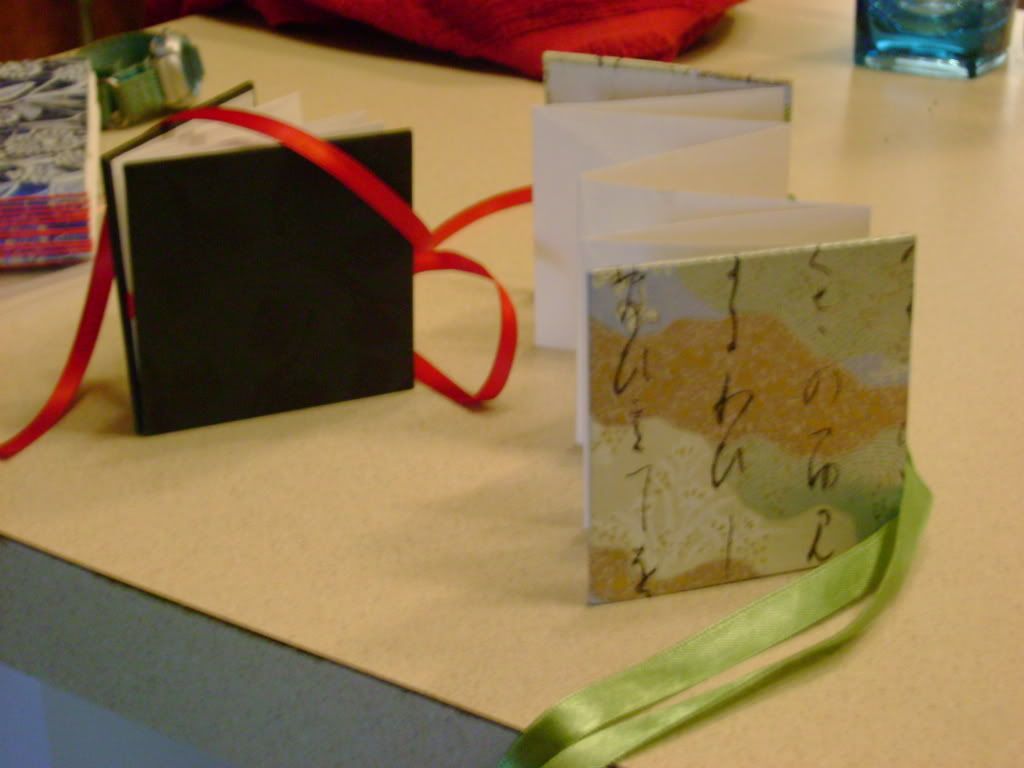
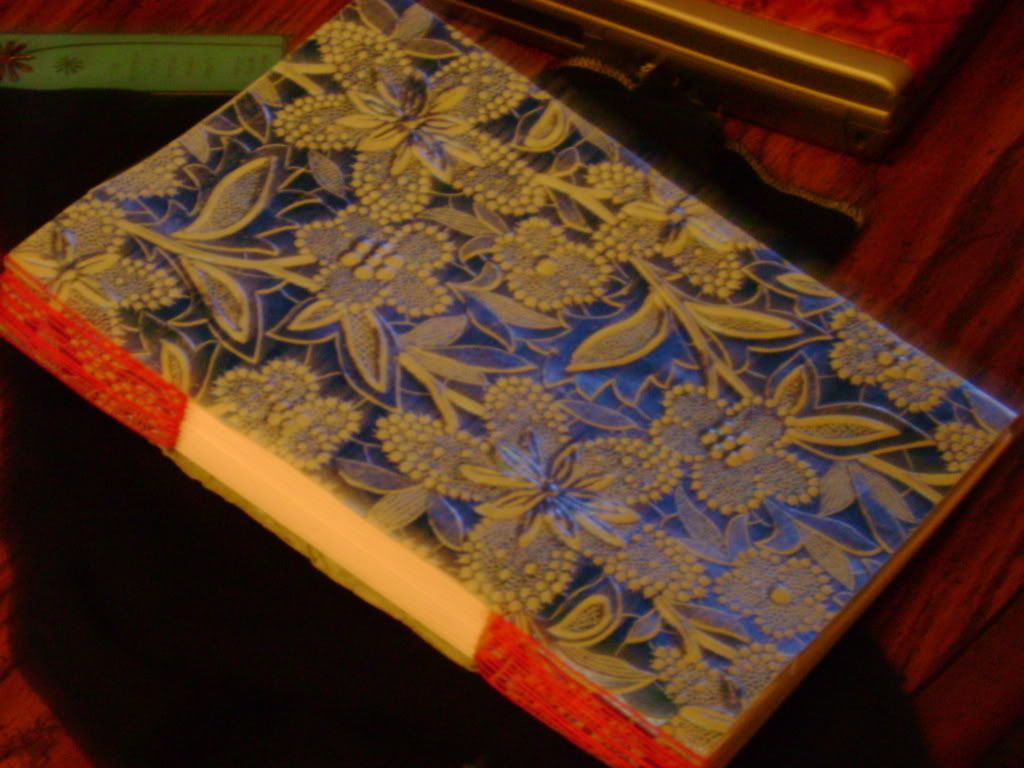
Here is one of the first books I made:


It's a buttonhole binding style--that red thread you see on the spine is how it's sewn together. I gave it to Lance's mom as a birthday gift--it's a simple but beautiful book.

Here's a close-up of the spine:


Here's some cute little accordion books--the book has no "spine", and the pages fan out like an accordion:


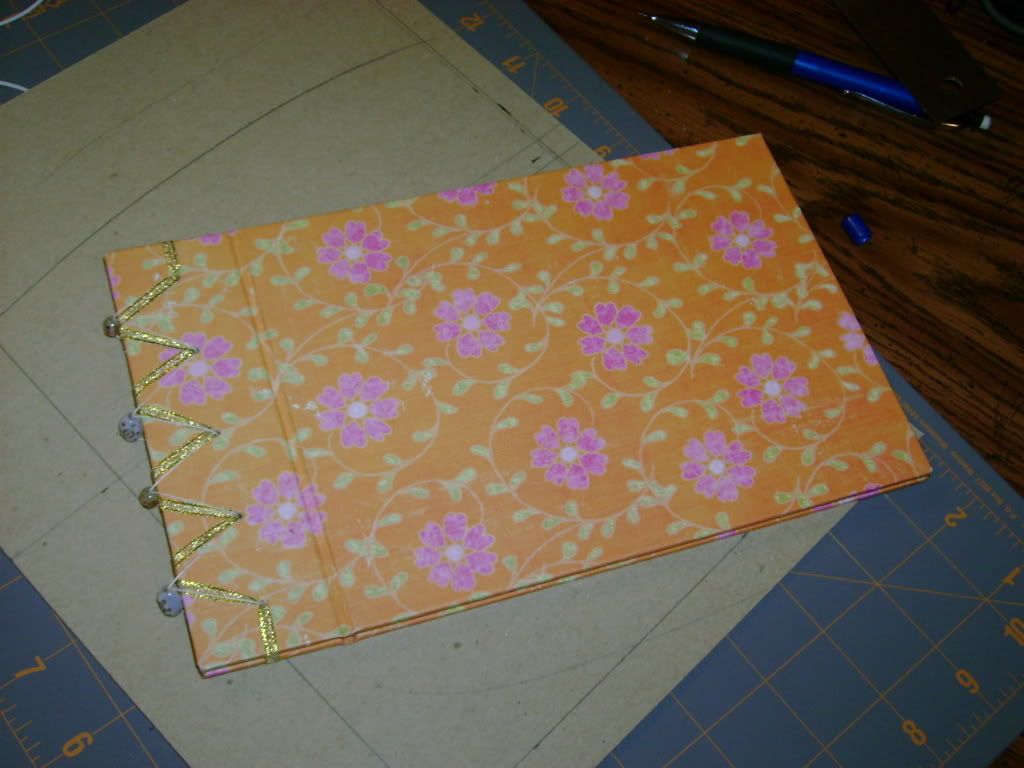
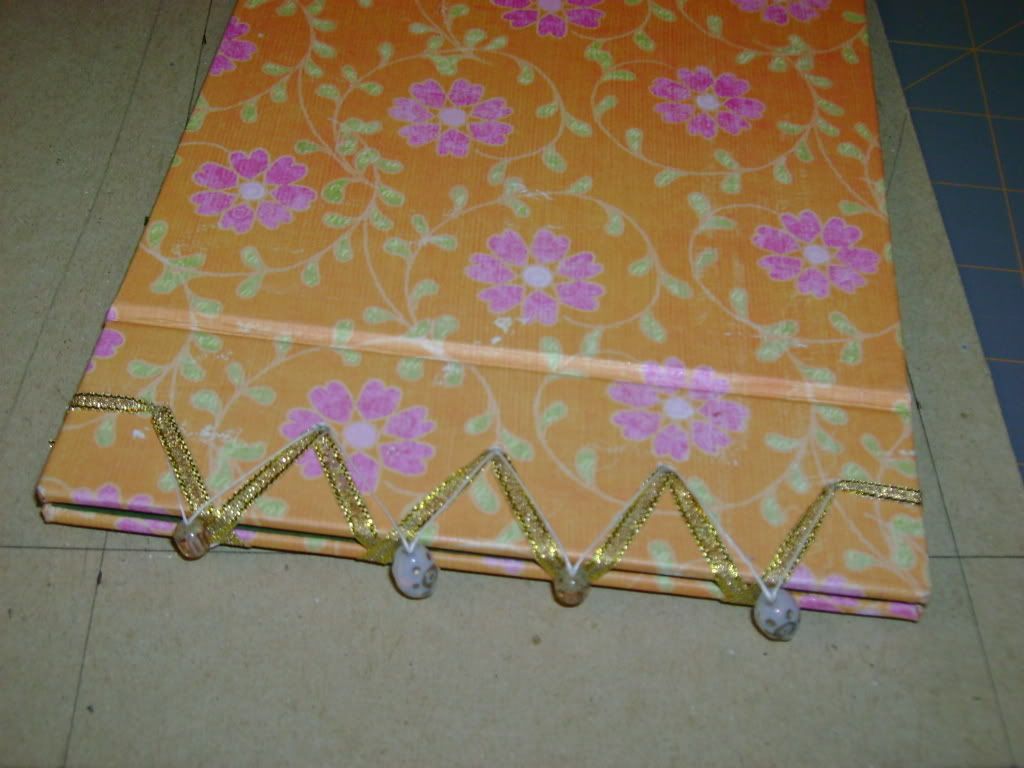
Here is the Japanese stab-binding, which I mentioned in an earlier post:


It's a neat book because you can use varied colored ribbons and cool beads on the spine:


As you can see, there's a lot of versatility when it comes to bookmaking. I'm going to save some of the other books for another post.

Thursday, February 22, 2007

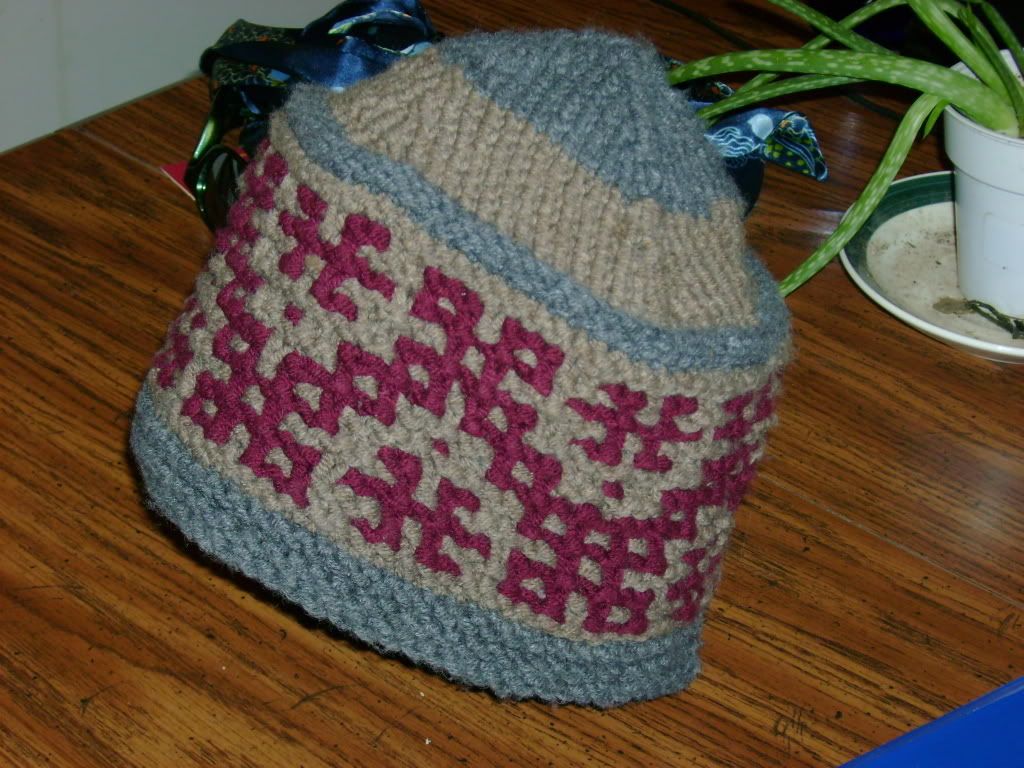
Poem: Oh, Hat


Oh, Hat.
You've plagued me longer than I like--
The child of a whimsy, flimsy promise
That returned to bite me for a year
(and a half).

Oh, Hat.
Look, you have been created,
The bastard child of circular needles,
wool yarn, online pattern, and my
Own imagination.
(And hands).

And there you are, your creation
Completed. You are warm, you are
handsome, you are a good Hat.
I take pride in you, pride in your
Workwomanship, Lovely Hat.

You are the first Hat,
Thus the best one always,
Bearing the fondness of
A First. And as a
Proudly-Worn Love-Gift.

Wednesday, February 21, 2007

Professing Literature: Poetry Lesson Plan

If I had to teach a poetry lesson, I'd teach John Donne. Partly because he's a wonderful writer, partly because he was the first poet I really "got", but mostly because he seems so teachable. I had fun picking out which poems I would teach--I selected "The Good Morrow" because it's one of my favorite poems ever, and two of the "Holy Sonnets" because they're a good mix of religious passion and the physical world. That's part of the beauty of Donne; he is able to use concrete, physical images to approach complex ideas, such as our relationship to the Divine, love, passion, etc.

Our assignment was to come up with a lesson plan on poetry for one class period. Without further ado, I present my lesson plan:

Jenn Miller
ENGL 5803
David Jolliffe
February 21, 2007

Poetry Lesson Plan: John Donne

Prior to class: Students should have read the poems and responded to them in a journal. The journal is a one page piece of informal writing that asks the students to address the poems in terms of elements that struck them particularly, whether it interested, bored, called up strong emotions of love or distaste, etc. The point of the journal is for them to engage the text. Any lines or elements they did not understand are also good journal material. The journals are an out-of-class assignment to help generate discussion within class.

Focus: To begin class, I will recite “The Good Morrow” from memory, as dramatically as possible. I will briefly touch on personal experiences with the poem’s meaning, introducing the way poetry written almost four centuries ago can still be relevant to a reader, and the way elements in Donne’s poetry can capture a reader’s imagination, intellect, and emotions.

Purpose: By the end of class, students will recognize characteristic elements of Donne’s work: the “metaphysical conceits”, Donne’s use of metaphor (especially his use of concrete, physical images—the metaphysical aspect), his combinations of erotic love and religious passion, his complex and innovative structure, and the reflection of his personal circumstances on the nature of his poetry. Students should also be able to recognize poetic devices such as line breaks, pauses, word choice and other elements that are effective in enhancing the meaning in Donne’s work.

Overview: We’ll begin class with a discussion of journal writings. Afterwards, I’ll lecture briefly on Donne’s life and characteristic elements of his work, using “The Good Morrow” as an example. We’ll then break into groups to review the two remaining poems, and then come back together to discuss them.

Business: Class business, if any, conducted at this time. (Attendance, picking up journals).

Short discussion: what about the poems struck the students as being distinct from other poems they’ve read? Were there elements that confused the students? Did the poems elicit any strong emotions? Were the students able to identify with the speaker in any of the assigned poems?

Brief lecture: The purpose of the lecture is to give details of Donne’s biography and the time period that he lived in, placing him in his historical context (following Shakespeare, writing before Milton, etc) and alerting the students to certain historical conditions (the anti-Catholic nature of England in his life, etc). I’ll use “The Good Morrow” to help define certain terms (metaphysical conceits, etc) as well as demonstrate characteristics of Donne’s poetry, such as his use of broken lines, language, and metaphor. “The Good Morrow” uses the conceit of a world to describe the power of love, which helps the reader access the poem’s meaning.

Group work: Break the students into groups by poems, perhaps two groups to each poem, depending on the size of the class. They will be examining Donne’s use of language, the metaphors he uses in his religious poetry (the two Holy Sonnets), and other elements from the lecture earlier in class. Walk around as they discuss to monitor and offer assistance as needed. After sufficient time, ask each group to share with the class what they’ve discovered within their poem.

Closure: Review what I hope the students have learned about Donne’s work and poetic elements as a whole. Ask the students to continue to think about what makes effective poetry (for perhaps a creative writing assignment later, or an essay). Remind them of any work coming up for the next class period (including journals).

Assigned Poetry: John Donne[1]

“The Good Morrow” (1633)
I wonder, by my troth, what thou and I
Did, till we loved? Were we not weaned till then,
But sucked on country pleasures, childishly?
Or snorted we in the seven sleepers’ den?
‘Twas so; but this, all pleasures fancies be.
If ever any beauty did I see,
Which I desired, and got, ‘twas but a dream of thee.

And now good morrow to our waking souls,
Which watch not one another out of fear;
For love all love of other sights controls,
And makes one little room an everywhere.
Let sea-discoverers to new worlds have gone,
Let maps to others, worlds on worlds have shown:
Let us possess one world; each hath one, and is one.

My face in thine eye, thine in mine appears,
And true plain hearts do in the faces rest;
Where can we find two better hemispheres,
Without sharp North, without declining West?
Whatever dies was not mixed equally;
If our two loves be one, or thou and I
Love so alike that none do slacken, none can die.

From Holy Sonnets

14
Batter my heart, three-personed God; for you
As yet but knock, breathe, shine, and seek to mend;
That I may rise and stand, o’erthrow me, and bend
Your force to break, blow, burn, and make me new.
I, like an usurped town, to another due,
Labor to admit you, but O, to no end;
Reason, your viceroy in me, me should defend,
But is captivated, and proves weak or untrue.
But dearly I love you, and would be loved fain,
But am betrothed unto your enemy,
Divorce me, untie or break that knot again;
Take me to you, imprison me, for I,
Except you enthrall me, never shall be free,
Nor ever chaste, except you ravish me.

17

Since she whom I loved hath paid her last debt
To Nature, and to hers, and my good is dead,
And her soul early into heaven ravished,
Wholly on heavenly things my mind is set.
Here the admiring her my mind did whet
To seek thee, God; so streams do show the head;
But though I have found thee; and thou my thirst hast fed,
A holy thirsty dropsy melts me yet.
But why should I beg more love, whenas thou
Dost woo my soul, for hers offering all thine:
And dost not only fear lest I allow
My love to saints and angels, things divine,
But in they tender jealousy dost doubt
Let the world, flesh, yea, devil put thee out.


[1] All poems taken from The Norton Anthology of English Literature, Vol. 1, pgs 1236-1276.

Monday, February 19, 2007

I'm Back!

After recovering from a bout of either the flu or the sinus infection (it was diagnosed as the flu, but I suspect that it might not have been), I've returned. Everyone else I read posts much more frequently than I do, so sometimes I feel pressured to put up a post, even if it's not talking about my self-proclaimed blog topics.

I sometimes feel the need to specialize and organize my life to the nth degree--I actually starting a crafting blog, and then decided that I was getting a little too neurotic about categorizing. So while this is still my "academic" space, I think I'm going to expand it to a bit more (so I have more to talk about).

I'm dreadfully behind in my studies: working full-time puts a damper on the amount of time I have to procrastinate before finally settling down to read. I'm taking two classes this semester, so if I relax a little after work or go for a run, then I don't have enough time to do my homework. Then I get stressed, and my boyfriend chides me for taking on too much, since that's what I do. But I also enjoy that other stuff, so I guess I should cut down on the procrastination time...

I'll post more soon about my next assignment in Professing Literature, the horrible book I'm slogging through for Literary Theory, the hat that I made, and bookmaking. That should give me a few posts...

Thursday, February 08, 2007

Color Swap Questionnaire

Well, though I haven't heard from my pal yet, I've decided to go ahead and post the questionnaire...

Favorite Color Swap Questionnaire

1. What are your top three favorite colors?
Let's see...red is my top favorite color, but I love other bright colors too. The colors I wear a lot are in the pink family (anything from coral to magenta), green (not kelly green, but paler greens), and red.

2. What crafts do you really enjoy?
I LOVE to knit. But I've also recently taken up bookbinding and jewelry making. I'm really loving the bookbinding--its so much fun!

3. What products do you really covet?
Bamboo knitting needles under size 7. And bamboo circular needles...

4. What other activities do you enjoy besides your favorite crafty things?
I'm an avid runner, and I also enjoy yoga, reading books other than books for class (I'm a Masters student in English), and music. I'm always on the hunt for new music.

5. Is there anything you collect?
Ummm...not really...unless you count books.

6. What is your zodiac sign and/or Chinese zodiac symbol?
I'm a Leo/Dog

7.What are your favorite…

…scents/smells?
I like clean scents. Floral scents can be good. Fruits (Like citrus) are usually okay, but I really don't like overpowering smells or wearing things that smell like food. Strong perfumes or incense kinda make my nose itch, so...

…types of music and/or bands?
The Decemberists are currently my favorite band, though I also really enjoy Franz Ferdinand, Lucinda Williams, Phish, Jack Johnson...my tastes are pretty eclectic, and I always enjoy discovering new music.

…authors?
Ha! Can I sooner choose a favorite star from the heavens? Well, okay, if you insist...I enjoy J.R.R. Tolkien (I wrote my thesis on him), Jane Austen, Sir Walter Scott, Ursula LeGuin. See, I told you I can't really pick a favorite...

…animals?
I like all sorts of critters, though if pressed, I would have to say I love horses and cats.

…places to shop?
I really enjoy Target, but also local boutiques--they're so much fun, and you never know what you'll find!--thrift shops, and craft stores. Let us not forget the craft stores...

…season?
Fall. Definitely fall--the colors are gorgeous, the weather is lovely...

…yarn/fabric/paper/other craft supplies?
With the bookmaking, I've been building a good paper supply. I'm always on the outlook for new, cool papers, and also yarn. Can't get enough of that yarn.

…candies or goodies?
Dark chocolate (the good stuff!) and peanut butter M&Ms. Mmmmm. Ginger is pretty good, and I love cranberry. I'm a coffee and tea drinker too...

8. Do you have any wish lists?
Not at the moment...

9. Are you allergic to anything?
Ah, perhaps cigarette smoke and incense.

10. Do you have any pets? What are they?
One cat, Rory, who is a brown/black tabby kitten. I've had her for almost two months now.

11. Please include anything else you would like your secret pal to know about you- anything that would be helpful in finding you little gifts that you will really enjoy.
Mmm...it's always hard to think of things...I guess if you want to know anything, just let me know!

Wednesday, February 07, 2007

Literary Missionary

This was an assignment for my Professing Literature class, the subject of which was "On Me as a Student of Literature."

I easily could have been a non-reader. After all books—through available in my home—were not cherished by anyone in my family. I was not read to, encouraged to read, or given books to promote a reading lifestyle; I was merely left alone with access to a shelf full of books that my parents had acquired with the vague notion that owning literature was good, similar to the concept that families should attend church or own a family Bible for their moral well-being. Out of five children, I alone read voraciously, wolfing down books as fast as I could gulp. I clearly remember my first reading experience: Morris Goes to School, a book about Morris the Moose, well, going to school. I was in kindergarten and not “supposed” to be reading yet, but there I was enjoying this book. My first chapter book was Charlotte’s Web, a book that we later read as a class in third grade, and a book that got me accused of not actually reading because I was able to read it so quickly.

I can’t remember a time when I wasn’t reading. I loved the feeling I got when I read a particularly captivating book, the feeling of being absorbed into the written page, the “willing suspension of disbelief” or being pulled into a “secondary world” as Tolkien describes in his beautiful essay “On Fairy Stories”. High points, low points, and silly points were bookmarked by some literary work. I empathized with Jane Eyre when I was childishly infatuated with an older man; conversely, I finally understood John Donne’s “The Good Morrow” when I fell in love and found myself loved in return. I trailed my self-conscious girl heroes in Robin McKinley’s The Blue Sword and The Hero and the Crown, and I grew up with Anne of Green Gables. I read great literature, mediocre literature, challenging literature, stupid literature, books that made me think, cry, hate, love, works that inspired anger and brought great joy. I always carried a book (or two) with me—I never knew when I’d need one—and my parents took away my books to punish me.

I drank in books in long draughts and thirsted for more, but interestingly I was a mediocre English student until my senior year of high school. I was one of those unexceptionally brilliant teenagers; you know, the ones who know how to take the tests and bother to do the assignments but are really only parroting. I excelled in science and wanted to teach biology or chemistry (or both), for studying literature was a dull, unending track of reading, writing, vocabulary and pointless sentences to copy down and correct in a notebook. Who cared? Certainly not my teachers.

Enter Mrs. Galligan, my senior AP English teacher. She taught me to love John Donne with unequivocal passion, delight in the beauties and intricacies of Shakespeare. She got me to read Shakespeare on my own—Twelfth Night, King Lear, A Midsummer Night’s Dream—and because of her guidance, I wrote an interesting paper (for a high-school student) about King Lear and Jane Smiley’s A Thousand Acres. That paper was my introduction to literary criticism and academic writing, and began teaching me a way of reading that extended beyond plot. She made me learn; she made me love, and I left to attend college as a chemistry/biology major.

Wait, as what? Yes, that’s right; Mrs. Galligan had only planted the seed of loving literary studies, but I still wanted science. (For one, it was so much more safe and certain than literature, and I was sure to get a job). It wasn’t until about half-way through my first semester that I discovered that I liked science well enough, but I loved English. I loved writing, I loved talking about literature, and I loved helping other people write better. My epiphany came, actually, while I was in the middle of peer-editing and I felt satisfaction deep in my spirit. I use the word epiphany carefully because the experience was akin to a religious moment. It was as though I was traveling down the road of Science, only to be struck blind with the light of all that English had to offer me. Like any new convert, I struggled at first with giving up the old ways—I couldn’t change my major!—but I soon settled into my new path with a contentment and passion I’d never had before.

I was therefore determined to become a literary missionary, and the goal of my outreach would be high school students. After all, had I not suffered at the hands of countless years of incompetent, uncaring English teachers? I would save others from that fate, and help them discover the truth and joy that literature could bring. Then I discovered that the majority of high school students didn’t care. Why should they? I went to my internship hours at various public schools with the growing feeling that I wouldn’t be happy teaching in a public school. There were restrictions on what you could teach; you had to teach grammar and other state-mandated curriculum topics. With a sinking feeling, as I continued on in my education classes, I realized that I would be an unhappy, potentially bored English teacher. I wanted my profession to be something that in which I could grow, develop into a better scholar, and fulfill my own needs as a passionate lover of literature, while also helping others.

I knew I was “good” at English; I made high grades in all of my classes and was praised by my professors. (I always had the vague anxiety that I was repeating the mistakes of my youth, however, simply parroting back to the teachers what they wanted to know, never creating anything new for myself). My honors thesis adviser encouraged me to think about graduate school. “You have the skills to be a good scholar,” he enthused as I shared insights on The Lord of the Rings with him each week, connecting Tolkien’s work with Aristotle, Hegel, Dostoevsky, and others I encountered. Other signs appeared before me in the forms of friends who thought I would be a miserable high school teacher, or the English department chair who listened to my passion for my studies and said, “You would be a very happy graduate student.” I scoffed; being a teacher was my calling after all, and who was I to oppose a divine injunction? Education was what I wanted to do because I could see myself doing nothing else.

Yes, I still believe it’s my calling, but I began to realize I clung to the hope of teaching high school English because it was secure. I knew that I could find a job somewhere, anywhere…but graduate school meant more years of moving, living as a student, the roaming scholar who relied on the bounty of others. In my heart, though, I realized it was what I wanted. I wanted to keep pursuing learning, grasping new knowledge with both hands, absorbing ideas and theories as I read those books so long ago. It appeared to me in another epiphany: I had registered for my first semester of practicum, when I’d be taking almost all education courses and interning at a public high school, and it clicked—I didn’t want that. My friend Shannon was the push I needed because as I was talking to her about my dilemma (to teach or not to teach—high school, anyway) I became increasingly convicted that my place was in higher education. I hoped so anyway, because part of me sniggered and accused myself of being too afraid to face the lion’s den of the public school system. I thought of the satisfaction of belonging to a profession that requires its members to be both scholars and teachers. The more I thought about it, the more I realized it was what I wanted to be—a professor of literature.

I’m on my way to becoming that literary missionary in both the capacity of the wise professor wielding knowledge and the eternal student questing to know more. Of late, I’ve begun to ask But to what purpose? but haven’t found the answer to that question. All I know is that I love studying, I love teaching, and I want to pursue a field that would allow me to do what I love in a way that can (maybe) bring joy to others. Perhaps the clues lie in Robert Scholes’ attempt to have us rethink the concept of English as a discipline; perhaps my place would be in helping the profession move forward in subtle ways. Ultimately, perhaps the answer is merely that by doing something that I’m wildly passionate about, I would be a small light to others on the value of literary studies and English as a whole.

Friday, February 02, 2007

Prose: Teaching Knitting

I began my boyfriend's hat yesterday, the one that's been looming before me as the penultimate goal of my knitting career. Penultimate because obviously there will be another knitting project that is more important and watched for with greater anticipation than his hat (I just don't know what it is yet).

So I begin the hat. It's my first project "knitting on the round" or rather, using circular needles. I already goofed the joining, but the rest looks good, so I suppose I got the knack of it. I may pull it all out, or use it to make sure I'm even making it close to the right size--the danger of using circular needles being the size is a secret until you've knit for quite some time. This hat has been bothering me in the form of my boyfriend for over a year now, when we bought some yarn and he jumped up and down with glee in the aisle of Hobby Lobby when I said I would make him a hat. Every time I'd start a new project, I'd hear about how his head was cold, how he wished he had a great wool hat to keep his curls warm...

But this is not a tale of the perpetually unknit knit hat: this is a story of how I taught my boyfriend to knit. It all began with my roommate holding a set of my needles curiously and looking through my handy-dandy knitting guide (I have a small spiral bound one that I whip out to learn all sorts of interesting things, like cable cast-on or how to do an increase or decrease). She wanted to learn, so I asked, "Do you want me to teach you how to knit?" "Yes!" she exclaimed, as she was looking for a way to escape her history texts and enjoy her snow day. Lance looked at me tellingly, so I asked him to, which made him say, "Yes, me too!"

Thus commenced the knitting lesson. I made them cast-on (over and over again) until they got it down. I had to get Sarah to reverse her hands (she apparently will knit "backwards" or left-handed), and Lance quickly progressed to purling. I swear, he is the best first-time knitter I've ever seen--his practice swatch was only a little crooked on his cast-on row. He's a mechanical engineer with an amazing ability for spatial orientation--and what is knitting but a spatial skill?--and he was able to capture the big picture of what knitting does in addition to being able to creatively add to what I taught him. The knitting circle has increased by two.

Lance started planning all his projects, and asking me questions about how things are done. I had the challenge of a bright student, and as a bright student, he of course tried to overstep what he knows by asserting he could knit a circle (not a tube like his hat, but an actual circle). Ah, haha, he will learn soon enough what he can and cannot do. I felt the slight tremor that a teacher can feel when faced with a particularly promising pupil that perhaps he'll soon overtake my skill--and I'll have nothing left to teach because he will be become better than me!--but I realized that for now, I have the advantage of several years of experience and knowing how to read the charts. So I have time to reconcile myself to the prospect of his surpassing my knowledge, and time to come around to the idea that it's okay if he does because I can then just learn from him.

I look forward to more cold afternoons and evenings with my knitting pupils and watching them grow in skill and confidence as they knit toward their first projects. I'm a teacher by nature, and I love being able to pass my passions along to those around me, whether it be literature and writing, or knitting.

Thursday, January 18, 2007

The Beauty of Writing on a Blog

Blogs get a lot of criticism, even from me who writes in several online spaces. It's easy to get sucked into the trap of almost unconscious writing, or worse: the sort of gibberish that I lament is killing the minds of teenagers everywhere, IM-lingo. (Uggh, I hate it). However, Donna's post from yesterday made me think about the purpose of blogging.

And I realized even when I'm being "intellectual", it's a release of pent-up word energy. It's a way for me to write in a forum where there are no critics (harsh ones anyway), no professors to grade what I write, and if someone disagrees with me, so what? I can alternate my roles from reader, creative writer, book critic, book lover, and thinker, switching from scholar to curious individual (or some combination therein) with each entry I form. I can hope that others read and enjoy my entries, but in the end it doesn't actually matter.

The beauty of writing on a blog--to play, to grow, to learn. It can be a lovely thing, this blogging on varied interests, developing a writing style. Those writing teachers always say "write everyday" (or something like that) and blogging provides an incentive to do so, with the added charm that an audience exists out there in the Interwebs to read, enjoy, and learn with me. My pent-up word energy is out, and I'm better for it because I'm making it available for other eyes, giving me an audience to write for, even if they are only in my mind.

Wednesday, January 17, 2007

Fem Lit--or, The Only Place Feminist Criticism is Welcome

I've stated before that I dislike feminist criticism. It's not that I dislike feminism (I occasionally fancy myself a bit of a feminist--but wouldn't you, growing up in a conservative family with four brothers?) but rather their often over-reaching approaches and their snooty jargon. They always seem to be glaring at me, frowning at my knitting and domestic pride, and my lack of desire to read everything as men trying to screw me. It's just not how I think, okay?

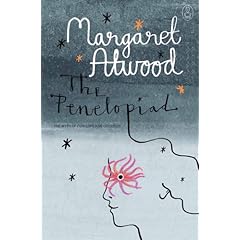
However, feminist literature is certainly a valid field for feminist theory--since it's feminist theory turned narrative. So, without further ado, I delve into an exploration of Margaret Atwood's The Penelopiad. It's a modern, feminist retelling of The Odyssey from the perspective of Penelope. But she's dead when she's telling it, which brings all sorts of interesting implications. She opens by declaring that's she's dead, and thus knows everything. If that's true, then why does she spend so much of her time wondering why her twelve maids were killed, why Eurycleia picked them to be hanged, and other incidents during her mortal existence.

The Penelopiad is written from women's voices, alternating between Penelope with the twelve hanged maid serving as a chorus. It also brings in the voice of Helen, her beauty queen cousin. The maids were hanged for certain sexual crimes and insolence against their master, and they are bent on avenging their deaths. Their chorus both supports the tale that Penelope spins, and undermines it until the reader is caught trying to figure out the truth along with Penelope--a truth that, in typically feminist, is never arrived at.

The feminism within the work is carefully plotted. Penelope occasionally mentions ideas from her Greek society that seem almost preposterous to us--the father "selling" his daughter to the man who can win the contest; the maids whose lot (if they are especially young and pretty) is to be raped and sexually used by their master and perhaps his guests; and the role of a young noblewoman in marriage. On her wedding night, Penelope has to pretend to scream like she's being raped to satisfy the ceremonial wedding rites. This is a story where women are property, their bodies are not their own, and men control them and their lives. In the case of the twelve maids, they are hung by Odysseus after he kills the suitors.

And yet, not quite. Atwood teases out another story through the chorus of maids, asserting that they are not the Twelve Maids, but the Twelve Maidens of the goddess Artemis, the feminine goddess of chastity, the moon, the huntress who takes no man. And as there are thirteen lunar months, Penelope is the Queen of them, which she indeed has claimed all throughout the book that these Twelve are her special, beautiful, chosen maids, trained by her and used by her to keep the Suitors at bay. Then the story becomes about the repression of the cult of the Moon-goddess and a further dominance of the patriarchy.

And then the further question--did Penelope sleep with any of the Suitors? It would be difficult to resist a little dalliance, Atwood seems subtly to assert, when her husband has been gone for twenty years. The maids declare outright that they helped her in her infidelity, while Penelope maintains that she was never unfaithful to her husband, even when she heard he was off sleeping with beautiful goddesses. Or whores, if you don't believe the "high" version of the tale. But then she undermines herself by linking herself with Odysseus, the honey-tongued liar. Does she lie, or tell the truth? Apparently even dead she still buries some of the voices of her tale.

The novella is a rich and imaginative creation by one of my favorite feminist authors (read The Handmaid's Tale). A modern feminist revision of an ancient patriarchal tale offers up the sort of ideas that are easily read using feminist theories, and the most productive.

Friday, January 12, 2007

Knitting, Delurking, and other Non-Literature Things

So...

This is my "literature blog". However, I don't write on it unless I have something burning about books to talk about. So I think I'm going to make more use of that prose bit of my title and write about a variety of my interests. Because my interests are many.

Take knitting for example. I've recently been caught in a wave of knitting madness: Donna is learning (yay!), and she introduced me to the Secret Knitter, who recently decided to secretly knit scarves for his family, and has since been hooked on knitting. My own knitting history began when I taught myself how to knit my junior year of college, knit a bazillion garter-stitch scarves, got bored, made my first project from a pattern, and have been tinkering ever since (I love stitch patterns). Here is one product of my tinkering:

There's a feeling that emerges from designing and creating a new thing. This didn't exist before I made it (it may have been available in other forms, but this particular manifestation emerged from the fusion of my mind and my knitting needles). And the story behind it is fun: my friend and bookbinding teacher offered to swap one iPod cozy for a bookbinding class (Japanese stab-binding, which I'll be using for a wedding guest book for two of my friends). So, I thought of a design that would be useful and cute (I own an iPod nano, so that was pretty easy), and out it popped. I like it.

Incidentally, if I have any blog lurkers, it's National Delurking Week. So leave a message and say "hi!" Thanks!

Tuesday, January 02, 2007

Weirdness

Donna, I suppose in an attempt to get me to post, has tagged Amanda and me to post six weird things. But these are not just any six weird things, but six weird things that relate to graduate school and English literature. So without further ado:

1.) When I'm reading something, I often talk out loud in order to think. However, I only do this when someone else is in the room; otherwise, my thoughts are written or kept internal. They often think I'm actually talking to them (and I usually direct my comments in their direction), but really I'm just thinking out loud.

2.) When I'm doing research, I attack books (especially ones I shouldn't write in) with tiny Post-it Notes. Sometimes the notes just mark a spot that I'll cite in my paper. Mostly, I scribble little notes on them. I do this a lot with each book, so when I'm done, the book has a zillion varied colored notes sticking out all over it.

3.) I'm obsessed with office supplies. I love Post-it Notes, pens, pencils, erasers, staplers, notebooks, and all forms of supplies. I especially love Post-it Notes. Every year, I have to resist buying spiral bound notebooks when they're on sale (10 for a dollar! Sweet!) since I have a plastic storage tub full of them. The Boyfriend mocks me for them, and for my office supply obsession. Luckily, being in graduate school means I have to buy office supplies every now and then...

4.) Whenever I find another person as obsessed as me about literature, I hop up and down and squeal. I get really excited about finding other literature lovers. In fact, I found one over Christmas, and he was as excited as me to find another English MA student, so perhaps that's not so weird after all...

5.) I HATE feminist criticism. I like feminists, though. Or feminism, at least. But feminist criticism? Drives me insane. I hate it. I hate how they ignore the text, skew everything to be about feminine oppression, and how they use terms like "the father", "phallocentric", etc. to interpret literature. Sometimes their points are valid, but for the most part, I have little use for them.

6.) I tend to relate things in real life to books I'm currently reading/obsessed with. Sometimes, it carries on to such a degree that those around me roll their eyes and wonder how they put up with my zaniness and nerdyness. I also tend to relate other books I'm reading to books I've just read, coming up with some odd connections that please me in an intangibly, indescribably satisfying way.

Now, who to tag? There are relatively few people, I believe, who read this blog, so...Michael, you're the only one. Do it. Do it now. And to take a page from Donna, you have to relate your six things to technologically based weirdness...