It was a cool July evening. Those two words don't normally go together when we're talking about Arkansas weather, but it had just rained and it was approaching dusk. Of course, the mosquitoes were out in swarms to make up for the lack of muggy weather.
I had picked up my three teachers (Wendy, Haydee, and Brenda) from their dorm. Wendy (whose parents liked the name, so she has a non-Spanish first name) was running late from her shower, so I was chatting with Haydee (pronounced Ay-day, in true Spanish fashion) and Brenda about their weekend trip to Eureka Springs and Talequah. The program they are participating in keeps them busy, shuttling them around Arkansas to various sites, getting them to social events with Americans, not to mention all of their classes, so they are having fun, but feeling a bit tired.
We went to play mini-golf, where my ankles were immediately attacked by mosquitoes--I didn't realize until we played our 18 holes that they had repellent at the club house. Darn. I'm not a very good player, but I did get two hole-in-ones, including the 18th, so I got a free pass! The teachers punctuated playing with taking photos: group photos, pictures of them in front of the animal statues (gorillas, giraffes, elephants). They love taking pictures--just like I did when I went to Mexico. I forget they are also tourists.
I love listening to them talk and talking with them. They are supposed to speak in English--Brenda scolded one person for talking in Spanish because she thought I didn't speak it--but they switch constantly between English and Spanish, often blending the two languages. If I were more fluent in Spanish, I suppose I could do it too. But it is certainly interesting to listen to and try to understand what they're saying.
We had ice cream at our local Shake's (formerly Shakey's), and then I took them home. It has been a fun experience getting to know them--Wendy has made me promise to come visit her sometime, which I plan to do. Vacation in Mexico...of course! She is from Yucatan, so it should be a good trip. They talked to me about becoming a teacher (I'm planning to teach on the college level), and they also talk to me about their culture and language. I think I'll definitely volunteer to be a buddy next year too.
Tuesday, July 31, 2007

Thursday, July 26, 2007
Why Mark Should Read Lord of the Rings
As Secret Knitter (Mark) and I were going back and forth about what I should perhaps post today, this totally fun and random thought popped into my head. I should post reasons he should get Tolkien's The Lord of the Rings and read them! He claims to have avoided them because of the fanboy aura and other assorted paltry excuses. Well, I'm going to give him incontrovertible evidence of why he should immediately go and read them.
- First, he should read The Hobbit, which is short, a fun read, and the best way to become intrigued in the world Tolkien builds further in his longer work. I love The Hobbit because it is a lighthearted tale, and as a reader, I just feel the fun Tolkien had while writing it.
- After reading The Hobbit, he may or may not be consumed with a desire to read more about hobbits. No matter; I don't expect him to suddenly become obsessed or anything. But he should at least now be intrigued by Tolkien's art.
- He's someone who makes a living out of writing about films, so I'm almost certain he's seen Peter Jackson's excellent renditions of Tolkien's work. If you've seen the films and liked them, then the books should be enjoyable too.
- Tolkien writes about all sorts of relevant and important ideas, like friendship and storytelling and love. Not to mention the inspiration notion of small heroic actions leading to the destruction of a great evil.
- Since he's a fan of Harry Potter, he really should get familiar with the father of fantasy literature.
- After he finishes the book, he can ask me about what I wrote my undergraduate Honors thesis about and understand what I'm talking about.
- The Lord of the Rings features some wonderful, memorable characters like Eowyn, Frodo, Sam, Gandalf, Aragorn, and many, many others. And not all of the cool ones are portrayed in the film, like Tom Bombadil.
- The last part of The Return of the King is my favorite part of the book. (When the hobbits return to the Shire). But he'll never understand why I love it so much unless he reads it...
- It's a damn good book, that's why!
Wednesday, July 25, 2007
Lurking in the Library
I had to run over to the University library today to pick up a book (it has an essay I need to read on genre). Historically, trips to the library to "pick up a book" typically end with me carting home an armload. Today was not much different.
I picked up several books by Kenneth Burke because a professor had raved about him in class, and I was curious. I stopped myself from looking at any other books and still left the library with my bag significantly heavier. As I was leaving, I had to concentrate on just walking--rows and rows of books beckoned to me, tried to call me to them. The University Library has thousands of volumes, books full of all sorts of knowledge and interesting things. The library always reminds me that there is so much in the world I don't know and so many books I long to read.
I'm lucky to be a patron of both the university library and my town's public library (a fantastic place, by the way). And as I have to go pick up a reserved item at the public library, I get to visit them both, so...
I picked up several books by Kenneth Burke because a professor had raved about him in class, and I was curious. I stopped myself from looking at any other books and still left the library with my bag significantly heavier. As I was leaving, I had to concentrate on just walking--rows and rows of books beckoned to me, tried to call me to them. The University Library has thousands of volumes, books full of all sorts of knowledge and interesting things. The library always reminds me that there is so much in the world I don't know and so many books I long to read.
I'm lucky to be a patron of both the university library and my town's public library (a fantastic place, by the way). And as I have to go pick up a reserved item at the public library, I get to visit them both, so...
Tuesday, July 24, 2007
Fun With English
I'm the sort of nerd who gets a kick out of certain words and phrases, especially when they convey an unintentional joke.
Take this phrase:
Today's browsing was particularly fruitful in the usage department. Did I ever tell you that one of my favorite books ever is the Strunk and White's The Elements of Style (Thanks Noel for talking about that in class once.) I was particularly distressed when I moved to my current city, and I discovered it was missing from my library. I am excited because it is required reading for one of my classes in the fall. Well, in my browsing today I stumbled on this essay by George Orwell, which is both on the same lines as Strunk and White and applicable to today's politics. Here are his rules for writing:
And finally, courtesy of my pal Secret Knitter, comes a link to an NPR story about a grammar vandal. A grammar vandal? I want to be a grammar vandal! I'll be listening to that here shortly, so hopefully it's good.
Well, enjoy the Fun With English Day!
Take this phrase:
It was an unexpected surprise when a pair of baby twins was born at 12 midnight.Do you see the joke?
Today's browsing was particularly fruitful in the usage department. Did I ever tell you that one of my favorite books ever is the Strunk and White's The Elements of Style (Thanks Noel for talking about that in class once.) I was particularly distressed when I moved to my current city, and I discovered it was missing from my library. I am excited because it is required reading for one of my classes in the fall. Well, in my browsing today I stumbled on this essay by George Orwell, which is both on the same lines as Strunk and White and applicable to today's politics. Here are his rules for writing:
(i) Never use a metaphor, simile, or other figure of speech which you are used to seeing in print.
(ii) Never use a long word where a short one will do.
(iii) If it is possible to cut a word out, always cut it out.
(iv) Never use the passive where you can use the active.
(v) Never use a foreign phrase, a scientific word, or a jargon word if you can think of an everyday English equivalent.
(vi) Break any of these rules sooner than say anything outright barbarous.
I'm a big fan of clear, concise writing, so I like these rules. And the essay is pretty good too.
Another site I discovered with the Fun with Words site. I'll be checking that one out in a bit more detail later.And finally, courtesy of my pal Secret Knitter, comes a link to an NPR story about a grammar vandal. A grammar vandal? I want to be a grammar vandal! I'll be listening to that here shortly, so hopefully it's good.
Well, enjoy the Fun With English Day!
Monday, July 23, 2007
How I Learned to Read
Thanks, Donna, for giving me the prompt for today's post. How did I learn to read? What's my reading story? Obviously if I can gulp down an 700+ page book, then I must love to read.
My love of reading began at a early age. One of my first memories is sitting with my mom and reading a book I was given. I don't ever remember not reading, and unfortunately my parents don't really remember when I first started reading. But I do recall being able to read before I finished kindergarten.
I was well on my way to chapter books like Charlotte's Web in first and second grade. We read Charlotte's Web as a class when I was in third grade, and since I already knew the story and also was a pretty quick reader, I was ahead of my classmates. They, of course not believing that I was actually reading, accused me of faking.
I've always loved reading. I would check books out from the library constantly; I loved library time in school. There has always been a pleasure and intensity to reading that I found inescapable. And I was hooked on it.
I volunteered for librarians starting in seventh grade. Working in a library was not just a way to get out of boring study hall; when you walk around a library (smelling the books, touching the spines, reading the titles), you pick up books that look interesting and read them. Once, while working in the elementary school library, I attempted to make it through the entire Newberry Medal winner list. I got pretty far, too.
Books have been a huge part of my life. I wish I could remember more details about my first book, or how I started reading, but all I remember is just loving it and reading more. And perhaps that's just enough.
My love of reading began at a early age. One of my first memories is sitting with my mom and reading a book I was given. I don't ever remember not reading, and unfortunately my parents don't really remember when I first started reading. But I do recall being able to read before I finished kindergarten.
I was well on my way to chapter books like Charlotte's Web in first and second grade. We read Charlotte's Web as a class when I was in third grade, and since I already knew the story and also was a pretty quick reader, I was ahead of my classmates. They, of course not believing that I was actually reading, accused me of faking.
I've always loved reading. I would check books out from the library constantly; I loved library time in school. There has always been a pleasure and intensity to reading that I found inescapable. And I was hooked on it.
I volunteered for librarians starting in seventh grade. Working in a library was not just a way to get out of boring study hall; when you walk around a library (smelling the books, touching the spines, reading the titles), you pick up books that look interesting and read them. Once, while working in the elementary school library, I attempted to make it through the entire Newberry Medal winner list. I got pretty far, too.
Books have been a huge part of my life. I wish I could remember more details about my first book, or how I started reading, but all I remember is just loving it and reading more. And perhaps that's just enough.
Sunday, July 22, 2007
Finished: HARRY POTTER and the DEATHLY HALLOWS
Yes, indeed. In one marathon reading session that had me rocking back and forth, laughing, gasping in shock, and finally crying through the last six chapters of the book (partly out of heightened emotions and sheer mental weariness), I closed the book with a satisfying snap. I knew it would be good; I was promised for two years it would be good. And the fact that I was so emotionally vested in these characters, that I was reacting to them as I would real people, told me that Rowling cast her charms well.
The book is that good. Now I wait until other finish, so I can gab about it to them. As promised, I reveal nothing here.
I'll chat a little instead about my path to Harry Potter. The first book in the series, The Sorcerer's Stone, was published while I was in high school. As part of an ultra-conservative household, I was forbidden to read them, and I complied. After some of my conservative luster fell away, I still balked at reading them until my sophomore year of college, when The Goblet of Fire was released. I then read all four books, and I liked them. I ended up doing my Honors sophomore lecture on the debate over Harry Potter--good books or evil? I concluded they were good books, but perhaps younger children should be guided while reading them. (Mostly because the conservative side of the argument was so blatantly ludicrous.)
I didn't attend a midnight release for the fifth or sixth. I eventually bought the fifth after reading a borrowed copy along with the others I didn't already have. I was hooked. The sixth I pre-ordered on Amazon and was pleased when it arrived that Saturday.
But the seventh, oh the seventh. As you can tell from the week's posts, I had been looking forward to the final installment. And it was worth the wait, let me tell you.
I wonder if Rowling will write anything else, at least something not connected to Harry Potter. She's a brilliant storyteller, but it might be hard to top her own magnificent feat. Of course, Tolkien was asked to write another Hobbit, and look what he turned out...
The book is that good. Now I wait until other finish, so I can gab about it to them. As promised, I reveal nothing here.
I'll chat a little instead about my path to Harry Potter. The first book in the series, The Sorcerer's Stone, was published while I was in high school. As part of an ultra-conservative household, I was forbidden to read them, and I complied. After some of my conservative luster fell away, I still balked at reading them until my sophomore year of college, when The Goblet of Fire was released. I then read all four books, and I liked them. I ended up doing my Honors sophomore lecture on the debate over Harry Potter--good books or evil? I concluded they were good books, but perhaps younger children should be guided while reading them. (Mostly because the conservative side of the argument was so blatantly ludicrous.)
I didn't attend a midnight release for the fifth or sixth. I eventually bought the fifth after reading a borrowed copy along with the others I didn't already have. I was hooked. The sixth I pre-ordered on Amazon and was pleased when it arrived that Saturday.
But the seventh, oh the seventh. As you can tell from the week's posts, I had been looking forward to the final installment. And it was worth the wait, let me tell you.
I wonder if Rowling will write anything else, at least something not connected to Harry Potter. She's a brilliant storyteller, but it might be hard to top her own magnificent feat. Of course, Tolkien was asked to write another Hobbit, and look what he turned out...
Friday, July 20, 2007
At Last: The Deathly Hallows Will Be Mine!
I apologize, dear reader, for not carrying through with my "Harry Potter Week". However, a nasty summer bug laid me out for two days, so I was not in the mind to amuse or occupy you with my wit. Or the borrowed wit of others, as I shall today.
I must say I am looking forward to reading Harry Potter. Do you think I can finish it off tomorrow, to avoid being pestered by the hyped up media, my roommate, and my boyfriend (who wants to borrow the book)?
The following is an amusing song that expresses the feeling of many Potter fans: http://www.brotherhood2.com/?p=158
Pretty amusing.
Anyway, on with some small chatter. I'm hoping that the media doesn't spoil anything for me. That's the problem with a book gaining such wild popularity is that everyone wants to read it as soon/fast as possible, then they want to gab about it. And for those who simply cannot stay up all night to polish off the 800-page book have their surprise spoiled. I read a NY Times book review about the novel, against my better discretion, but they had the good taste to not give anything away.
So I'll turn the question to you: the hype. Is the book worth all the attention? I give a grudging yes, because it is rare to find a work of literature that can so wholly capture the hearts and minds of such a wide audience. We're not talking one demographic--I'm a 24 year old English MA student, and I'm sure I'll be rubbing shoulders with a range of readers tonight at the midnight release party. There will be a lot of kids, sure. But all of my friends are also eagerly awaiting their copies.
Rarely do writers become such superstars. Even Salman Rushdie, who is a fantastic writer and deals with death threats on a regular basis, is still not as well known as Rowling. Even those who haven't read the Harry Potter books know who she is.
Well, talk. What's your opinion?
I must say I am looking forward to reading Harry Potter. Do you think I can finish it off tomorrow, to avoid being pestered by the hyped up media, my roommate, and my boyfriend (who wants to borrow the book)?
The following is an amusing song that expresses the feeling of many Potter fans: http://www.brotherhood2.com/?p=158
Pretty amusing.
Anyway, on with some small chatter. I'm hoping that the media doesn't spoil anything for me. That's the problem with a book gaining such wild popularity is that everyone wants to read it as soon/fast as possible, then they want to gab about it. And for those who simply cannot stay up all night to polish off the 800-page book have their surprise spoiled. I read a NY Times book review about the novel, against my better discretion, but they had the good taste to not give anything away.
So I'll turn the question to you: the hype. Is the book worth all the attention? I give a grudging yes, because it is rare to find a work of literature that can so wholly capture the hearts and minds of such a wide audience. We're not talking one demographic--I'm a 24 year old English MA student, and I'm sure I'll be rubbing shoulders with a range of readers tonight at the midnight release party. There will be a lot of kids, sure. But all of my friends are also eagerly awaiting their copies.
Rarely do writers become such superstars. Even Salman Rushdie, who is a fantastic writer and deals with death threats on a regular basis, is still not as well known as Rowling. Even those who haven't read the Harry Potter books know who she is.
Well, talk. What's your opinion?
Monday, July 16, 2007
BONUS: Harry Potter and the Half Blood Prince
One sentence summary:
J.K. Rowling must have cried her eyes out writing the end of this book.
J.K. Rowling must have cried her eyes out writing the end of this book.
Bienvenidos a los Estados Unidos
In the spirit of wanting to make new friends and help people out from another country, I signed up to be a "Teacher Buddy". The role of the Teacher Buddy is to provide some social opportunities for a teacher from Mexico and/or Ecuador who are in Fayetteville for a intensive summer language and teacher training course.
I went last week to the welcome banquet and met my three buddies. All three are women in their late twenties/early thirties from eastern Mexico, and I think they are going to be a lot of fun to hang out with. We talked and talked until it was time to go home. They are supposed to speak English the whole time, but they promised to teach me a little Spanish to prepare me for my Spain trip.
I'm happy for the opportunity to meet people from other countries and share across cultures. Sometimes Americans get caught up in the idea that we have the best of everything--including culture--that we forget that other cultures have something wonderful to offer as well. It's often my opinion that many of the clashes between Christian and Muslim, for example, stem from an unwillingness to learn and share, and perhaps a fear of discovering that we're not so different after all.
I went last week to the welcome banquet and met my three buddies. All three are women in their late twenties/early thirties from eastern Mexico, and I think they are going to be a lot of fun to hang out with. We talked and talked until it was time to go home. They are supposed to speak English the whole time, but they promised to teach me a little Spanish to prepare me for my Spain trip.
I'm happy for the opportunity to meet people from other countries and share across cultures. Sometimes Americans get caught up in the idea that we have the best of everything--including culture--that we forget that other cultures have something wonderful to offer as well. It's often my opinion that many of the clashes between Christian and Muslim, for example, stem from an unwillingness to learn and share, and perhaps a fear of discovering that we're not so different after all.
Friday, July 06, 2007
War, Oppression, and Friendship: Hosseini's A THOUSAND SPLENDID SUNS
One eye on my soup, the other on the pages of Khaled Hosseini's A Thousand Splendid Suns, I managed to finish this excellent novel just a short time ago. And so I decided to tell you all about it.
Hosseini, author of The Kite Runner, brings the world of Afghanistan to life for his American audience, enchanting us with his descriptions of its beauty and richness, and wrenching our hearts as we watch it slowly destroyed through thirty years of conflict. In many ways it is a book to make us not forget about Afghanistan, a fear voiced by a character at the close of the novel, keep in our minds the effects of war and cultural strife that tore Afghanistan apart.
But it also a compelling narrative about two women, Mariam and Laila who are caught in the aftermath of war and violence, victims of the power shift from the Soviets to the Mujahideen, who then fell into civil unrest and sectarian violence, followed by the rise of the Taliban and the restrictions they enforced. Mariam is married off at fifteen to Rasheed, a violent, ill-tempered man who forces Mariam to dress in burka and punishes her because she cannot carry a child to term. Her silent, long-suffering character is juxtaposed with Laila, the young, beautiful girl who is love with Tariq, her childhood friend who lost a leg to a land mine.
Mariam is reclusive and shy, while Laila is able to go to school and have a public life. But it all changes the day that her parents are killed when a rocket blows up their house; fourteen year old Laila survives and is nursed back to health by Mariam and Rasheed. Rasheed decides that Laila either needs to marry him or leave; he refuses to pay for her upkeep any longer. Laila agrees--but only because she discovers she is pregnant with Tariq's child, who she has been told is dead, and cannot make it to the Pakistan border.
As the narrative continues, Mariam move from enemies to friends who both suffer at the hands of their violent husband who insults, beats, and abuses both women. It is their friendship that sustains them both, giving love and purpose to Mariam's life and offering Laila love and support in turn.
The novel is not without its faults, but I found it compelling and captivating. It was hard to put down, and I feel offered a window into life in Afghanistan in the turbulent years leading up to 9/11 and the events following. It's a great read, and I recommend it if you need something good to fill up your summer evenings.
Hosseini, author of The Kite Runner, brings the world of Afghanistan to life for his American audience, enchanting us with his descriptions of its beauty and richness, and wrenching our hearts as we watch it slowly destroyed through thirty years of conflict. In many ways it is a book to make us not forget about Afghanistan, a fear voiced by a character at the close of the novel, keep in our minds the effects of war and cultural strife that tore Afghanistan apart.
But it also a compelling narrative about two women, Mariam and Laila who are caught in the aftermath of war and violence, victims of the power shift from the Soviets to the Mujahideen, who then fell into civil unrest and sectarian violence, followed by the rise of the Taliban and the restrictions they enforced. Mariam is married off at fifteen to Rasheed, a violent, ill-tempered man who forces Mariam to dress in burka and punishes her because she cannot carry a child to term. Her silent, long-suffering character is juxtaposed with Laila, the young, beautiful girl who is love with Tariq, her childhood friend who lost a leg to a land mine.
Mariam is reclusive and shy, while Laila is able to go to school and have a public life. But it all changes the day that her parents are killed when a rocket blows up their house; fourteen year old Laila survives and is nursed back to health by Mariam and Rasheed. Rasheed decides that Laila either needs to marry him or leave; he refuses to pay for her upkeep any longer. Laila agrees--but only because she discovers she is pregnant with Tariq's child, who she has been told is dead, and cannot make it to the Pakistan border.
As the narrative continues, Mariam move from enemies to friends who both suffer at the hands of their violent husband who insults, beats, and abuses both women. It is their friendship that sustains them both, giving love and purpose to Mariam's life and offering Laila love and support in turn.
The novel is not without its faults, but I found it compelling and captivating. It was hard to put down, and I feel offered a window into life in Afghanistan in the turbulent years leading up to 9/11 and the events following. It's a great read, and I recommend it if you need something good to fill up your summer evenings.
Thursday, July 05, 2007
Currently Reading
- I'm currently re-reading the entire Harry Potter series. I just finished up The Goblet of Fire, and am about to jump into The Order of the Phoenix. I'm constantly amazed at Rowling's skill at writing and her ability to compose a compelling story. I love that she plants little clues to things that become important later in the narrative (either within the same book, or in a later one). And I'm really looking forward to learning what is between Snape and Dumbledore in about two weeks.
- I'm also currently reading A Thousand Splendid Suns by Khaled Hosseini. It's his second novel, following the hit The Kite Runner (which I've also enjoyed). Thus far it's pretty interesting, and I've certainly been reading it quickly. (It's my "work" book, so I don't have to lug Harry Potter around. Those later books are heavy).
- I'm enrolled in a genre theory independent readings course, and we're reading something called The Rhetoric and Ideology of Genre. I'm supposed to find ways to apply it to my thesis--which won't be hard, considering I'm dealing with basically transitioning between genres, and I want to use an informed concept of genre to formulate the class.
- I've also picked up several knitting books from the library, trying to devise ways to use up my stash of mediocre yarn so I can buy pretty, nice yarn. Mmm, knitting.
Anyone else got lots on the summer reading list? Tell, tell!
Tuesday, July 03, 2007
Thesis--Approved!
I had a meeting with my independent readings course yesterday, and with my professor that hoped would be my thesis adviser. He likes my topic! So I'm going to start moving forward with it. One question I hope to answer is why do we need freshman composition? I challenged a fellow MA student yesterday when she gave the trite, pat answer of "to make well-rounded individuals". I think that answer is too easy, I declared. I'm not sure what the answer is, but I'm guessing it involves both giving students skills they need to be writers in their profession, and the desire to create an educated, reading public. I want students to realize that they have to read the world around them in the way they read a book. Student empowerment through literature, perhaps?
And I hope I did not offend anyone with my post yesterday. I certainly did not wish to imply that all Muslims were like the narrow-minded people quoted in the article I linked to. I realize that Muslims and Christians come in all varieties of tolerance and acceptance--and I'm sure that being Muslim is difficult in the world we currently live in and is enough to make anyone sensitive to perceived attacks on her beliefs. I was just saddened by the way that an author of great talent is treated for receiving an honor he deserves.
And I hope I did not offend anyone with my post yesterday. I certainly did not wish to imply that all Muslims were like the narrow-minded people quoted in the article I linked to. I realize that Muslims and Christians come in all varieties of tolerance and acceptance--and I'm sure that being Muslim is difficult in the world we currently live in and is enough to make anyone sensitive to perceived attacks on her beliefs. I was just saddened by the way that an author of great talent is treated for receiving an honor he deserves.
Monday, July 02, 2007
Writing Martyrs
Salman Rushdie was knighted recently in Great Britain, setting off reactions from the Muslim community. In retaliation, the fatwa was renewed. Rushdie's life is now in danger because he dared to write a novel about the nature of religion and happened to use Islam as his target.
In this article, the Muslims come off as big whiners--after all, religions are often the target of authors. Philip Pullman's His Dark Materials trilogy attacks Christianity in a very pointed way, as does Towing Jehovah. I'm sure there have been lots of angry people who condemned those books. But nobody wants to kill them.
The death threat is similar to the fundamentalists who want to bomb abortion clinics and the like--they feel that if they can remove the source of that which is to their beliefs (Salman Rushdie, doctors who preform abortions), then their belief systems will be in some way validated as the one true belief system.
In his talk on the role of the writer (which I attended), Rushdie described writers as people who push the establishment, which always pushes back. Depending on the skill of the writer and what they are pushing, it can be a big push with a big reaction, or merely a small push. I wondered at the time if this was merely a romantic notion of authorship--my jaded, postmodern self didn't think that a writer could make that big of a difference. But then I was struck by what Rushdie has endured for writing The Satanic Verses--persecution, death threats, forced hiding, and when honored with knighthood for his contribution to art the leaders of Pakistan, Iran, Iraq, Afghanistan, etc call for its revocation--I realized that he is living this idea. Because he dared to push the establishment, many Muslims around the world hate him, and many want him dead.
Art isn't tame. It's a dangerous creature, capable of sparking debate, controversy, and anger to those who are willing to use their art to push politically, socially, or culturally. I use this site to keep track of literary censorship in schools, and it's amazing how much art can anger and upset parents and school administrators.
So perhaps artists (and maybe comedians too: see John Stewart and Steven Colbert) can keep pushing the establishment toward change. Rushdie is willing to risk his life to push, and even if he is honored in the attempt, he still has a violent and upset group of people after him.
In this article, the Muslims come off as big whiners--after all, religions are often the target of authors. Philip Pullman's His Dark Materials trilogy attacks Christianity in a very pointed way, as does Towing Jehovah. I'm sure there have been lots of angry people who condemned those books. But nobody wants to kill them.
The death threat is similar to the fundamentalists who want to bomb abortion clinics and the like--they feel that if they can remove the source of that which is to their beliefs (Salman Rushdie, doctors who preform abortions), then their belief systems will be in some way validated as the one true belief system.
In his talk on the role of the writer (which I attended), Rushdie described writers as people who push the establishment, which always pushes back. Depending on the skill of the writer and what they are pushing, it can be a big push with a big reaction, or merely a small push. I wondered at the time if this was merely a romantic notion of authorship--my jaded, postmodern self didn't think that a writer could make that big of a difference. But then I was struck by what Rushdie has endured for writing The Satanic Verses--persecution, death threats, forced hiding, and when honored with knighthood for his contribution to art the leaders of Pakistan, Iran, Iraq, Afghanistan, etc call for its revocation--I realized that he is living this idea. Because he dared to push the establishment, many Muslims around the world hate him, and many want him dead.
Art isn't tame. It's a dangerous creature, capable of sparking debate, controversy, and anger to those who are willing to use their art to push politically, socially, or culturally. I use this site to keep track of literary censorship in schools, and it's amazing how much art can anger and upset parents and school administrators.
So perhaps artists (and maybe comedians too: see John Stewart and Steven Colbert) can keep pushing the establishment toward change. Rushdie is willing to risk his life to push, and even if he is honored in the attempt, he still has a violent and upset group of people after him.
Friday, June 29, 2007
News Bulletin
It was an exciting day:
- Lance and I have been planning to go to Spain for a while. Yesterday, we bought our plane tickets to do it! We'll be heading out after Christmas and coming back just before school starts. (Unfortunately I have to still use my passport with the horrible, horrible photo. "So?" you say to yourself, "Everyone's photo is bad". Well...my photo was taken when I was about 50 pounds heavier, so I really, really detest this passport photo. But I'm also cheap, and it doesn't expire until 2012. Drat.) So exciting!
- We have a new kitten. My roommate and a friend of ours found a little flea-bitten calico kitten and decided to adopt her. We are currently defleaing her. Her name is Rowan. Rory hissed at her and flopped down on the floor to keep an eye on her. Rowan hisses only at people (until you pet her, and then she purrs) and was merely curious about the other cat in the house. This should be an entertaining adjustment period.
- My dad quit smoking! Considering he's been smoking since the age of 17 (he's in his fifties now), this is a huge accomplishment. And it's also encouraged my mom to take some much needed steps toward improving her own health. Yay!
- It's pay day. I've only got one month left until I'm completely out of debt.
Thursday, June 28, 2007
The Apostrophe War
I had a brief hiatus. My brain was not feeling up to thinking up something to write, so I didn't, but here's a new post.
Lance and I took a trip for a wedding this weekend (I was a bridesmaid). We made a gas stop, and I decided to take the opportunity to use the bathroom before we got on the road for the three hour trip. While in the ladies room, I noticed an amusing conversation on a sign from the management. It ended with "Thank's". I chuckled over this for a minute, but I was also amused by some handwritten comments on the sign.
Someone had taken a pen and scribbled out the obviously wrong apostrophe and wrote "NO APOSTROPHE". Someone else had later scribbled "Who cares?" The third (or possibly fourth) conversant added tartly, "The small percentage of Americans who are actually educated".
There's a weird tension that I run across in the attitudes toward being educated. For example, my mother always wanted me to use proper grammar so I wouldn't sound uneducated (and perhaps have ignorant parents), but she would mock or deliberately misunderstand any signs I showed of participating in higher education. (She hates discussions, for example, which I think are integral to academia). If you don't speak standard English, you could be labeled a hick (in Arkansas) and basically be called ignorant, stupid, or uneducated, but if you use a wide range of words, people laugh at you for being a nerd or a show-off.
Gerald Graff in Clueless in Academe (and probably some of his other books) addresses what he sees as America's anti-intellectualism. Aren't we a nation that prides itself itself on being full of working men (and women) who pull themselves up? Isn't that a part of the American dream, to go from nothing and work hard to make yourself into a success?
People want to be successful, but they don't want to be seen as too smart or intellectual. My mom called me an egghead because I got some of those glasses with the dark frames. It was a slight insult, an acknowledgment that I was purposefully adopting the nerd look (if that's what I was doing). My brothers and parents used to either imply or directly state that though I was "book smart", I had no "common sense", as if those things were mutually exclusive (I believe I was naive at that point in my life, but I'm fairly sure I've got a good measure of sense along with my book-smarts).
In one of my education classes, our professor asked us if we'd rather be highly gifted or of average intelligence, or if we'd rather deal with students with genius-level IQ scores, or those with below average scores. I immediately said that I'd rather be highly gifted, and that I'd rather work with intelligent students (but praise those who have the patience and love to work with students who are not so privileged); however, to my shock, many of my other classmates said that they would not like to have a high IQ because people who did were unable to socialize properly, were somehow outside of society, were nerds who didn't live in the same world they did, even though our professor told us that research shows that those with a high IQ are usually highly socialized, able to move successfully in the world, and typically function as normal individuals. But those students could not get out of their minds the image of the nerd: the awkward, unsociable individual who is out of touch with pop culture and society, the one who plays video games and chess, and wears dark heavy framed glasses and pocket protectors.
There is a strong anti-intellectual streak in American culture. Perhaps that's why we have the president that we do.
However, the apostrophe war in the bathroom stall gives me (a little) hope that people do care about education, about being intelligent citizens. We may not all be grammar nerds (or nerds in general), but we can still care about the "life of the mind", improving ourselves through education, and being intelligent, capable individuals who can make the world better.
Lance and I took a trip for a wedding this weekend (I was a bridesmaid). We made a gas stop, and I decided to take the opportunity to use the bathroom before we got on the road for the three hour trip. While in the ladies room, I noticed an amusing conversation on a sign from the management. It ended with "Thank's". I chuckled over this for a minute, but I was also amused by some handwritten comments on the sign.
Someone had taken a pen and scribbled out the obviously wrong apostrophe and wrote "NO APOSTROPHE". Someone else had later scribbled "Who cares?" The third (or possibly fourth) conversant added tartly, "The small percentage of Americans who are actually educated".
There's a weird tension that I run across in the attitudes toward being educated. For example, my mother always wanted me to use proper grammar so I wouldn't sound uneducated (and perhaps have ignorant parents), but she would mock or deliberately misunderstand any signs I showed of participating in higher education. (She hates discussions, for example, which I think are integral to academia). If you don't speak standard English, you could be labeled a hick (in Arkansas) and basically be called ignorant, stupid, or uneducated, but if you use a wide range of words, people laugh at you for being a nerd or a show-off.
Gerald Graff in Clueless in Academe (and probably some of his other books) addresses what he sees as America's anti-intellectualism. Aren't we a nation that prides itself itself on being full of working men (and women) who pull themselves up? Isn't that a part of the American dream, to go from nothing and work hard to make yourself into a success?
People want to be successful, but they don't want to be seen as too smart or intellectual. My mom called me an egghead because I got some of those glasses with the dark frames. It was a slight insult, an acknowledgment that I was purposefully adopting the nerd look (if that's what I was doing). My brothers and parents used to either imply or directly state that though I was "book smart", I had no "common sense", as if those things were mutually exclusive (I believe I was naive at that point in my life, but I'm fairly sure I've got a good measure of sense along with my book-smarts).
In one of my education classes, our professor asked us if we'd rather be highly gifted or of average intelligence, or if we'd rather deal with students with genius-level IQ scores, or those with below average scores. I immediately said that I'd rather be highly gifted, and that I'd rather work with intelligent students (but praise those who have the patience and love to work with students who are not so privileged); however, to my shock, many of my other classmates said that they would not like to have a high IQ because people who did were unable to socialize properly, were somehow outside of society, were nerds who didn't live in the same world they did, even though our professor told us that research shows that those with a high IQ are usually highly socialized, able to move successfully in the world, and typically function as normal individuals. But those students could not get out of their minds the image of the nerd: the awkward, unsociable individual who is out of touch with pop culture and society, the one who plays video games and chess, and wears dark heavy framed glasses and pocket protectors.
There is a strong anti-intellectual streak in American culture. Perhaps that's why we have the president that we do.
However, the apostrophe war in the bathroom stall gives me (a little) hope that people do care about education, about being intelligent citizens. We may not all be grammar nerds (or nerds in general), but we can still care about the "life of the mind", improving ourselves through education, and being intelligent, capable individuals who can make the world better.
Friday, June 22, 2007
Because Wikipedia is Just Too Liberal
It's every conservative person's nightmare! Access to free information that people can edit? Yikes! The liberals will take over everything!
So they started the much inferior Conservapedia. And what they post is slightly terrifying for its closed minded talk and refusal to face the fact that not all of the liberals are out to destroy the truth. Their motto? "A conservative encyclopedia you can trust. The truth shall set you free." Their logo has an American flag as the background.
One: I don't trust any information because it's conservative or liberal. I'm suspicious unless the information is backed up and substantiated to my satisfaction. That's how you end up with mass genocides and other atrocities: blind trusting.
Two: The writing is terrible*. As in a fourth-grader wrote most of the articles.
Three: The articles are laughable. Check out Pat Robertson for example--the quotations (which they misuse throughout the article) are enough to make you fall out of your chair laughing.
Four: Their rules. (Also known as commandments). They're even better. My personal favorite is that "CE" and "BCE" are unacceptable because they remove the historical basis of "BC" and "AD" (maybe they don't realize that "AD" is anno domini, not "after death".) But I guess they don't understand that not all historians would feel comfortable using a dating system that is based on one religion. Read the comments--they are a hoot.
Five: Obviously bias means nothing to the writers. Because truth must be biased toward the conservative mindset, no? (Why did they feel the need to include that Nancy Pelosi is one of the richest members of Congress?). And obviously they have no better opinion of Hillary Clinton.
Well folks, I'll leave you to it. I simply wanted to shake my head at the anti-intellectual, anti-science madness of this site, where terms such as "objectivity" and "evidence" are disregarded. Luckily, RationalWiki was created to refute their unsubstantiated claims. Check out the Slacktivist's comments on it.
*My original intention was to bash their writing, but I got carried away with myself. Oops.
So they started the much inferior Conservapedia. And what they post is slightly terrifying for its closed minded talk and refusal to face the fact that not all of the liberals are out to destroy the truth. Their motto? "A conservative encyclopedia you can trust. The truth shall set you free." Their logo has an American flag as the background.
One: I don't trust any information because it's conservative or liberal. I'm suspicious unless the information is backed up and substantiated to my satisfaction. That's how you end up with mass genocides and other atrocities: blind trusting.
Two: The writing is terrible*. As in a fourth-grader wrote most of the articles.
Three: The articles are laughable. Check out Pat Robertson for example--the quotations (which they misuse throughout the article) are enough to make you fall out of your chair laughing.
Four: Their rules. (Also known as commandments). They're even better. My personal favorite is that "CE" and "BCE" are unacceptable because they remove the historical basis of "BC" and "AD" (maybe they don't realize that "AD" is anno domini, not "after death".) But I guess they don't understand that not all historians would feel comfortable using a dating system that is based on one religion. Read the comments--they are a hoot.
Five: Obviously bias means nothing to the writers. Because truth must be biased toward the conservative mindset, no? (Why did they feel the need to include that Nancy Pelosi is one of the richest members of Congress?). And obviously they have no better opinion of Hillary Clinton.
Well folks, I'll leave you to it. I simply wanted to shake my head at the anti-intellectual, anti-science madness of this site, where terms such as "objectivity" and "evidence" are disregarded. Luckily, RationalWiki was created to refute their unsubstantiated claims. Check out the Slacktivist's comments on it.
*My original intention was to bash their writing, but I got carried away with myself. Oops.
Wednesday, June 20, 2007
Wanted: Coherent Narrative
I went to the drive-in this past weekend (yes, we have a drive-in! It's awesome!) to see Pirates of the Caribbean: World's End. We had seen Dead Man's Chest the year before, so we thought it was fitting.
The movie was awful. It was made tolerable by quantities of Jack Sparrow's favorite beverage. Parts of it were certainly entertaining, but we kept asking each other, "What just happened?" and declaring "I don't understand what's going on!"*
I don't normally delve into the world of film (not my expertise), but the third film brought something to mind that I wanted to explore: the power of good storytelling. Good storytelling (visually or verbally) is more than just shiny flashy pretty things and catchy words. It requires a coherent narrative. And that coherent narrative was something that the third Pirates film was lacking. The first film was fun, had a fun story, and was thoroughly entertaining. The second and third? A ploy for more money because the structure broke down somewhere in the second one.
Let us compare it to another famous series: Harry Potter. It comes easily to mind because for one, I'm rereading them, and for another, they are one of the bestselling series of all time. Each novel has a self-contained narrative arc, but the series works together to form a whole, coherent narrative. Little things that showed up in one book return later. J.K. Rowling doesn't just randomly spring twists on her reader; she carefully sets them up so that the reader says to herself, "Ah! I remember Mrs. Figg now! That's why she's there!" Rowling is clever with her storytelling, and she is a master of the art of storytelling.
When creating a good story, remember: you can't just spring things randomly on your viewer/reader--if you want to surprise them really well, you set it up before hand so that the surprise is even better because the evidence was right under their noses. And it doesn't come from nowhere and entail the characters acting in ways that the reader/viewer doesn't expect.
*What was up with the random wedding in the middle of the battle? And how many times did each character double-cross the other characters? And WHY did Calypso turn into a bunch of crabs?
The movie was awful. It was made tolerable by quantities of Jack Sparrow's favorite beverage. Parts of it were certainly entertaining, but we kept asking each other, "What just happened?" and declaring "I don't understand what's going on!"*
I don't normally delve into the world of film (not my expertise), but the third film brought something to mind that I wanted to explore: the power of good storytelling. Good storytelling (visually or verbally) is more than just shiny flashy pretty things and catchy words. It requires a coherent narrative. And that coherent narrative was something that the third Pirates film was lacking. The first film was fun, had a fun story, and was thoroughly entertaining. The second and third? A ploy for more money because the structure broke down somewhere in the second one.
Let us compare it to another famous series: Harry Potter. It comes easily to mind because for one, I'm rereading them, and for another, they are one of the bestselling series of all time. Each novel has a self-contained narrative arc, but the series works together to form a whole, coherent narrative. Little things that showed up in one book return later. J.K. Rowling doesn't just randomly spring twists on her reader; she carefully sets them up so that the reader says to herself, "Ah! I remember Mrs. Figg now! That's why she's there!" Rowling is clever with her storytelling, and she is a master of the art of storytelling.
When creating a good story, remember: you can't just spring things randomly on your viewer/reader--if you want to surprise them really well, you set it up before hand so that the surprise is even better because the evidence was right under their noses. And it doesn't come from nowhere and entail the characters acting in ways that the reader/viewer doesn't expect.
*What was up with the random wedding in the middle of the battle? And how many times did each character double-cross the other characters? And WHY did Calypso turn into a bunch of crabs?
Tuesday, June 19, 2007
Who Was That Masked Ad?
Newspapers have a great and interesting history. They are cheap and easy to publish and disseminate, so political movements have used them to spread their ideas. Both conservatives and liberals, people with good ideas and crazy make use of the glory of newsprint to get people fired up for change.
But today--in my mailbox I get something that is called "Citizen News Weekly". Sounds like a potential fun, liberal newspaper, right? Ohhh no, it's not. It's a piece of crap Hynudai advertisement that is pretending to be a newspaper. I was neither entertained, convinced of a political ideology, nor amused by this ploy.
I hate advertising sometimes. It takes perfectly legitimate forms of expression (and the conventions associated with those forms) and twists them to catch a potential consumer's attention. I don't like being tricked, or having my own understanding of my culture and society used against me.
What I really hate is how it seems that our energies and impulses toward activism and world change are being absorbed and thwarted by consumerism. We no longer have the same vigor for activism because we're selling our ideas for security, for nice things, for having what we want. And I implicate myself in this--it's easy to go to the Gap and buy a nice pair of jeans without thinking of how little workers in China are getting paid to provide me these comfortable pair of jeans.
I didn't exactly mean to go on an anti-consumerism rant, but it's difficult when you love forms of expression for their rich history, just to see them co-opted by advertising. And I realize that papers are full of advertisements, but this one purposefully set out to trick me into thinking it was an independent paper of the same ilk as our Free Weekly, which is dedicated to the community. It hoped to use my knowledge of that form to convince me I need a new piece of crap car (because that's what Hyundais are). And it kills trees just to tell me something I have no interest in.
I hate advertising.
But today--in my mailbox I get something that is called "Citizen News Weekly". Sounds like a potential fun, liberal newspaper, right? Ohhh no, it's not. It's a piece of crap Hynudai advertisement that is pretending to be a newspaper. I was neither entertained, convinced of a political ideology, nor amused by this ploy.
I hate advertising sometimes. It takes perfectly legitimate forms of expression (and the conventions associated with those forms) and twists them to catch a potential consumer's attention. I don't like being tricked, or having my own understanding of my culture and society used against me.
What I really hate is how it seems that our energies and impulses toward activism and world change are being absorbed and thwarted by consumerism. We no longer have the same vigor for activism because we're selling our ideas for security, for nice things, for having what we want. And I implicate myself in this--it's easy to go to the Gap and buy a nice pair of jeans without thinking of how little workers in China are getting paid to provide me these comfortable pair of jeans.
I didn't exactly mean to go on an anti-consumerism rant, but it's difficult when you love forms of expression for their rich history, just to see them co-opted by advertising. And I realize that papers are full of advertisements, but this one purposefully set out to trick me into thinking it was an independent paper of the same ilk as our Free Weekly, which is dedicated to the community. It hoped to use my knowledge of that form to convince me I need a new piece of crap car (because that's what Hyundais are). And it kills trees just to tell me something I have no interest in.
I hate advertising.
Monday, June 18, 2007
Making Things
I'm a creative person. I like thinking up good ideas for papers, writing them. I do a little creative writing on the side.
But I also make things. Like a skirt. I made myself a long black skirt for a wedding I am in next week. And while it could be better, it looks pretty good for a first attempt at skirt making. I used this book, which teaches you how to make skirts without patterns. I am inordinately proud of my skirt, and might make another this week out of some linen Lance bought for me from Ikea.
I also make books, as I've shown before. So now I'm going to post pictures of a book I made for the same wedding as the skirt!

(longstitch binding)
Here's a better shot of the spine stitching

(spine)
I picked a cool endpaper too!
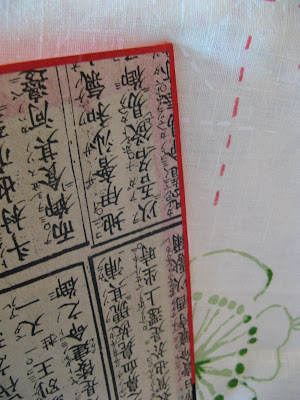
(Chinese character paper)
I started making books last August and have really progressed--this is one that I figured out how to make myself! It's a neat skill to have, and I love making books for friends.
But I also make things. Like a skirt. I made myself a long black skirt for a wedding I am in next week. And while it could be better, it looks pretty good for a first attempt at skirt making. I used this book, which teaches you how to make skirts without patterns. I am inordinately proud of my skirt, and might make another this week out of some linen Lance bought for me from Ikea.
I also make books, as I've shown before. So now I'm going to post pictures of a book I made for the same wedding as the skirt!
(longstitch binding)
Here's a better shot of the spine stitching
(spine)
I picked a cool endpaper too!
(Chinese character paper)
I started making books last August and have really progressed--this is one that I figured out how to make myself! It's a neat skill to have, and I love making books for friends.
Friday, June 15, 2007
100th Post! (And Thesis, Perhaps?)
It's only fitting that on my 100th post, I would tell you, my dear readers, about the brilliant idea (at least brilliant by comparison to the NOTHING I had before) I have had for what to write my thesis on. This will soon become a recurrent theme, I fear, so be prepared. But for now, simply celebrate or offer your thoughts on my thesis idea.
I work for the College of Engineering. I am an administrative assistant who is in touch with both professors and students on a daily basis. Several of both have opinions that they like to share with me about English literature and writing.
I've been contemplating going for a PhD in Rhetoric and Composition, which means I perhaps should move in that direction during my MA days. That's when the idea occurred to me (this past weekend, actually, around breakfast time): What if I were to do research on creating a freshman composition/writing class geared toward engineers (or other technical/science fields) to teach them the skills they need to use for their professional lives? It wouldn't be "technical writing" per se, but help them realize that the same skills that go into writing an academic essay are the same that they will employ when writing a lab report or a project proposal.
The project would have several parts. In the first, I would examine the need for freshman composition in the first place (which obviously I would argue there is a need for it). Then I would do research on alternative methods of teaching such a class. I'm planning to interview several of the engineering professors, and perhaps some engineering firms/employers and students to further assess what the class should contain, then I would build a syllabus, reading list, and prospective course to teach.
I'm really excited about this project because I can see the implications for my university for one, but it might perhaps be of interest to other programs as well. A little tweaking, and the same concepts could be applied to other programs of study. I'm also excited because it is a lot of fun to design a class--I loved the one that I did for my professing literature class. It was a lot of fun, and my professor really loved it.
Anyway, there's the thesis idea. I've pitched it to my potential thesis adviser and am now awaiting a reply. And I've already mentioned to the engineering professors I want to use in it, and they've all been excited as well, so I have a feeling this is going to be my project! Yay for thesis ideas!
I work for the College of Engineering. I am an administrative assistant who is in touch with both professors and students on a daily basis. Several of both have opinions that they like to share with me about English literature and writing.
I've been contemplating going for a PhD in Rhetoric and Composition, which means I perhaps should move in that direction during my MA days. That's when the idea occurred to me (this past weekend, actually, around breakfast time): What if I were to do research on creating a freshman composition/writing class geared toward engineers (or other technical/science fields) to teach them the skills they need to use for their professional lives? It wouldn't be "technical writing" per se, but help them realize that the same skills that go into writing an academic essay are the same that they will employ when writing a lab report or a project proposal.
The project would have several parts. In the first, I would examine the need for freshman composition in the first place (which obviously I would argue there is a need for it). Then I would do research on alternative methods of teaching such a class. I'm planning to interview several of the engineering professors, and perhaps some engineering firms/employers and students to further assess what the class should contain, then I would build a syllabus, reading list, and prospective course to teach.
I'm really excited about this project because I can see the implications for my university for one, but it might perhaps be of interest to other programs as well. A little tweaking, and the same concepts could be applied to other programs of study. I'm also excited because it is a lot of fun to design a class--I loved the one that I did for my professing literature class. It was a lot of fun, and my professor really loved it.
Anyway, there's the thesis idea. I've pitched it to my potential thesis adviser and am now awaiting a reply. And I've already mentioned to the engineering professors I want to use in it, and they've all been excited as well, so I have a feeling this is going to be my project! Yay for thesis ideas!
Thursday, June 14, 2007
The Golden Compass
The Golden Compass, an amazing book by Philip Pullman, is being made into a movie. The site looked pretty neat, so I went and played for a while and created a daemon, which in the novel is the manifest part of your soul as a creature. The site lets you take a personality quiz, and then assigns you a daemon. Mine is a tiger--but it might be wrong. So in my sidebar, you can click and take a quiz to see if I'm right!
Edit: apparently the sidebar quiz is a little funky, so here's a direct link to take it...
Edit: apparently the sidebar quiz is a little funky, so here's a direct link to take it...
Tuesday, June 12, 2007
Podcastin'
I've been delving wholeheartedly into the world of podcasts. I think they're great--and if I ever got my iPod an iTrip, I could listen to them while riding in the car on long trips.
The newest podcast that I've encountered is The Writer's Almanac with Garrison Keillor. Many will know Garrison Keillor as the host of A Prairie Home Companion (which I adore). The Writer's Almanac is a daily podcast, about 6 minutes long, that gives a bit of literary history and concludes with Garrison Keillor* reading a poem. I love it--you should check it out. Today is Anne Frank's birthday, so the episode was about her life and now famous diary. Yesterday's poem "The Calf Path" by Sam Walter Foss was a hilarious poem. You can check the website for transcripts of the episodes as well, if you prefer to read the poems as well as hear Garrison Keillor read them aloud.
(*I find myself at a loss when I try to type just "Garrison" or "Keillor" or "Mr. Keillor". No matter what I try, I seem to only be able to refer to Garrison Keillor as his full name, Garrison Keillor.)
The newest podcast that I've encountered is The Writer's Almanac with Garrison Keillor. Many will know Garrison Keillor as the host of A Prairie Home Companion (which I adore). The Writer's Almanac is a daily podcast, about 6 minutes long, that gives a bit of literary history and concludes with Garrison Keillor* reading a poem. I love it--you should check it out. Today is Anne Frank's birthday, so the episode was about her life and now famous diary. Yesterday's poem "The Calf Path" by Sam Walter Foss was a hilarious poem. You can check the website for transcripts of the episodes as well, if you prefer to read the poems as well as hear Garrison Keillor read them aloud.
(*I find myself at a loss when I try to type just "Garrison" or "Keillor" or "Mr. Keillor". No matter what I try, I seem to only be able to refer to Garrison Keillor as his full name, Garrison Keillor.)
Monday, June 11, 2007
Knitters' Coffee Swap--Received!
I got my package from my pal! (after an unfortunate delay and a re-addressing incident).

(goodies!!!)

(goodies!!!)
Thank you, thank you, RACHEL! It was fantastic--it contains a ton of coffee, 4 skeins of really nifty yarn (2 skeins of sock yarn! And some great Nashua wool/alpaca)! That green round disc on the front is a pocket mirror, which I'm happy about because I've been wanting one to stick in my purse, since I don't wear makeup. And the other is wonderful arty buttons. Instant City, the book in the back, is a literary journey through San Francisco. There is also a project bag (you can barely see it peaking out) for socks, a journal, a David/Amy Sedaris book, and a Knit.1 magazine. I feel so spoiled--thank you again. It was totally worth the wait.
Friday, June 08, 2007
Step Away From the Credit Card (NOT BUYING IT)
Could you go a year without shopping? While you could still buy essentials (non-processed food, soap, toilet paper, etc), what would it be like to go an entire year without shopping for new clothes, new books, and anything else strictly unnecessary?
Judith Levine in her book Not Buying It takes on this task: to go one year without shopping. She recruits her partner Paul on the endeavor, and they vow to only spend money on the necessities (no processed food or sweets count). So no eating out, no picking up a little something, no shopping for new clothes, no shopping for gifts. The experiment spans 2004--the last presidential election--and she structures the book in a diary format with each month forming a theme about consumerism and buying.
Levine explores the nature of consumerism and American culture's shopping habits. She also takes a look at what it is to need and to want, to shop consciously, and to understand the implications of spending on the global community. She learns that the public systems (libraries, art, etc) are in serious disrepair from a citizenship that is reluctant to pay taxes. Levine also reads a lot of anthropologists, philosophers, talks to individuals who take part of movements like Voluntary Simplicity and Buy Nothing Day. Levine participates in 2004 Buy Nothing Day (here's a photo from the event she describes):

Not only an exploration of her own habits and impulses as a consumer, Not Buying It is a book about seeking alternatives. She talks to anyone from an average consumer to a man who lives off of less than $5,000 a year. She talks to individuals who want to simplify their life in a Thoreauvian gesture, but can't quite do it.
The book's strength is in the way it looks out. Levine uses her experiment as a personal starting point or as a place to ground these larger questions. Capitalism within the United States is spinning out of control and we're buying it. We're buying the idea that it's normal and natural to want things, to want to make money. We're also buying Bush's declaration that the best way to recover from September 11th is to buy more stuff. (We have to show the terrorists what they're missing in typical imperialist style). Levine doesn't want to buy it anymore. Her experiment helps her grow in many personal ways, but she points out that when she wasn't spending on herself, she was donating more to helping others. She was involved more in the public (free) sphere of her community. Perhaps we all could do so much.
I picked up this book because even though I readily contribute to the consumerist lifestyle (and love to shop), it bothers me. I may have more disposable income now than ever before, and while I am donating to good causes and using my spending to speak (by buying organic, shopping locally, etc), I'm still participating more than I would like. I went to Wal-Mart to shop yesterday for the first time in a long time and realized that I lost the ability to shop there. The choices overwhelmed me, and I would pick items up and put them down again. The book interested me because I wanted to read books that would enrich my life in some way and perhaps steer me toward a simpler--and better--way of living.
Judith Levine in her book Not Buying It takes on this task: to go one year without shopping. She recruits her partner Paul on the endeavor, and they vow to only spend money on the necessities (no processed food or sweets count). So no eating out, no picking up a little something, no shopping for new clothes, no shopping for gifts. The experiment spans 2004--the last presidential election--and she structures the book in a diary format with each month forming a theme about consumerism and buying.
Levine explores the nature of consumerism and American culture's shopping habits. She also takes a look at what it is to need and to want, to shop consciously, and to understand the implications of spending on the global community. She learns that the public systems (libraries, art, etc) are in serious disrepair from a citizenship that is reluctant to pay taxes. Levine also reads a lot of anthropologists, philosophers, talks to individuals who take part of movements like Voluntary Simplicity and Buy Nothing Day. Levine participates in 2004 Buy Nothing Day (here's a photo from the event she describes):
(Reverend Billy nails the Nine Theses Against Corporate Rule on a New York McDonald's)
Not only an exploration of her own habits and impulses as a consumer, Not Buying It is a book about seeking alternatives. She talks to anyone from an average consumer to a man who lives off of less than $5,000 a year. She talks to individuals who want to simplify their life in a Thoreauvian gesture, but can't quite do it.
The book's strength is in the way it looks out. Levine uses her experiment as a personal starting point or as a place to ground these larger questions. Capitalism within the United States is spinning out of control and we're buying it. We're buying the idea that it's normal and natural to want things, to want to make money. We're also buying Bush's declaration that the best way to recover from September 11th is to buy more stuff. (We have to show the terrorists what they're missing in typical imperialist style). Levine doesn't want to buy it anymore. Her experiment helps her grow in many personal ways, but she points out that when she wasn't spending on herself, she was donating more to helping others. She was involved more in the public (free) sphere of her community. Perhaps we all could do so much.
I picked up this book because even though I readily contribute to the consumerist lifestyle (and love to shop), it bothers me. I may have more disposable income now than ever before, and while I am donating to good causes and using my spending to speak (by buying organic, shopping locally, etc), I'm still participating more than I would like. I went to Wal-Mart to shop yesterday for the first time in a long time and realized that I lost the ability to shop there. The choices overwhelmed me, and I would pick items up and put them down again. The book interested me because I wanted to read books that would enrich my life in some way and perhaps steer me toward a simpler--and better--way of living.
Thursday, June 07, 2007
A List
Good:
- Fresh fruit (Mango, strawberries, etc.)
- Ginger/cinnamon
- Coffee (with cinnamon and cream)
- Brown Cow Cream Top (Plain)
- Jasmine #12
- DVDs on sale (Thank you, Target)
- Lance
- knitting (being done with all my swap projects)
- friends (you know who you are)
- Random Chat Buddies
- The Decemberists
- Heather Dubrow's Genre
- my kitty
- running/iPod with sport kit
- Knitters' Coffee Swap
- Friend with flea medicine
- New apartment--room with light!
- Friends with babies
- Bachelorette party
- Ginger spread (I love you, Ginger People)
- Still not being done with Dubrow's Genre
- Kitty has fleas (drat)
- new apartment still a little messy
- too many projects, not enough time
- up too late, up too early
- no run today yet...
- More books than I can ever read!
Wednesday, June 06, 2007
I'm Smarter Than My Computer
Grammar Check and I are both lovers and enemies. Like Spell Check, Grammar Check is both a useful and debilitating feature on Microsoft programs. Usually I roll my eyes at the suggestions Grammar Check gives me, (and occasionally yell "That's not a frackin' fragment!!), but in the end I feel good because I know things that a computer can never know.
Grammar Check reinforces that language is more complex than even a machine can understand. See, while language has rules that a programmer can use to define language in a system, language also has exceptions to those rules. And a computer has difficulty understanding embedded phrases. So, for example, if I say "Here are the civil engineering summer and fall updated reports", grammar check wants to replace "are" with "is" because logically, the subject of "are" follows directly after, right? And "civil engineering" is singular. However, what the computer doesn't realize is that "reports" (plural) is actually the subject of the verb, thus the verb needs to be plural. But I imagine in order to define such an easy concept (for our language instinct carrying brains) requires impossible programming rules, since it can change on a whim.
That's why Grammar Check and Spell Check have to be used carefully. While they can be useful for catching a misspelled word or an accidental misuse of tense, ultimately computers can only understand the basic logical framework of language. The complexities and twists and turns that we instinctually make as native English speakers is impossible to define for a programmer (though, I hear they are getting closer). When it comes to language and grammar, we are always smarter than our computers (even if we can't always spell properly--but don't forget about those tricky words!)
If you are interested in more about language, I highly recommend Steven Pinker's The Language Instinct. He's a really smart, really easy-to-read guy, and as language has always fascinated me, I adored his book.
Grammar Check reinforces that language is more complex than even a machine can understand. See, while language has rules that a programmer can use to define language in a system, language also has exceptions to those rules. And a computer has difficulty understanding embedded phrases. So, for example, if I say "Here are the civil engineering summer and fall updated reports", grammar check wants to replace "are" with "is" because logically, the subject of "are" follows directly after, right? And "civil engineering" is singular. However, what the computer doesn't realize is that "reports" (plural) is actually the subject of the verb, thus the verb needs to be plural. But I imagine in order to define such an easy concept (for our language instinct carrying brains) requires impossible programming rules, since it can change on a whim.
That's why Grammar Check and Spell Check have to be used carefully. While they can be useful for catching a misspelled word or an accidental misuse of tense, ultimately computers can only understand the basic logical framework of language. The complexities and twists and turns that we instinctually make as native English speakers is impossible to define for a programmer (though, I hear they are getting closer). When it comes to language and grammar, we are always smarter than our computers (even if we can't always spell properly--but don't forget about those tricky words!)
If you are interested in more about language, I highly recommend Steven Pinker's The Language Instinct. He's a really smart, really easy-to-read guy, and as language has always fascinated me, I adored his book.
Tuesday, June 05, 2007
What's in a Name...(THE NAMESAKE)
I once read the chapter "The Circle and the Square" from Lame Deer, Seeker of Visions, where Lame Deer comments on how white people's names have no meaning. Which, while not precisely true, hits on something in American society: naming. We name our children because we like the sound of it or after someone who has meaning in our lives. Rarely do we consider what the name itself means; my name means "fair" or "white" derived from the Welsh Gwenhwyfar/Guinevere, and I know my parents didn't think of that when they named me. They just liked the sound of it.
Although our naming has become aesthetic or a sign of individuality (you've seen the names in the paper), other cultures still put a lot of care and consideration on the naming of their children. The meanings of names and the effects names can have on their bearers is a major theme in Jhumpa Lahiri's novel The Namesake. The novel follows the life of Gogol Ganguli, an American boy born to Bengali parents. The novel brings in the cultural gaps between foreign parents and their basically American children. Gogol is named such when the letter containing his name is lost between Calcutta and Boston; his father chooses to name him after Nikolai Gogol, the Russian writer who is significant to him as a sign of life in the midst of death.
Gogol grows up never understanding the significance of his name, and growing to hate it. His parents intended Gogol to be his private pet name and Nikhil to be his public name, but as a young boy, Gogol doesn't understand why he has to switch and the American school system doesn't understand Bengali custom, so Gogol sticks. He switches to Nikhil legally when he begins his freshman year at Yale and hopes to make a leave Gogol behind.
Gogol learns about the origin of his name and begins to feel differently about his namesake, finally reaching an understanding of his family's Bengali heritage, his own name's worth, and learning who Gogol is in the process. The novel closes with him in harmony with his family and his name--one of the best conclusions to a novel. I finished feeling closure and satisfied, as well as walking away with some ideas to think about my own family.
The novel was moving and an intriguing examination of not only the significance of names, but the relationships between parents and children and the culture gap between the two. I had a hard time with Lahiri's style at first--it's spartan and often feels a little choppy--but her ability to spin a story and to describe the world pulls the reader in and keeps her transfixed. By the end of the book, I was entranced, and I think I'll be looking for more of her works.
Although our naming has become aesthetic or a sign of individuality (you've seen the names in the paper), other cultures still put a lot of care and consideration on the naming of their children. The meanings of names and the effects names can have on their bearers is a major theme in Jhumpa Lahiri's novel The Namesake. The novel follows the life of Gogol Ganguli, an American boy born to Bengali parents. The novel brings in the cultural gaps between foreign parents and their basically American children. Gogol is named such when the letter containing his name is lost between Calcutta and Boston; his father chooses to name him after Nikolai Gogol, the Russian writer who is significant to him as a sign of life in the midst of death.
Gogol grows up never understanding the significance of his name, and growing to hate it. His parents intended Gogol to be his private pet name and Nikhil to be his public name, but as a young boy, Gogol doesn't understand why he has to switch and the American school system doesn't understand Bengali custom, so Gogol sticks. He switches to Nikhil legally when he begins his freshman year at Yale and hopes to make a leave Gogol behind.
Gogol learns about the origin of his name and begins to feel differently about his namesake, finally reaching an understanding of his family's Bengali heritage, his own name's worth, and learning who Gogol is in the process. The novel closes with him in harmony with his family and his name--one of the best conclusions to a novel. I finished feeling closure and satisfied, as well as walking away with some ideas to think about my own family.
The novel was moving and an intriguing examination of not only the significance of names, but the relationships between parents and children and the culture gap between the two. I had a hard time with Lahiri's style at first--it's spartan and often feels a little choppy--but her ability to spin a story and to describe the world pulls the reader in and keeps her transfixed. By the end of the book, I was entranced, and I think I'll be looking for more of her works.
Monday, June 04, 2007
Weddings and Death
I've been reading a lot of non-fiction lately, written in engaging journalistic styles. Recently, I completed One Perfect Day: The Selling of the American Wedding by Rebecca Mead, who writes for The New Yorker.
Mead examines the culture surrounding the modern American wedding, including the concept of "Bridezilla", which she sees as an indicator of how the industry is influencing the way Americans get married. With an average of 25,000 dollars spent on a wedding, those involved in providing the products for the event are part of group that wants to make sure the consumer--brides, especially--feels they need to spend, spend, spend in order to create a successful ceremony (and hopefully a successful marriage). "Bridezilla" is a fabrication of the wedding industry because while she is fearsome to behold (and not entirely an invention), she is their best consumer because she is willing to pay for what she wants. And she wants a lot.
Pointing out the rising divorce rates and uncertainly surrounding marriage, Mead demonstrates how Americans are emphasizing the actual wedding ceremony. Marriage is no longer a rite of passage from childhood to adulthood, from virginity to sexual experience (for a growing number, anyway); it is no longer a movement from the parents' home to a home of one's own. For couples who co-habitate before getting married, there may be few differences between being unmarried and marriage. Culturally, weddings have begun to take the place of this ritual transition, with all its perceived traditions (which were actually created by the wedding industry itself).
Mead could have easily taken a sarcastic, condemning tone on some of the gimmicks and blatant consumerism taking place in the weddings she attended researching for her book. And occasionally she points out the almost ridiculous choices people make for their weddings. However, she is often moved in spite of herself; even though she may barely know the bride and groom, she understands that underneath the spending and irrational consuming, there can be true sentiment and drama at a wedding ceremony.
She closes her book by briefly discussing gay marriage and commenting that if heterosexual couples had to fight for the right to be married in the same way homosexual couples do, then perhaps we would think differently about marriage. It was a subtle political commentary, but I thought an effective way to end the book. (In the epilogue, we learn that she got married in the course of writing and researching, and that her own ceremony was small, but what she wanted).
I've been enjoying my non-fiction books. I spotted the title of this one in a New York Times article, and since I know lots of people who are getting married (and I will presumably get married at some point), it sounded interesting. And it turned out to be so--I recommend it, even if you are married already, but are interested in culture and consumer sorts of things.
Mead examines the culture surrounding the modern American wedding, including the concept of "Bridezilla", which she sees as an indicator of how the industry is influencing the way Americans get married. With an average of 25,000 dollars spent on a wedding, those involved in providing the products for the event are part of group that wants to make sure the consumer--brides, especially--feels they need to spend, spend, spend in order to create a successful ceremony (and hopefully a successful marriage). "Bridezilla" is a fabrication of the wedding industry because while she is fearsome to behold (and not entirely an invention), she is their best consumer because she is willing to pay for what she wants. And she wants a lot.
Pointing out the rising divorce rates and uncertainly surrounding marriage, Mead demonstrates how Americans are emphasizing the actual wedding ceremony. Marriage is no longer a rite of passage from childhood to adulthood, from virginity to sexual experience (for a growing number, anyway); it is no longer a movement from the parents' home to a home of one's own. For couples who co-habitate before getting married, there may be few differences between being unmarried and marriage. Culturally, weddings have begun to take the place of this ritual transition, with all its perceived traditions (which were actually created by the wedding industry itself).
Mead could have easily taken a sarcastic, condemning tone on some of the gimmicks and blatant consumerism taking place in the weddings she attended researching for her book. And occasionally she points out the almost ridiculous choices people make for their weddings. However, she is often moved in spite of herself; even though she may barely know the bride and groom, she understands that underneath the spending and irrational consuming, there can be true sentiment and drama at a wedding ceremony.
She closes her book by briefly discussing gay marriage and commenting that if heterosexual couples had to fight for the right to be married in the same way homosexual couples do, then perhaps we would think differently about marriage. It was a subtle political commentary, but I thought an effective way to end the book. (In the epilogue, we learn that she got married in the course of writing and researching, and that her own ceremony was small, but what she wanted).
I've been enjoying my non-fiction books. I spotted the title of this one in a New York Times article, and since I know lots of people who are getting married (and I will presumably get married at some point), it sounded interesting. And it turned out to be so--I recommend it, even if you are married already, but are interested in culture and consumer sorts of things.
Thursday, May 31, 2007
Grammarians Unite?
A very funny British woman decided to write a book about punctuation, which become the wildly popular Eats, Shoots and Leaves: The Zero Tolerance Approach to Punctuation. I remember in one chapter Lynne Truss describes her urge to walk around with a giant red Sharpie correcting punctuation and grammar in signs, especially the apostrophe.
I occasionally have that same impulse. For example, today I was walking back from lunch and I noticed a sign that read "Stamped with Mamas Great Seal of Approval". Did you spot the missing punctuation? It's Mama's Great Seal, after all. People, I muttered to myself, have no sense of punctuation or proper uses of grammar.
Which leads me to the other half of my internal debate: should I get so caught up in others' improper use of grammar and punctuation? Do I side with the language purists who declare that English is going to hell in a handbasket (which apparently has been going on for centuries)--or do I side with the more moderate linguists who say "So? It's language. It's meant to change".
Sometimes I just don't know. Punctuation is a useful tool when employed properly, and I know that I can be confused by misplaced apostrophes or commas, or the lack thereof. The rules are not merely there to give a writer a headache and complicate their already difficult task; punctuation is useful to clarify, separate, and keep phrases where they belong. Remove the punctuation from the previous sentence, and you (my dear readers) would be confused. I would like then to separate the concept of language from punctuation, and spoken communication from writing.
Punctuation assists in clarifying writing in a way that is unnecessary in oral communication. Commas, periods, question marks, etc. provide the pauses, the emphasis, the lilt of speaking. We really cannot do away with punctuation, though in language we can come to accept the current use of "like" (instead of "as", for example, not as a random insertion that teenagers use). Punctuation is not as flexible as trends in language because punctuation fills a need that a different word cannot: it simulates spoken language.
I think in the matter of punctuation, I am going to side with Truss and the unbending grammarians: use it properly. Though I could probably survive if we forever dumped the who/whom distinction (subject/object pronouns!), I would likely perish if I could no longer use the colon or semicolon (don't even try to count how many I've used in this post alone). And the pesky apostrophe? I think we should keep it too. It tells me if people are possessing things instead of being plural, or if a word is a contraction. Terribly useful.
Do you think we should let the poor users of punctuation do away with our useful system? Where do you sit? And if you are obsessed with a piece of punctuation, what is it?
I occasionally have that same impulse. For example, today I was walking back from lunch and I noticed a sign that read "Stamped with Mamas Great Seal of Approval". Did you spot the missing punctuation? It's Mama's Great Seal, after all. People, I muttered to myself, have no sense of punctuation or proper uses of grammar.
Which leads me to the other half of my internal debate: should I get so caught up in others' improper use of grammar and punctuation? Do I side with the language purists who declare that English is going to hell in a handbasket (which apparently has been going on for centuries)--or do I side with the more moderate linguists who say "So? It's language. It's meant to change".
Sometimes I just don't know. Punctuation is a useful tool when employed properly, and I know that I can be confused by misplaced apostrophes or commas, or the lack thereof. The rules are not merely there to give a writer a headache and complicate their already difficult task; punctuation is useful to clarify, separate, and keep phrases where they belong. Remove the punctuation from the previous sentence, and you (my dear readers) would be confused. I would like then to separate the concept of language from punctuation, and spoken communication from writing.
Punctuation assists in clarifying writing in a way that is unnecessary in oral communication. Commas, periods, question marks, etc. provide the pauses, the emphasis, the lilt of speaking. We really cannot do away with punctuation, though in language we can come to accept the current use of "like" (instead of "as", for example, not as a random insertion that teenagers use). Punctuation is not as flexible as trends in language because punctuation fills a need that a different word cannot: it simulates spoken language.
I think in the matter of punctuation, I am going to side with Truss and the unbending grammarians: use it properly. Though I could probably survive if we forever dumped the who/whom distinction (subject/object pronouns!), I would likely perish if I could no longer use the colon or semicolon (don't even try to count how many I've used in this post alone). And the pesky apostrophe? I think we should keep it too. It tells me if people are possessing things instead of being plural, or if a word is a contraction. Terribly useful.
Do you think we should let the poor users of punctuation do away with our useful system? Where do you sit? And if you are obsessed with a piece of punctuation, what is it?
Tuesday, May 29, 2007
More Reading
Lance is gone this week, to Montana. Without him around, I suddenly find myself with a lot of free time (which I don't really understand, since we are not always doing things--a lot of times, we just eat dinner at home and hang out), but maybe it's free time to do solitary things, like reading. So I've been planning out my week with regards to reading. Last week I finished Night by Elie Wiesel,which was short but powerful. (I'm still working up to posting on it.)
Then I started One Perfect Day by New Yorker writer Rebecca Mead. It's really interesting. I'll post more when I've finished it, which will be soon since it's a quick read.
Two weeks ago, I read volumes 2-7 of the Sin City series. The last one (Hell and Back) was the best, I think. Or at least it contained the most admirable character of the whole series, and provided a wonderful ending to the series of novels. Miller also began adding color to the graphic novels (starting with That Yellow Bastard, where he made one character yellow). However, in the last one, when the main character is given some drugs that are meant to mess with his mind, the pages suddenly burst with color. When he returns to his normal mental state, the black and white pages seem darker than before. I enjoyed this whole series and look forward to seeing what Rodriguez does with the second film.
At some point, I need to start working on my homework. I have until next Thursday to read a short book and a few articles. I am taking a readings class (an independent study, essentially) on Genre Theory. I thought it would be interesting and a way for me to explore some of the areas of Rhetoric and Composition and see if it is what I want to study in graduate school.
It feels good to have time to read outside of my assignments for school.
Then I started One Perfect Day by New Yorker writer Rebecca Mead. It's really interesting. I'll post more when I've finished it, which will be soon since it's a quick read.
Two weeks ago, I read volumes 2-7 of the Sin City series. The last one (Hell and Back) was the best, I think. Or at least it contained the most admirable character of the whole series, and provided a wonderful ending to the series of novels. Miller also began adding color to the graphic novels (starting with That Yellow Bastard, where he made one character yellow). However, in the last one, when the main character is given some drugs that are meant to mess with his mind, the pages suddenly burst with color. When he returns to his normal mental state, the black and white pages seem darker than before. I enjoyed this whole series and look forward to seeing what Rodriguez does with the second film.
At some point, I need to start working on my homework. I have until next Thursday to read a short book and a few articles. I am taking a readings class (an independent study, essentially) on Genre Theory. I thought it would be interesting and a way for me to explore some of the areas of Rhetoric and Composition and see if it is what I want to study in graduate school.
It feels good to have time to read outside of my assignments for school.
Thursday, May 24, 2007
Summer Readin'
In the flurry of the regular semester, I rarely get time to make a dent in the steadily increasing pile of Things I Should (and/or Want to) Read. But this summer, I am making an effort to read voraciously and widely. This past week, I polished off Oryx and Crake, The Namesake, and have almost completed Night (which I'll post about when I finish). The library has two more books awaiting me that I requested--one about the wedding consumerism culture (you might find it interesting, Kerry) and one about a woman who decided to go a year without buying anything unnecessary.
I used to read wildly during the summers, before I started working and schooling. Then, somewhere, I lost the ability to just read. Sit down with a book and read for hours. Part of it was the working and the schooling, part of it was also that I became much more social. But finishing two books this week made me feel good about my ability to still sit down and get through a book, even with the working and the schooling and the socializing.
I like it when I have an active reading life. My creativity and energy go up. I think more. I have more to talk about, and I can recommend books to others. It feels like something I should be doing, considering my future goals and all. And I really enjoy the satisfying feeling of finishing up a good book. It's like being thirsty and finishing off a tall glass of refreshing water, when you say "Ahhhh" and smack your lips with contentment.
What are you all currently reading?
I used to read wildly during the summers, before I started working and schooling. Then, somewhere, I lost the ability to just read. Sit down with a book and read for hours. Part of it was the working and the schooling, part of it was also that I became much more social. But finishing two books this week made me feel good about my ability to still sit down and get through a book, even with the working and the schooling and the socializing.
I like it when I have an active reading life. My creativity and energy go up. I think more. I have more to talk about, and I can recommend books to others. It feels like something I should be doing, considering my future goals and all. And I really enjoy the satisfying feeling of finishing up a good book. It's like being thirsty and finishing off a tall glass of refreshing water, when you say "Ahhhh" and smack your lips with contentment.
What are you all currently reading?
Wednesday, May 23, 2007
Anybody Out There? (ORYX AND CRAKE)
Oryx and Crake, a novel by Margaret Atwood, is one created in the familiar vein of a post-apocalyptic, ravaged world with its survivors meting out a stifled existence. Only this story involves Snowman, perhaps the last human being, left to guard a created humanoid tribe and with his memories of his two loves, Oryx and Crake.
Atwood plunges her reader in the midst of this world, a land full of the decaying skeletal remains of humanity, its triumph and its ruin. Now Snowman and previously Jimmy, the narrative shifts between the two iterations of one individual. Jimmy's genius best friend Crake and his "one true love" Oryx figure as the main characters in a world that reflects our own gradual creep--or perhaps deliberate movement?--into despair, corruption, and ruin. Rich scientists experiment with creating new life forms, anything from deadly viruses (bioforms used as weapons) to creating spliced animals, rakunks (raccoon and skunk), wolvogs (deceptively friendly wolf-dogs), pigoons (pigs engineered to grow human organs), and others. Crake works to create a new type of human, one without the impulses within us that lead to war, misery, and destruction so they can live without the same sexual misery, warfare, and religious anxieties that plague humanity currently.
There is an uneasiness to Atwood's description of the world, both in the easy acceptance of humans ability to play God, and sometimes the character's reactions to this meddling, especially as the meddling is done by corporations seeking to profit off of the desire to live forever, to cease to age, to be in a state of bliss. This tampering eventually leads to Snowman's creation and isolation, the Crakers he is asked to guard too simple and different to understand his condition.
Snowman makes a journey to the past and back, both back to his personal past and the place where he last sees Oryx and Crake, and the novel ends ambiguously as he finds that he is not the last of his kind, and stands poised to either greet them or destroy them. Perhaps Atwood leaves his future--and implicitly ours--in the hands of her reader, but the effect is powerful. Our world cannot continue on its current path and her dystopian vision is terrifying because of its feasibility. The novel's conclusion could serve to give us hope that we are not doomed--or it could assert that human nature will always keep us on our same, flawed track.
Erudite, interesting, and a little horrifying, Atwood recalls the same power of storytelling as The Handmaid's Tale, though perhaps not to the same effect. While Oryx and Crake lacks some of the narrative strength as her previous work, it nevertheless accomplishes its goals: to tell a story about a world that could be ours someday and fill readers with a mixture of hope and dread, and ask us to question our present reality.
Atwood plunges her reader in the midst of this world, a land full of the decaying skeletal remains of humanity, its triumph and its ruin. Now Snowman and previously Jimmy, the narrative shifts between the two iterations of one individual. Jimmy's genius best friend Crake and his "one true love" Oryx figure as the main characters in a world that reflects our own gradual creep--or perhaps deliberate movement?--into despair, corruption, and ruin. Rich scientists experiment with creating new life forms, anything from deadly viruses (bioforms used as weapons) to creating spliced animals, rakunks (raccoon and skunk), wolvogs (deceptively friendly wolf-dogs), pigoons (pigs engineered to grow human organs), and others. Crake works to create a new type of human, one without the impulses within us that lead to war, misery, and destruction so they can live without the same sexual misery, warfare, and religious anxieties that plague humanity currently.
There is an uneasiness to Atwood's description of the world, both in the easy acceptance of humans ability to play God, and sometimes the character's reactions to this meddling, especially as the meddling is done by corporations seeking to profit off of the desire to live forever, to cease to age, to be in a state of bliss. This tampering eventually leads to Snowman's creation and isolation, the Crakers he is asked to guard too simple and different to understand his condition.
Snowman makes a journey to the past and back, both back to his personal past and the place where he last sees Oryx and Crake, and the novel ends ambiguously as he finds that he is not the last of his kind, and stands poised to either greet them or destroy them. Perhaps Atwood leaves his future--and implicitly ours--in the hands of her reader, but the effect is powerful. Our world cannot continue on its current path and her dystopian vision is terrifying because of its feasibility. The novel's conclusion could serve to give us hope that we are not doomed--or it could assert that human nature will always keep us on our same, flawed track.
Erudite, interesting, and a little horrifying, Atwood recalls the same power of storytelling as The Handmaid's Tale, though perhaps not to the same effect. While Oryx and Crake lacks some of the narrative strength as her previous work, it nevertheless accomplishes its goals: to tell a story about a world that could be ours someday and fill readers with a mixture of hope and dread, and ask us to question our present reality.
Monday, May 21, 2007
7 Random Things
I was tagged by my penpal, Kris, to post seven random things about myself. I'm never much good at these, but in the spirit of the tagging, I may as well post something (mmm, good post fodder anyway). So here goes:
1.) When I read, I often talk out loud about what I'm reading if someone is in the room. I'm not really talking to them, though. I'm simply verbalizing my thoughts, which helps me think. Part of it ends up being an attempt to include them in my thought processes, which often baffles the person I'm including because they don't realize what I'm doing. Lance has become accustomed to my odd habit, and I get a way to think.
2.) I use lots of cinnamon. Most people simply use it when baking, but I tend to add it to my coffee grounds in the morning, dump huge quantities in anything I'm baking/cooking, and otherwise plow through a sack of cinnamon in a short period of time. I'm almost the same way with ginger. I have some ginger jelly that I put in anything from oatmeal to a peanut butter sandwich.
3.) I use some phrases that confuse people. One is "toasted cheese sandwich", which apparently is supposed to be called a grilled cheese. Whatever. A new one is "peanut butter half". I said that one a few days ago, and my co-workers were confused: what is a peanut butter half? they queried. In case you didn't know, it's when you take one slice of bread, slather it with peanut butter (and sometimes honey or jelly), fold it in half, and consume. Peanut butter half. I picked up this and the other weird phrases from my family.
4.) I make random connections between books that I'm reading, music, shows I'm watching, etc. I guess that's what makes me a good analyzer of literature--the ability to make connections. I was relieved when I figured out this was a good skill to have in academia, and can often lead to some good research topics. Though, some roll their eyes at my more obscure connections, like that episode of Dr. Who I just watched last night and the book I just finished by Margaret Atwood, Oryx and Crake. (Nerd, they whisper).
5.) I'm a sucker for romantic comedies. I just saw Music and Lyrics, and loved it. I know that I should have more...um...cultured? tastes, but I love watching that genre. Of course, if it's an awful film, I won't watch it. And sometimes when I go back and re-watch one, I realize how sort of shallow it was, like Love Actually. (Almost no character development. But still some entertaining bits). I still enjoy them, however, to the chagrin of Lance.
6.) I'm a crafty, creative person who has a desire to learn more things. This desire manifests itself in wanting to sew more, learn new knitting techniques, read non-fiction, etc. I love learning; I love learning new things. It's a random bit of myself that connects my personal life to my academic life--my desire to know. I hope that it never goes away because it is such a pleasure to want to learn, and then to do so.
7.) I'm sort of a mockingbird. Meaning, when I listen to people talk, I tend to pick up their phrasings and ways of speaking and use them (if I like them), or if I'm reading, I'll often write, think, or talk in the style of the author. (Right now I'm reading The Namesake. I read for several hours yesterday and found myself thinking in her short, crisp style.) It's random and weird, so there you go.
I guess I can tag some people. Amanda, Kerry, Justin, Samantha, Kathryn, Amber, and G-girl...you're up.
1.) When I read, I often talk out loud about what I'm reading if someone is in the room. I'm not really talking to them, though. I'm simply verbalizing my thoughts, which helps me think. Part of it ends up being an attempt to include them in my thought processes, which often baffles the person I'm including because they don't realize what I'm doing. Lance has become accustomed to my odd habit, and I get a way to think.
2.) I use lots of cinnamon. Most people simply use it when baking, but I tend to add it to my coffee grounds in the morning, dump huge quantities in anything I'm baking/cooking, and otherwise plow through a sack of cinnamon in a short period of time. I'm almost the same way with ginger. I have some ginger jelly that I put in anything from oatmeal to a peanut butter sandwich.
3.) I use some phrases that confuse people. One is "toasted cheese sandwich", which apparently is supposed to be called a grilled cheese. Whatever. A new one is "peanut butter half". I said that one a few days ago, and my co-workers were confused: what is a peanut butter half? they queried. In case you didn't know, it's when you take one slice of bread, slather it with peanut butter (and sometimes honey or jelly), fold it in half, and consume. Peanut butter half. I picked up this and the other weird phrases from my family.
4.) I make random connections between books that I'm reading, music, shows I'm watching, etc. I guess that's what makes me a good analyzer of literature--the ability to make connections. I was relieved when I figured out this was a good skill to have in academia, and can often lead to some good research topics. Though, some roll their eyes at my more obscure connections, like that episode of Dr. Who I just watched last night and the book I just finished by Margaret Atwood, Oryx and Crake. (Nerd, they whisper).
5.) I'm a sucker for romantic comedies. I just saw Music and Lyrics, and loved it. I know that I should have more...um...cultured? tastes, but I love watching that genre. Of course, if it's an awful film, I won't watch it. And sometimes when I go back and re-watch one, I realize how sort of shallow it was, like Love Actually. (Almost no character development. But still some entertaining bits). I still enjoy them, however, to the chagrin of Lance.
6.) I'm a crafty, creative person who has a desire to learn more things. This desire manifests itself in wanting to sew more, learn new knitting techniques, read non-fiction, etc. I love learning; I love learning new things. It's a random bit of myself that connects my personal life to my academic life--my desire to know. I hope that it never goes away because it is such a pleasure to want to learn, and then to do so.
7.) I'm sort of a mockingbird. Meaning, when I listen to people talk, I tend to pick up their phrasings and ways of speaking and use them (if I like them), or if I'm reading, I'll often write, think, or talk in the style of the author. (Right now I'm reading The Namesake. I read for several hours yesterday and found myself thinking in her short, crisp style.) It's random and weird, so there you go.
I guess I can tag some people. Amanda, Kerry, Justin, Samantha, Kathryn, Amber, and G-girl...you're up.
Thursday, May 17, 2007
Poem: A Contest
I'm participating in a Knitter's Coffee Swap (knitting AND coffee, yesss). The hostess has been giving us contests to participate in, and the last one was titled "Still Life With Coffee and Yarn", and was to feature a photo (or a poem) involving the two.
Since I didn't have a camera at that point (I just got one), I wrote a little poem and submitted it to the contest.
Then this morning I discovered I had been selected as a winner!
I was just so excited that my poem won, that I decided to share it here. I'll let you click the link to view the poem. It's cutesy, but it does some of the same things I described in my post yesterday (convey a feeling, etc).
I love winning contests!
Since I didn't have a camera at that point (I just got one), I wrote a little poem and submitted it to the contest.
Then this morning I discovered I had been selected as a winner!
I was just so excited that my poem won, that I decided to share it here. I'll let you click the link to view the poem. It's cutesy, but it does some of the same things I described in my post yesterday (convey a feeling, etc).
I love winning contests!
Wednesday, May 16, 2007
Poetics (Mine)
Poets have different goals. Some write to be satirical (Alexander Pope or John Dryden), some write to thwart traditions (Shakespeare's sonnets), some write for reasons only they know. Sometimes the same poet has different intentions, depending on the poem--Alexander Pope is the author of both the wildly satirical Rape of the Lock and the more weighty philosophical The Epistle on Man.
Lately, I've found myself with the same idea in mind as I compose poetry. When I write a poem, my main goal is to convey some feeling with words. If you read the poem from yesterday, you may notice that when I'm describing rain, I use several words that begin with S and end with -ing. My intention was to give the feeling of motion, of rain moving wildly and energetically. When someone reads my poem, I want them to feel the movement of the rain, to visualize rain, and to allow that to transport them into an experience of the poem.
The same theme is repeated in the second stanza. I hoped to inspire a visualization of gray sky, rain, and sidewalks suddenly broken with a brilliant red umbrella. Then people also break the plane of motion by disrupting the downward fall of water with their horizontal movement. Even though they are inside shelter, out of the falling rain, they still are "raining" as the water drips off of them.
The final stanza was meant to convey my situation: I was sitting in a coffee shop reading when the storm suddenly struck. There was lightning, there was thunder. But I was cozy and observant. The final lines of calm form a tension with the kinetic energy of the rest of the poem, which I like. I could move it to the beginning and start the poem off with that tension, but I preferred the feeling of plunging in--you, the reader, are dashing in from the storm toward my place.
Here's the fun thing about analyzing your own poetry: ideas and feelings I got when reading the poem, I pretended I actually consciously thought about all of it. However, the truth is probably I only had a vague notion that I wanted to convey feelings of motion; all other meaning formed as I wrote about it. So does that make analysis pointless? Not really. I created meaning out of my own poem that I truly believe is there. Another reader might create some other, similar meaning from their own experience.
This is not a license for wild interpretation, though. You can't put something into a poem that is not there, in the language. You notice I didn't pretend that the tension was reflective of a conflict with my mother, though some might argue that "rain/nature" equals "mother", which you possibly could get away with as a psychoanalytical approach, maybe. If anything, the tension is reflective of indoor/outdoor distinctions. Not a conflict, per se, but rather a relationship. If I were analyzing this poem as a scholar, I would probably take into account that the author (myself) is interested more in the relationships between opposing forces, not necessarily the conflict (even though conflict is often the center of a relationship). Perhaps I (as the scholar) would conclude that the author's intent was to create tension between the wild outside and the calm inside to demonstrate how the two are compliments of one another. The heavy rain would not be so "merry" and full of "wild joy" if the author was not safe inside observing it.
Anyway, just some thoughts on interpretation. As someone whose job it is to analyze literature, it is difficult to toe the line between feasible interpretations and just making something up. Hopefully I tend away from the "just making something up" (also known as the "it's about God, death, or sex" interpretation). This is a personal conflict I've dealt with on here before, and will likely deal with again...
Lately, I've found myself with the same idea in mind as I compose poetry. When I write a poem, my main goal is to convey some feeling with words. If you read the poem from yesterday, you may notice that when I'm describing rain, I use several words that begin with S and end with -ing. My intention was to give the feeling of motion, of rain moving wildly and energetically. When someone reads my poem, I want them to feel the movement of the rain, to visualize rain, and to allow that to transport them into an experience of the poem.
The same theme is repeated in the second stanza. I hoped to inspire a visualization of gray sky, rain, and sidewalks suddenly broken with a brilliant red umbrella. Then people also break the plane of motion by disrupting the downward fall of water with their horizontal movement. Even though they are inside shelter, out of the falling rain, they still are "raining" as the water drips off of them.
The final stanza was meant to convey my situation: I was sitting in a coffee shop reading when the storm suddenly struck. There was lightning, there was thunder. But I was cozy and observant. The final lines of calm form a tension with the kinetic energy of the rest of the poem, which I like. I could move it to the beginning and start the poem off with that tension, but I preferred the feeling of plunging in--you, the reader, are dashing in from the storm toward my place.
Here's the fun thing about analyzing your own poetry: ideas and feelings I got when reading the poem, I pretended I actually consciously thought about all of it. However, the truth is probably I only had a vague notion that I wanted to convey feelings of motion; all other meaning formed as I wrote about it. So does that make analysis pointless? Not really. I created meaning out of my own poem that I truly believe is there. Another reader might create some other, similar meaning from their own experience.
This is not a license for wild interpretation, though. You can't put something into a poem that is not there, in the language. You notice I didn't pretend that the tension was reflective of a conflict with my mother, though some might argue that "rain/nature" equals "mother", which you possibly could get away with as a psychoanalytical approach, maybe. If anything, the tension is reflective of indoor/outdoor distinctions. Not a conflict, per se, but rather a relationship. If I were analyzing this poem as a scholar, I would probably take into account that the author (myself) is interested more in the relationships between opposing forces, not necessarily the conflict (even though conflict is often the center of a relationship). Perhaps I (as the scholar) would conclude that the author's intent was to create tension between the wild outside and the calm inside to demonstrate how the two are compliments of one another. The heavy rain would not be so "merry" and full of "wild joy" if the author was not safe inside observing it.
Anyway, just some thoughts on interpretation. As someone whose job it is to analyze literature, it is difficult to toe the line between feasible interpretations and just making something up. Hopefully I tend away from the "just making something up" (also known as the "it's about God, death, or sex" interpretation). This is a personal conflict I've dealt with on here before, and will likely deal with again...
Tuesday, May 15, 2007
Summer Downpour
An absolute downpour
Opening up the Heavens and letting it rip;
The rain comes gushing down,
Rolling and flowing,
Striking and slipping,
Sinking into an earth that holds her hands out merrily.
A red umbrella breaks the grey. People
dash and dart, ducking into shelter,
the water rolling off of shiny damp skin, hair limp,
and clothes clinging
Then the lightning splits the sky, the thunder rumbles with wild joy.
And here I sit, cup of chai and book in hand,
enjoying a lusty summer storm.
Opening up the Heavens and letting it rip;
The rain comes gushing down,
Rolling and flowing,
Striking and slipping,
Sinking into an earth that holds her hands out merrily.
A red umbrella breaks the grey. People
dash and dart, ducking into shelter,
the water rolling off of shiny damp skin, hair limp,
and clothes clinging
Then the lightning splits the sky, the thunder rumbles with wild joy.
And here I sit, cup of chai and book in hand,
enjoying a lusty summer storm.
Monday, May 14, 2007
Graduation Ritual
The university I work for held their commencement ceremonies last week. I got to work during it, which wasn't too bad (I got to say congratulations to some of the students that I knew from working with them. And I get comp time).
Setting up for and working at the commencement got me to thinking--I could officially walk in next year's ceremony. Depending on the courses that are offered, I could finish up in the summer of 2008 and have my MA in English. A little frightening, no?
I'm looking forward to another ceremony, though. I'm intrigued by rituals and ceremonies in our society, especially the ones that still have the outward trappings though little of the meaning. Or ones where the old forms take on new meanings for the ritual's participants. Graduation is one of those things. Even if I did it just two years ago, I want to walk down and be hooded. I like the thought of being distinguished from undergrads. Most of all, it's sealing the completion of something in my life, a ritual ending and conclusion to one stage, and the beckoning of another.
Perhaps that is why we cling to certain, seemingly meaningless rituals in this postmodern era. We may have forgotten the history and deep meaning of old traditions, but they still bear significance and meaning for the participants, even if it is meaning they create for themselves. Earning a degree just wouldn't seem quite as powerful or important if it weren't accompanied by the ritual of wearing a gown and walking across a stage to receive a diploma. Some people say they don't care, but I most certainly do. And next May, I'll be walking proudly to the cheering of my family and friends, wearing a goofy hood down my back, and accepting my empty diploma holder so I can enact that ceremony once more.
Setting up for and working at the commencement got me to thinking--I could officially walk in next year's ceremony. Depending on the courses that are offered, I could finish up in the summer of 2008 and have my MA in English. A little frightening, no?
I'm looking forward to another ceremony, though. I'm intrigued by rituals and ceremonies in our society, especially the ones that still have the outward trappings though little of the meaning. Or ones where the old forms take on new meanings for the ritual's participants. Graduation is one of those things. Even if I did it just two years ago, I want to walk down and be hooded. I like the thought of being distinguished from undergrads. Most of all, it's sealing the completion of something in my life, a ritual ending and conclusion to one stage, and the beckoning of another.
Perhaps that is why we cling to certain, seemingly meaningless rituals in this postmodern era. We may have forgotten the history and deep meaning of old traditions, but they still bear significance and meaning for the participants, even if it is meaning they create for themselves. Earning a degree just wouldn't seem quite as powerful or important if it weren't accompanied by the ritual of wearing a gown and walking across a stage to receive a diploma. Some people say they don't care, but I most certainly do. And next May, I'll be walking proudly to the cheering of my family and friends, wearing a goofy hood down my back, and accepting my empty diploma holder so I can enact that ceremony once more.
Friday, May 11, 2007
Grades: An Added Bonus
Bonus Post!
I got my grades in today. Quite nice. Of course, I had to laugh at myself for my overeagerness to know what I earned--even though I was fairly certain that I did well--but there is something about actually seeing the grades on the screen that is calming and reassuring. I've always liked making good grades, and it was only in the semester that I decided I would settle for a B in a class that I learned that they didn't really matter much.
Not too much, anyway, because they are still influential factors in my life. I like seeing an A at the end of my assignments, the confirmation that I am intelligent and capable. We've been discussing the grading system and how it makes unreasonable demands of certain types of students. Do we have a better way, however, to assess student learning? Shevek in LeGuin's The Dispossessed abhors the grading system when he is on Urras, so he decides to give all the students the same grade because he sees them as arbitrary anyway. The students protest: how are you to separate the good students from the mediocre and poor ones?
Is that what our current system does? Does it provide a ranking system of students who meet the teacher's expectations and the ones who do not? In that case, can grades be a true assessment of student learning? What about the students who do not thrive in a system that is competitive and driven by this arbitrary structure? Can we find a place for them without crushing them?
Grade inflation is a worry among universities, but I read a retort: if most students at elite universities are not making high grades, wouldn't that be more cause to worry than the fact that most students score highly? Is it truly grade inflation then? Do we need a system that dictates only a certain percentage is capable of high achievement?
Even as all these questions pepper my mind, I still feel the calm, glowing satisfaction of having my hard work arbitrary rewarded by a certain letter--A--and a certain number--4.0. Is that bad? Or am I just one of those students who thrives under the current grading system?
I got my grades in today. Quite nice. Of course, I had to laugh at myself for my overeagerness to know what I earned--even though I was fairly certain that I did well--but there is something about actually seeing the grades on the screen that is calming and reassuring. I've always liked making good grades, and it was only in the semester that I decided I would settle for a B in a class that I learned that they didn't really matter much.
Not too much, anyway, because they are still influential factors in my life. I like seeing an A at the end of my assignments, the confirmation that I am intelligent and capable. We've been discussing the grading system and how it makes unreasonable demands of certain types of students. Do we have a better way, however, to assess student learning? Shevek in LeGuin's The Dispossessed abhors the grading system when he is on Urras, so he decides to give all the students the same grade because he sees them as arbitrary anyway. The students protest: how are you to separate the good students from the mediocre and poor ones?
Is that what our current system does? Does it provide a ranking system of students who meet the teacher's expectations and the ones who do not? In that case, can grades be a true assessment of student learning? What about the students who do not thrive in a system that is competitive and driven by this arbitrary structure? Can we find a place for them without crushing them?
Grade inflation is a worry among universities, but I read a retort: if most students at elite universities are not making high grades, wouldn't that be more cause to worry than the fact that most students score highly? Is it truly grade inflation then? Do we need a system that dictates only a certain percentage is capable of high achievement?
Even as all these questions pepper my mind, I still feel the calm, glowing satisfaction of having my hard work arbitrary rewarded by a certain letter--A--and a certain number--4.0. Is that bad? Or am I just one of those students who thrives under the current grading system?
Prose: Realizations
I'm sitting in the middle of the coffee shop, surrounded by people, and I think to myself My brother is a jerk.
Now, I don't think of myself as being a jerk. I am occasionally to my darling boyfriend, but then I apologize and we make out. And I don't like to think that I hang out with jerks. It just so happens that I am related to one, and this jerk is the form of a almost-six-foot-tall stocky Marine. He has tattoos winding around his left arm, his hair is in the high-and-tight standard Marine style, and his mouth spouts Marine-isms, punctuated with the word 'fuck'. He also has the standard military issue fear of homosexuals, or really, anyone who is different from himself.
The night begins: I was to cook dinner for he and his wife. Suddenly, his friends are coming along, and he didn't bother to tell us, and then his wife decides that she'd prefer to eat out. And he didn't bother to tell me until I called him when I got off of work--he'd 'forgotten' that I had told him my plans a scant 4 hours before.
This was the inkling of my realization that my brother is a jerk. Annoyed and a little hurt, I told him to just bring along his friends, and we'd go out to eat. Then we chose a most delicious hole-in-the-wall sort of place, The Cajun Gypsy. (They have probably the best Cajun food in our area). My sister-in-law loved it, trying all the foods we ordered. My brother sulked. Then we thought we'd go out for drinks, but because we weren't drinking to oblivion or playing pool but just hanging out and chatting, it was 'boring'.
The final incident which clinched the realization that my brother was a jerk was in the way he treated a dear friend of mine. This friend came along because I hadn't seen him all week, and I wanted to hang out with him more. My dear friend is one of the kindest, most generous people I know--and my brother treated him like dirt. And why did he treat him thus? Because he believed my friend was gay.
The realization was all mixed up in my head, with anger and love and pain on the part of my friend. He knew that my brother was being a jerk; he saw how he was ignored. Even my brother's marine buddy was friendly toward everyone. And I was left sitting in my chair, sipping my thankfully-spiked coffee, wondering how I ended up so differently from my brother. From the rest of my family for that matter. I don't think it was just college: there must be some fundamental difference of being. I'm not sure what.
But I do know this: while I love my brother to death, he is a jerk.
******
Additional note: Shortly after posting, I received a call from my brother. He said, "Hey, I just realized that I was being a huge jerk last night and I wanted to apologize". Huh. Maybe there is hope for him.
Now, I don't think of myself as being a jerk. I am occasionally to my darling boyfriend, but then I apologize and we make out. And I don't like to think that I hang out with jerks. It just so happens that I am related to one, and this jerk is the form of a almost-six-foot-tall stocky Marine. He has tattoos winding around his left arm, his hair is in the high-and-tight standard Marine style, and his mouth spouts Marine-isms, punctuated with the word 'fuck'. He also has the standard military issue fear of homosexuals, or really, anyone who is different from himself.
The night begins: I was to cook dinner for he and his wife. Suddenly, his friends are coming along, and he didn't bother to tell us, and then his wife decides that she'd prefer to eat out. And he didn't bother to tell me until I called him when I got off of work--he'd 'forgotten' that I had told him my plans a scant 4 hours before.
This was the inkling of my realization that my brother is a jerk. Annoyed and a little hurt, I told him to just bring along his friends, and we'd go out to eat. Then we chose a most delicious hole-in-the-wall sort of place, The Cajun Gypsy. (They have probably the best Cajun food in our area). My sister-in-law loved it, trying all the foods we ordered. My brother sulked. Then we thought we'd go out for drinks, but because we weren't drinking to oblivion or playing pool but just hanging out and chatting, it was 'boring'.
The final incident which clinched the realization that my brother was a jerk was in the way he treated a dear friend of mine. This friend came along because I hadn't seen him all week, and I wanted to hang out with him more. My dear friend is one of the kindest, most generous people I know--and my brother treated him like dirt. And why did he treat him thus? Because he believed my friend was gay.
The realization was all mixed up in my head, with anger and love and pain on the part of my friend. He knew that my brother was being a jerk; he saw how he was ignored. Even my brother's marine buddy was friendly toward everyone. And I was left sitting in my chair, sipping my thankfully-spiked coffee, wondering how I ended up so differently from my brother. From the rest of my family for that matter. I don't think it was just college: there must be some fundamental difference of being. I'm not sure what.
But I do know this: while I love my brother to death, he is a jerk.
******
Additional note: Shortly after posting, I received a call from my brother. He said, "Hey, I just realized that I was being a huge jerk last night and I wanted to apologize". Huh. Maybe there is hope for him.
Wednesday, May 09, 2007
What is the Novel For--Salman Rushdie, Cont.
At the end of the first post on Salman Rushdie, I promised to summarize his points on what the novel is for. What is it for? Some would say that novels are nothing but rubbish--they certainly did when novels came to being in the 19th century--while others would fight for their legitimacy as important works of art and vital to understanding the human condition.
Rushdie, however, takes a less specific--or rather, a less definite--track on this question. What is the novel for? It's not a moral question, he argues, nor is it about having answers or solving problems. Really, the most important aspect of a novel is to ask questions rather than pose answers. For it is the complicated questions that survive--why do you think we are still reading Shakespeare? He poses complex questions and often arrives at no answer. Susan Sontag is a theorist who described a story as a journey; and that's the point of a novel, is the journey not any answer it might offer.
Shifting to global implications of his question, Rushdie wondered aloud if perhaps it is a luxury to talk about the novel in this way. However, he believes that even in a place where so much hinges on daily life, it is important to maintain the space for intimacy, for human activity: to maintain the possibility for love in a combat zone. Literature, he said, can look to that which is not affected by outside circumstances.
He brought in the examples of Kurt Vonnegut and Joseph Heller, who used humor and comedy to deal with dark and dangerous situations: war, death, etc. Rushdie described them as writers who use language to aim lightness at the darkness. Literature is often used to insist upon seriousness in a time of frivolity, and it is important for literature to insist on serious things, even within a comedy. And the works of Vonnegut and Heller do this.
Literature defines a period. Writers can even replace history as the truth, which is a very dangerous aspect of literature, but one that conveys the power it can wield. Looking backwards, literature tells who we are, just as Huck Finn defines the American identity.
Next post: Finishing up--Literature and worlds
Rushdie, however, takes a less specific--or rather, a less definite--track on this question. What is the novel for? It's not a moral question, he argues, nor is it about having answers or solving problems. Really, the most important aspect of a novel is to ask questions rather than pose answers. For it is the complicated questions that survive--why do you think we are still reading Shakespeare? He poses complex questions and often arrives at no answer. Susan Sontag is a theorist who described a story as a journey; and that's the point of a novel, is the journey not any answer it might offer.
Shifting to global implications of his question, Rushdie wondered aloud if perhaps it is a luxury to talk about the novel in this way. However, he believes that even in a place where so much hinges on daily life, it is important to maintain the space for intimacy, for human activity: to maintain the possibility for love in a combat zone. Literature, he said, can look to that which is not affected by outside circumstances.
He brought in the examples of Kurt Vonnegut and Joseph Heller, who used humor and comedy to deal with dark and dangerous situations: war, death, etc. Rushdie described them as writers who use language to aim lightness at the darkness. Literature is often used to insist upon seriousness in a time of frivolity, and it is important for literature to insist on serious things, even within a comedy. And the works of Vonnegut and Heller do this.
Literature defines a period. Writers can even replace history as the truth, which is a very dangerous aspect of literature, but one that conveys the power it can wield. Looking backwards, literature tells who we are, just as Huck Finn defines the American identity.
Next post: Finishing up--Literature and worlds
Tuesday, May 08, 2007
Beware the Big Bad...Grammar?
I've been encountering this a lot lately: people find out that I'm an English person, and suddenly they're commenting that they need to watch how they talk or act embarrassed about their writing. Things of that nature. I didn't used to get that quite as much, but ever since I started my MA program (meaning that my answer to "What do you do?" has changed), I've been getting a lot more of it. But why?
I always smile a little and hurry to reassure the worried party that I am in fact NOT judging their writing or their speaking. (Well, part of my is analyzing their writing and speech, but I tuck that bit away). But here's the deal--why would I critique the way someone speaks? That's just plain rude. I'd hate for someone to start criticizing my eyebrows. And that's what language is--it's a part of us, part of who we are, and part of our appearance. I don't correct grammar (for the most part--usually it's people who I know would want to say things properly, or I'm dating/related to them) because that would be like telling someone their eyebrows are weird.
Everyone speaks proper English--just not SAE (Standard American English), which is the dialect that They selected as the paragon of spoken English. Here's the deal--almost no one speaks SAE. If they say they do, they lie. I say "y'all" a lot, as well as some non-standard phrases, but they are still correct. The listener understands what I am saying.
Anyway, I might occasionally mock bad writing, but usually it is in the context of that person being a professional writer--and doing it horribly. I would never dare to tell someone that is writing for enjoyment or fun that they are punctuating improperly or that they really should capitalize. I can grumble about it to myself, but I would never tear another human being down in such a way. How we speak and write is an intrinsic part of our selves--and probably why people get so nervous when they hear that I am an English MA student. (I wonder: do they suddenly see me as taller? As brandishing a red pen? Or thumping a yardstick?)
It's a weird balance to strike. Just as I have to separate my critical self from my sensibilities that might be outraged by a work of art (Kant!), I have to separate out the part of myself that wants to "fix" writing and grammar and realize that it's better to just let people be free to express themselves. I would never want to be the cause of a loss of self-expression and freedom.
I always smile a little and hurry to reassure the worried party that I am in fact NOT judging their writing or their speaking. (Well, part of my is analyzing their writing and speech, but I tuck that bit away). But here's the deal--why would I critique the way someone speaks? That's just plain rude. I'd hate for someone to start criticizing my eyebrows. And that's what language is--it's a part of us, part of who we are, and part of our appearance. I don't correct grammar (for the most part--usually it's people who I know would want to say things properly, or I'm dating/related to them) because that would be like telling someone their eyebrows are weird.
Everyone speaks proper English--just not SAE (Standard American English), which is the dialect that They selected as the paragon of spoken English. Here's the deal--almost no one speaks SAE. If they say they do, they lie. I say "y'all" a lot, as well as some non-standard phrases, but they are still correct. The listener understands what I am saying.
Anyway, I might occasionally mock bad writing, but usually it is in the context of that person being a professional writer--and doing it horribly. I would never dare to tell someone that is writing for enjoyment or fun that they are punctuating improperly or that they really should capitalize. I can grumble about it to myself, but I would never tear another human being down in such a way. How we speak and write is an intrinsic part of our selves--and probably why people get so nervous when they hear that I am an English MA student. (I wonder: do they suddenly see me as taller? As brandishing a red pen? Or thumping a yardstick?)
It's a weird balance to strike. Just as I have to separate my critical self from my sensibilities that might be outraged by a work of art (Kant!), I have to separate out the part of myself that wants to "fix" writing and grammar and realize that it's better to just let people be free to express themselves. I would never want to be the cause of a loss of self-expression and freedom.
Monday, May 07, 2007
Thinking Blogger Awards (finally!)
A while back (a long while, okay?) I was tagged for a Thinking Blogger award by the Secret Knitter. And I was, of course, honored, flattered, and felt really good about myself. He says:
It's good to see Jenn writing more regularly. She shares her grad school homework assignments, creative writing, and personal observations in a fun little blog.
I partly think he's trying to encourage me to write more, but nevertheless. I've been feeling guilt stings as the other recipients have passed out their awards...and then their awardees have in turn passed out more. (You probably get the picture). Here are the rules:
1. If, and only if, you get tagged, write a post with links to 5 blogs that make you think,
2. Link to this post so that people can easily find the exact origin of the meme,
3. Optional: Proudly display the 'Thinking Blogger Award' with a link to the post that you wrote (here is an alternative silver version if gold doesn't fit your blog).
All right--so many to choose from. I'd nominate Union, Trueheart, and Courtesy--but Donna has already been named multiple times (and she's quite deserving of the mentions). And Secret Knitter tagged me, so I'm guessing tag backs aren't allowed.
So here are my choices:
Kathryn's Blog--Kathryn is a good friend of mine and has recently been exploring the world of yoga. I enjoy reading her blog; she reflects on her practice and the challenges she faces in yoga as well as other interesting bits. It's a great read--and a good motivation for me to try to form my own yoga practice.
A Dress a Day--I love, love, love this blog. I discovered it when I first moved over to Blogger (it was a notable blog) and have been reading it ever since. I love how she blends her passion for dresses and her talent for writing. She writes about interesting dresses, dresses she's made, dresses she wants to make, and all the fabric that would make you drool. Interesting stuff.
ADAllen--Amanda may not write much...but when she does, it is consistently interesting and think-worthy. She writes about her academic interests as a graduate student in Student Affairs (sorry, I don't remember the official program name!)
The Slacktivist--Maybe it's because he quotes John Donne in his header. Maybe it's because he writes smart and insightful posts. Quite possibly it's because his criticism of the Left Behind series is both sharp and intelligent. All I know is that I enjoy reading his posts as he demonstrates that being on the left side of politics and a Christian are not incompatible--and he works in his own way to counter the perceptions of Christians of hard-nosed, Bible-thumping, condemning folks by showing the other side of faith.
And just for kicks, Domesticat. It's a knitting blog, but the author takes wonderful pictures and writes fun and witty posts. I enjoy reading it, and it makes me want to knit beautiful things and think about knitting...Most recently I participated in her letter swap...and made at least one new friend!
Now off to tag the recipients!
It's good to see Jenn writing more regularly. She shares her grad school homework assignments, creative writing, and personal observations in a fun little blog.
I partly think he's trying to encourage me to write more, but nevertheless. I've been feeling guilt stings as the other recipients have passed out their awards...and then their awardees have in turn passed out more. (You probably get the picture). Here are the rules:
1. If, and only if, you get tagged, write a post with links to 5 blogs that make you think,
2. Link to this post so that people can easily find the exact origin of the meme,
3. Optional: Proudly display the 'Thinking Blogger Award' with a link to the post that you wrote (here is an alternative silver version if gold doesn't fit your blog).


All right--so many to choose from. I'd nominate Union, Trueheart, and Courtesy--but Donna has already been named multiple times (and she's quite deserving of the mentions). And Secret Knitter tagged me, so I'm guessing tag backs aren't allowed.
So here are my choices:
Kathryn's Blog--Kathryn is a good friend of mine and has recently been exploring the world of yoga. I enjoy reading her blog; she reflects on her practice and the challenges she faces in yoga as well as other interesting bits. It's a great read--and a good motivation for me to try to form my own yoga practice.
A Dress a Day--I love, love, love this blog. I discovered it when I first moved over to Blogger (it was a notable blog) and have been reading it ever since. I love how she blends her passion for dresses and her talent for writing. She writes about interesting dresses, dresses she's made, dresses she wants to make, and all the fabric that would make you drool. Interesting stuff.
ADAllen--Amanda may not write much...but when she does, it is consistently interesting and think-worthy. She writes about her academic interests as a graduate student in Student Affairs (sorry, I don't remember the official program name!)
The Slacktivist--Maybe it's because he quotes John Donne in his header. Maybe it's because he writes smart and insightful posts. Quite possibly it's because his criticism of the Left Behind series is both sharp and intelligent. All I know is that I enjoy reading his posts as he demonstrates that being on the left side of politics and a Christian are not incompatible--and he works in his own way to counter the perceptions of Christians of hard-nosed, Bible-thumping, condemning folks by showing the other side of faith.
And just for kicks, Domesticat. It's a knitting blog, but the author takes wonderful pictures and writes fun and witty posts. I enjoy reading it, and it makes me want to knit beautiful things and think about knitting...Most recently I participated in her letter swap...and made at least one new friend!
Now off to tag the recipients!
Friday, May 04, 2007
The Amazing Salman Rushdie, Pt 1
It was my pleasure to have the opportunity to see Salman Rushdie, live and in person on April 18th. It was even better than seeing Amy Tan at the FPL (which was pretty cool--she's a funny lady). This post will be dedicated to his talk, which was wonderful and lovely and interesting. This is the first in a series of posts dedicated to summarizing his talk, and then maybe me talking about his talk.
His talk was titled "The Role of the Writer in the 21st Century", a topic that he called an old chestnut, but on e that needs to be addressed. He began by telling a story about Saul Bellow: Bellow was once asked why American writers had abdicated their responsibility to write against the power of America, to criticize and to call attention to abuses of power. Bellow's answer was that "We don't have obligations, we have inspirations"; thus, we cannot prescribe to a writer what he or she should write--and the role of the writer is that there is not one. Each writer must strive to be the writer that he or she can be.
He then moved on to the question: What does literature do? It pays attention, was his answer, it looks at the lives of the individual. Rarely does a book actually affect the world (a book like Harriet Beecher Stowe's Uncle Tom's Cabin might be an example, since it sparked the abolitionist movement and the Civil War in many ways). But for the most part, literature doesn't cause great changes, but through reading a book and loving a book, both the reader and the writer are changed in some small, unpredictable way. So books can change the world, but only one reader at a time. Literature is about the unexpected, about the inevitable because after all, what is expected is boring. Dull. And books that deal with the improbable are infinitely more interesting to read.
Literature, however, is not about how things are going to turn out. Writers don't know the future. He told a funny story about a man--Gary from Michigan--who would send letters (the same exact letter) to writers asking them if they thought civilization was going to survive as it currently existed. Most dismissed him as a dealer trying to get an famous author's signature. However, Angela Carter decided to write him back and told him "Yes, civilization will survive as we know it". He never wrote back again. But the point of the story was that writers are not indicators of the future; they are firmly planted within their time. For example, George Orwell's 1984 was not about what would happen in 1984--it was about what was going on in 1948 that frightened him. Rushdie concludes this point by saying that literature is in danger if it tries to tell you what's going to happen. That's just not what it is about.
Next post: So what is the novel for?
His talk was titled "The Role of the Writer in the 21st Century", a topic that he called an old chestnut, but on e that needs to be addressed. He began by telling a story about Saul Bellow: Bellow was once asked why American writers had abdicated their responsibility to write against the power of America, to criticize and to call attention to abuses of power. Bellow's answer was that "We don't have obligations, we have inspirations"; thus, we cannot prescribe to a writer what he or she should write--and the role of the writer is that there is not one. Each writer must strive to be the writer that he or she can be.
He then moved on to the question: What does literature do? It pays attention, was his answer, it looks at the lives of the individual. Rarely does a book actually affect the world (a book like Harriet Beecher Stowe's Uncle Tom's Cabin might be an example, since it sparked the abolitionist movement and the Civil War in many ways). But for the most part, literature doesn't cause great changes, but through reading a book and loving a book, both the reader and the writer are changed in some small, unpredictable way. So books can change the world, but only one reader at a time. Literature is about the unexpected, about the inevitable because after all, what is expected is boring. Dull. And books that deal with the improbable are infinitely more interesting to read.
Literature, however, is not about how things are going to turn out. Writers don't know the future. He told a funny story about a man--Gary from Michigan--who would send letters (the same exact letter) to writers asking them if they thought civilization was going to survive as it currently existed. Most dismissed him as a dealer trying to get an famous author's signature. However, Angela Carter decided to write him back and told him "Yes, civilization will survive as we know it". He never wrote back again. But the point of the story was that writers are not indicators of the future; they are firmly planted within their time. For example, George Orwell's 1984 was not about what would happen in 1984--it was about what was going on in 1948 that frightened him. Rushdie concludes this point by saying that literature is in danger if it tries to tell you what's going to happen. That's just not what it is about.
Next post: So what is the novel for?
Thursday, May 03, 2007
To Kris--
(about the Knitters Letter Swap)
Have you gotten my letter yet? I sent it last week. I don't know how long it takes to get over there. But I wanted to let you know that I loved your letter and that I did write you back. And do you have a blog? I'd love to read it, and I'm glad to know that you read mine...
Anyway, just checking on things.
I promise to post real stuff later. My final paper is due today, and then I'll be done with the semester. So look forward to posts about my contemplations on what PhD program I think I'd like to explore, Salman Rushdie!, and all the books I hope to read this summer.
Have you gotten my letter yet? I sent it last week. I don't know how long it takes to get over there. But I wanted to let you know that I loved your letter and that I did write you back. And do you have a blog? I'd love to read it, and I'm glad to know that you read mine...
Anyway, just checking on things.
I promise to post real stuff later. My final paper is due today, and then I'll be done with the semester. So look forward to posts about my contemplations on what PhD program I think I'd like to explore, Salman Rushdie!, and all the books I hope to read this summer.
Tuesday, May 01, 2007
Joining the Texters...
Damn. I did it--I signed up for text-messaging on my phone. Not entirely by my own choice, mind you, but I figured that if people insisted on sending messages to my phone, then I may as well make it apart of my cell phone plan so that I don't get angry every time I receive a message on my cell phone...
Anyway, I don't know what to think of it. I can understand the convenience of being able to text someone (you're in a meeting or class; you need to let someone know something quickly), but at the same time, we managed before without texting.
It's at times like these that I feel like an old, curmudgeonly Luddite.
My other objections to texting include text spam (which I've received), and the horrible use of spelling and punctuation in texting. But...those things exist on the Internet, and I still use it. So I'm going to try out text messaging for a month and see if it's worth the extra five bucks. If not, see you later texting.
Please don't judge my joining as indicative of my plans to become a frequent and misguided texter. I'll just use it like any other technology--because it's fun and (might) make my life easier. Maybe.
Anyway, I don't know what to think of it. I can understand the convenience of being able to text someone (you're in a meeting or class; you need to let someone know something quickly), but at the same time, we managed before without texting.
It's at times like these that I feel like an old, curmudgeonly Luddite.
My other objections to texting include text spam (which I've received), and the horrible use of spelling and punctuation in texting. But...those things exist on the Internet, and I still use it. So I'm going to try out text messaging for a month and see if it's worth the extra five bucks. If not, see you later texting.
Please don't judge my joining as indicative of my plans to become a frequent and misguided texter. I'll just use it like any other technology--because it's fun and (might) make my life easier. Maybe.
Monday, April 30, 2007
Another Busy Week...
Grad school makes life busy. I have my final theory paper due on Thursday, which means I have to do a massive overhaul of my previous draft (posted earlier) and add five to ten pages to it. I may be able to add seven, but I make no promises. Luckily my other class is done with the exception of one more meeting and talking more about Gerald Graff's Clueless in Academe.
My Professing Literature class ended very nicely. Remember that syllabus I posted? My teacher loved it--in fact he recommended that I get with another student and write an article about ways to spice up an introduction to literature class! I was proud. And then I thought to myself--perhaps this is a path I should take for PhD school. Maybe I should explore pedagogy and ways of teaching English literature. It's something I love and care about...why not study it more? Maybe I will...
We had guests in our last class, tenured professors. And I discovered that the issue I selected to write my prospective essay about is perhaps not as big a deal as I thought it was. It seems that these three that talked to us quite easily and successfully navigate the intersections between teaching, research, and service in their careers. They bring their research into their classes. And they love to teach.
Anyway, just wanted to post something. I'll be working on that paper until Thursday, and then I'll turn it in. And be done with this busy (but successful!) semester.
My Professing Literature class ended very nicely. Remember that syllabus I posted? My teacher loved it--in fact he recommended that I get with another student and write an article about ways to spice up an introduction to literature class! I was proud. And then I thought to myself--perhaps this is a path I should take for PhD school. Maybe I should explore pedagogy and ways of teaching English literature. It's something I love and care about...why not study it more? Maybe I will...
We had guests in our last class, tenured professors. And I discovered that the issue I selected to write my prospective essay about is perhaps not as big a deal as I thought it was. It seems that these three that talked to us quite easily and successfully navigate the intersections between teaching, research, and service in their careers. They bring their research into their classes. And they love to teach.
Anyway, just wanted to post something. I'll be working on that paper until Thursday, and then I'll turn it in. And be done with this busy (but successful!) semester.
Subscribe to:
Posts (Atom)