Showing posts with label authors. Show all posts

Wednesday, February 20, 2008

Who's that Austen Person?

Jane Austen: you either tear through her (fabulous!) novels with reckless abandon, or foster some vague idea of "chick-lit" or novels about "getting married and stuff." Well, I'm obviously of the former camp--since I started reading Austen for class, I voluntarily read through the rest of her canon with delight, finding her prose witty and ironical.

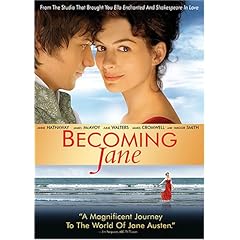
My interest in Austen led me to rent Becoming Jane. Little is known about the exact details of Austen's life, so much of the movie is speculation about why she never married based on what scholars do know.

The film seized on the angle of a unfulfilled romantic relationship as a possible influence on Austen's writings and explored the nature of this relationship.

I loved this movie. It might be over-romanticized, but it offered some interesting speculation about the life of a wonderful writer. The film itself was full of little references to Austen's works, something I found fun. I also enjoyed the scene where Jane met Ann Radcliffe, famous Gothic authoress who was a little boring (in contrast with her wild tales). It also showed the relationship between Austen and Tom LeFroy as an inspiration for her most famous work, Pride and Prejudice.

Anne Hathaway did a decent job portraying Austen, and I had to give her extra points when I learned from the special features that she is an Austen fan (she wrote her senior thesis at Vassar on Austen) and she read the Austen's entire body of works as well as criticism as research for this role. Impressive!

Taken with a grain of salt and viewed as a story based on limited knowledge, Becoming Jane offers a lovely possibility in the story of an author's life.

Tuesday, October 23, 2007

Bullets

  • I have a paper due Friday. Part of me wonders if I'll actually finish it. I do, however, have a thoroughly edited first sentence.
  • Dumbledore is gay. My reaction? "Hmmm, interesting". I really liked this NPR clip, though.
  • NPR has a podcast that's all about books. "Fresh Air" and other NPR shows have been keeping me apprised of all the new books coming out as well as allowing me to listen to authors speak. I really enjoy listening in. Pretty cool!
  • Research and writing is hard work. But it's also pretty rewarding.
  • I am for sure not graduating in the spring. But that's okay. I'll just take more classes!
  • Lance brought me presents from Montana. The only one I could have, however, was a giant cupcake cake pan. Isn't it cool?
  • Halloween is coming up--the time to dress like a slut. I think I'm going as a sexy librarian because I don't have to actually purchase anything for this costume. (After I finished typing that, I realized it made me sound like I had slutty clothes laying around everywhere--it's really going to be in the combination, however, and wearing a shirt that I ordinarily wear a tank top under).
  • Back to work. I'm taking off tomorrow afternoon to try and finish that dratted paper, so I'd best make sure I have everything done.

Tuesday, September 11, 2007

September 11th in Literature

I have some conflicted feelings about September 11th. While I believe that it was a sad event and that the people who died should be remembered, I also hate how it is used as a sign of patriotism, and a reminder of how we should all be afraid.

We should not be afraid. We should look forward with courage, and try to seek peace instead of retribution and more fear. But enough politicizing.

Recently, I've been thinking about how the events of September 11, 2001 have crept into our cultural conscious. In other words, how it is being represented in art, namely literature. More specifically, two books I've read in the past month both have representations (albeit small) of the events of September 11th from two different perspectives.

A Thousand Splendid Suns by Khaled Hosseini describes the events from the perspectives of an Afghani refugee family. I found this one interesting because it was from a perspective of the people whose country was then affected by the ensuing retaliation against the Taliban. Their reactions--and the author's call for readers to remember Afghanistan--marked a contrast with the American reaction. Sometimes, we forget that there are other victims of world events besides our own citizens and our own soldiers.

The second book, The Time Traveler's Wife by Audrey Niffenegger*, tells the event from an American perspective. In a brilliant artistic move, Niffenegger simply shows Clare and Henry looking at the television, watching the planes crash into the towers. She leaves it to her reader's imagination to place their own reactions to the events into the story, a cleverly engaging device. It brings a stark element of the real world into this already wonderful book.

I'm interesting in observing how those events will continue to creep into art and effect the public imagination. How do audiences who could name specifically where they were and what they were doing when they heard the news react to such representations? I know that in both of those sections in both novels, I felt strangely connected, as though I had a shared experience with the characters, whose lives were otherwise different from my own.


*In an intriguing aside, Niffenger is a book artist, who teaches in Chicago. How cool is that?

Sunday, August 26, 2007

Renewed Reading

As I was finishing up a reading packet for class tomorrow, I found myself struck by the absolute beauty of some of the sentences. We had three short readings, one of which ("The Philosophy of Composition by Richard Atlick and/or John Fenstermaker) was about good academic writing, and the other two concerned themselves with the literary "Canon Wars".

All three pieces were marvelously written, and often funny--Atlick/Fenstermaker used his footnotes to make funny jokes with an important point about the use of footnotes. I kept laughing the further I got through the piece--I'm sure Lance and his parents would have thought I was silly for enjoying a scholarly article so much. (Just as he laughs at me for adoring The Elements of Style).

It was in the last piece, (Katha Pollitt--"Canon to the Right of Me") when I discovered that I was highlighting a sentence just because it was such a well-crafted bit of wordsmithing that I remembered why I'm in graduate school in the first place--to read lovely bits of writing (poetical, fictional, or scholarly) and to admire that beauty and attempt to be like them. Spending part of last semester with Jameson didn't help, since his writing lacks the grace and elegance of more reader-friendly writers.

I'm glad that I am being told to leave behind the purposefully obscure, horrible pieces of writing. Even if I have to study them, I can mock their terrible writing and strive to be an academic that can pride herself on the quality of her craft. I would like others to read what I write and feel that sheer enjoyment of the well-written sentence, as well as learn something interesting. Those academics who feel the need to be obtuse are idiots. No one will ever appreciate their prose style, and fewer will understand their perhaps brilliant points than if they had chosen to write like Terry Eagleton or Jerome McGann.

It does me good to be reminded every now and then that I'm not going into English to study and learn more about literature--I'm going into it because I love the written word, and I love the beauty and power of well-used words.

Thursday, July 26, 2007

Why Mark Should Read Lord of the Rings

As Secret Knitter (Mark) and I were going back and forth about what I should perhaps post today, this totally fun and random thought popped into my head. I should post reasons he should get Tolkien's The Lord of the Rings and read them! He claims to have avoided them because of the fanboy aura and other assorted paltry excuses. Well, I'm going to give him incontrovertible evidence of why he should immediately go and read them.
  • First, he should read The Hobbit, which is short, a fun read, and the best way to become intrigued in the world Tolkien builds further in his longer work. I love The Hobbit because it is a lighthearted tale, and as a reader, I just feel the fun Tolkien had while writing it.
  • After reading The Hobbit, he may or may not be consumed with a desire to read more about hobbits. No matter; I don't expect him to suddenly become obsessed or anything. But he should at least now be intrigued by Tolkien's art.
  • He's someone who makes a living out of writing about films, so I'm almost certain he's seen Peter Jackson's excellent renditions of Tolkien's work. If you've seen the films and liked them, then the books should be enjoyable too.
  • Tolkien writes about all sorts of relevant and important ideas, like friendship and storytelling and love. Not to mention the inspiration notion of small heroic actions leading to the destruction of a great evil.
  • Since he's a fan of Harry Potter, he really should get familiar with the father of fantasy literature.
  • After he finishes the book, he can ask me about what I wrote my undergraduate Honors thesis about and understand what I'm talking about.
  • The Lord of the Rings features some wonderful, memorable characters like Eowyn, Frodo, Sam, Gandalf, Aragorn, and many, many others. And not all of the cool ones are portrayed in the film, like Tom Bombadil.
  • The last part of The Return of the King is my favorite part of the book. (When the hobbits return to the Shire). But he'll never understand why I love it so much unless he reads it...
  • It's a damn good book, that's why!
If you all out there have any other reasons for why Mark should read The Lord of the Rings, please post. If you think I'm wrong for thinking he should read them or miss out on a major work of literature...well, the Eye is watching.

Sunday, July 22, 2007

Finished: HARRY POTTER and the DEATHLY HALLOWS

Yes, indeed. In one marathon reading session that had me rocking back and forth, laughing, gasping in shock, and finally crying through the last six chapters of the book (partly out of heightened emotions and sheer mental weariness), I closed the book with a satisfying snap. I knew it would be good; I was promised for two years it would be good. And the fact that I was so emotionally vested in these characters, that I was reacting to them as I would real people, told me that Rowling cast her charms well.

The book is that good. Now I wait until other finish, so I can gab about it to them. As promised, I reveal nothing here.

I'll chat a little instead about my path to Harry Potter. The first book in the series, The Sorcerer's Stone, was published while I was in high school. As part of an ultra-conservative household, I was forbidden to read them, and I complied. After some of my conservative luster fell away, I still balked at reading them until my sophomore year of college, when The Goblet of Fire was released. I then read all four books, and I liked them. I ended up doing my Honors sophomore lecture on the debate over Harry Potter--good books or evil? I concluded they were good books, but perhaps younger children should be guided while reading them. (Mostly because the conservative side of the argument was so blatantly ludicrous.)

I didn't attend a midnight release for the fifth or sixth. I eventually bought the fifth after reading a borrowed copy along with the others I didn't already have. I was hooked. The sixth I pre-ordered on Amazon and was pleased when it arrived that Saturday.

But the seventh, oh the seventh. As you can tell from the week's posts, I had been looking forward to the final installment. And it was worth the wait, let me tell you.

I wonder if Rowling will write anything else, at least something not connected to Harry Potter. She's a brilliant storyteller, but it might be hard to top her own magnificent feat. Of course, Tolkien was asked to write another Hobbit, and look what he turned out...

Friday, July 20, 2007

At Last: The Deathly Hallows Will Be Mine!

I apologize, dear reader, for not carrying through with my "Harry Potter Week". However, a nasty summer bug laid me out for two days, so I was not in the mind to amuse or occupy you with my wit. Or the borrowed wit of others, as I shall today.

I must say I am looking forward to reading Harry Potter. Do you think I can finish it off tomorrow, to avoid being pestered by the hyped up media, my roommate, and my boyfriend (who wants to borrow the book)?

The following is an amusing song that expresses the feeling of many Potter fans: http://www.brotherhood2.com/?p=158

Pretty amusing.

Anyway, on with some small chatter. I'm hoping that the media doesn't spoil anything for me. That's the problem with a book gaining such wild popularity is that everyone wants to read it as soon/fast as possible, then they want to gab about it. And for those who simply cannot stay up all night to polish off the 800-page book have their surprise spoiled. I read a NY Times book review about the novel, against my better discretion, but they had the good taste to not give anything away.

So I'll turn the question to you: the hype. Is the book worth all the attention? I give a grudging yes, because it is rare to find a work of literature that can so wholly capture the hearts and minds of such a wide audience. We're not talking one demographic--I'm a 24 year old English MA student, and I'm sure I'll be rubbing shoulders with a range of readers tonight at the midnight release party. There will be a lot of kids, sure. But all of my friends are also eagerly awaiting their copies.

Rarely do writers become such superstars. Even Salman Rushdie, who is a fantastic writer and deals with death threats on a regular basis, is still not as well known as Rowling. Even those who haven't read the Harry Potter books know who she is.

Well, talk. What's your opinion?

Monday, July 16, 2007

BONUS: Harry Potter and the Half Blood Prince

One sentence summary:

J.K. Rowling must have cried her eyes out writing the end of this book.

Friday, July 06, 2007

War, Oppression, and Friendship: Hosseini's A THOUSAND SPLENDID SUNS

One eye on my soup, the other on the pages of Khaled Hosseini's A Thousand Splendid Suns, I managed to finish this excellent novel just a short time ago. And so I decided to tell you all about it.

Hosseini, author of The Kite Runner, brings the world of Afghanistan to life for his American audience, enchanting us with his descriptions of its beauty and richness, and wrenching our hearts as we watch it slowly destroyed through thirty years of conflict. In many ways it is a book to make us not forget about Afghanistan, a fear voiced by a character at the close of the novel, keep in our minds the effects of war and cultural strife that tore Afghanistan apart.

But it also a compelling narrative about two women, Mariam and Laila who are caught in the aftermath of war and violence, victims of the power shift from the Soviets to the Mujahideen, who then fell into civil unrest and sectarian violence, followed by the rise of the Taliban and the restrictions they enforced. Mariam is married off at fifteen to Rasheed, a violent, ill-tempered man who forces Mariam to dress in burka and punishes her because she cannot carry a child to term. Her silent, long-suffering character is juxtaposed with Laila, the young, beautiful girl who is love with Tariq, her childhood friend who lost a leg to a land mine.

Mariam is reclusive and shy, while Laila is able to go to school and have a public life. But it all changes the day that her parents are killed when a rocket blows up their house; fourteen year old Laila survives and is nursed back to health by Mariam and Rasheed. Rasheed decides that Laila either needs to marry him or leave; he refuses to pay for her upkeep any longer. Laila agrees--but only because she discovers she is pregnant with Tariq's child, who she has been told is dead, and cannot make it to the Pakistan border.

As the narrative continues, Mariam move from enemies to friends who both suffer at the hands of their violent husband who insults, beats, and abuses both women. It is their friendship that sustains them both, giving love and purpose to Mariam's life and offering Laila love and support in turn.

The novel is not without its faults, but I found it compelling and captivating. It was hard to put down, and I feel offered a window into life in Afghanistan in the turbulent years leading up to 9/11 and the events following. It's a great read, and I recommend it if you need something good to fill up your summer evenings.

Tuesday, July 03, 2007

Thesis--Approved!

I had a meeting with my independent readings course yesterday, and with my professor that hoped would be my thesis adviser. He likes my topic! So I'm going to start moving forward with it. One question I hope to answer is why do we need freshman composition? I challenged a fellow MA student yesterday when she gave the trite, pat answer of "to make well-rounded individuals". I think that answer is too easy, I declared. I'm not sure what the answer is, but I'm guessing it involves both giving students skills they need to be writers in their profession, and the desire to create an educated, reading public. I want students to realize that they have to read the world around them in the way they read a book. Student empowerment through literature, perhaps?

And I hope I did not offend anyone with my post yesterday. I certainly did not wish to imply that all Muslims were like the narrow-minded people quoted in the article I linked to. I realize that Muslims and Christians come in all varieties of tolerance and acceptance--and I'm sure that being Muslim is difficult in the world we currently live in and is enough to make anyone sensitive to perceived attacks on her beliefs. I was just saddened by the way that an author of great talent is treated for receiving an honor he deserves.

Monday, July 02, 2007

Writing Martyrs

Salman Rushdie was knighted recently in Great Britain, setting off reactions from the Muslim community. In retaliation, the fatwa was renewed. Rushdie's life is now in danger because he dared to write a novel about the nature of religion and happened to use Islam as his target.

In this article, the Muslims come off as big whiners--after all, religions are often the target of authors. Philip Pullman's His Dark Materials trilogy attacks Christianity in a very pointed way, as does Towing Jehovah. I'm sure there have been lots of angry people who condemned those books. But nobody wants to kill them.

The death threat is similar to the fundamentalists who want to bomb abortion clinics and the like--they feel that if they can remove the source of that which is to their beliefs (Salman Rushdie, doctors who preform abortions), then their belief systems will be in some way validated as the one true belief system.

In his talk on the role of the writer (which I attended), Rushdie described writers as people who push the establishment, which always pushes back. Depending on the skill of the writer and what they are pushing, it can be a big push with a big reaction, or merely a small push. I wondered at the time if this was merely a romantic notion of authorship--my jaded, postmodern self didn't think that a writer could make that big of a difference. But then I was struck by what Rushdie has endured for writing The Satanic Verses--persecution, death threats, forced hiding, and when honored with knighthood for his contribution to art the leaders of Pakistan, Iran, Iraq, Afghanistan, etc call for its revocation--I realized that he is living this idea. Because he dared to push the establishment, many Muslims around the world hate him, and many want him dead.

Art isn't tame. It's a dangerous creature, capable of sparking debate, controversy, and anger to those who are willing to use their art to push politically, socially, or culturally. I use this site to keep track of literary censorship in schools, and it's amazing how much art can anger and upset parents and school administrators.

So perhaps artists (and maybe comedians too: see John Stewart and Steven Colbert) can keep pushing the establishment toward change. Rushdie is willing to risk his life to push, and even if he is honored in the attempt, he still has a violent and upset group of people after him.

Wednesday, May 09, 2007

What is the Novel For--Salman Rushdie, Cont.

At the end of the first post on Salman Rushdie, I promised to summarize his points on what the novel is for. What is it for? Some would say that novels are nothing but rubbish--they certainly did when novels came to being in the 19th century--while others would fight for their legitimacy as important works of art and vital to understanding the human condition.

Rushdie, however, takes a less specific--or rather, a less definite--track on this question. What is the novel for? It's not a moral question, he argues, nor is it about having answers or solving problems. Really, the most important aspect of a novel is to ask questions rather than pose answers. For it is the complicated questions that survive--why do you think we are still reading Shakespeare? He poses complex questions and often arrives at no answer. Susan Sontag is a theorist who described a story as a journey; and that's the point of a novel, is the journey not any answer it might offer.

Shifting to global implications of his question, Rushdie wondered aloud if perhaps it is a luxury to talk about the novel in this way. However, he believes that even in a place where so much hinges on daily life, it is important to maintain the space for intimacy, for human activity: to maintain the possibility for love in a combat zone. Literature, he said, can look to that which is not affected by outside circumstances.

He brought in the examples of Kurt Vonnegut and Joseph Heller, who used humor and comedy to deal with dark and dangerous situations: war, death, etc. Rushdie described them as writers who use language to aim lightness at the darkness. Literature is often used to insist upon seriousness in a time of frivolity, and it is important for literature to insist on serious things, even within a comedy. And the works of Vonnegut and Heller do this.

Literature defines a period. Writers can even replace history as the truth, which is a very dangerous aspect of literature, but one that conveys the power it can wield. Looking backwards, literature tells who we are, just as Huck Finn defines the American identity.

Next post: Finishing up--Literature and worlds

Friday, May 04, 2007

The Amazing Salman Rushdie, Pt 1

It was my pleasure to have the opportunity to see Salman Rushdie, live and in person on April 18th. It was even better than seeing Amy Tan at the FPL (which was pretty cool--she's a funny lady). This post will be dedicated to his talk, which was wonderful and lovely and interesting. This is the first in a series of posts dedicated to summarizing his talk, and then maybe me talking about his talk.

His talk was titled "The Role of the Writer in the 21st Century", a topic that he called an old chestnut, but on e that needs to be addressed. He began by telling a story about Saul Bellow: Bellow was once asked why American writers had abdicated their responsibility to write against the power of America, to criticize and to call attention to abuses of power. Bellow's answer was that "We don't have obligations, we have inspirations"; thus, we cannot prescribe to a writer what he or she should write--and the role of the writer is that there is not one. Each writer must strive to be the writer that he or she can be.

He then moved on to the question: What does literature do? It pays attention, was his answer, it looks at the lives of the individual. Rarely does a book actually affect the world (a book like Harriet Beecher Stowe's Uncle Tom's Cabin might be an example, since it sparked the abolitionist movement and the Civil War in many ways). But for the most part, literature doesn't cause great changes, but through reading a book and loving a book, both the reader and the writer are changed in some small, unpredictable way. So books can change the world, but only one reader at a time. Literature is about the unexpected, about the inevitable because after all, what is expected is boring. Dull. And books that deal with the improbable are infinitely more interesting to read.

Literature, however, is not about how things are going to turn out. Writers don't know the future. He told a funny story about a man--Gary from Michigan--who would send letters (the same exact letter) to writers asking them if they thought civilization was going to survive as it currently existed. Most dismissed him as a dealer trying to get an famous author's signature. However, Angela Carter decided to write him back and told him "Yes, civilization will survive as we know it". He never wrote back again. But the point of the story was that writers are not indicators of the future; they are firmly planted within their time. For example, George Orwell's 1984 was not about what would happen in 1984--it was about what was going on in 1948 that frightened him. Rushdie concludes this point by saying that literature is in danger if it tries to tell you what's going to happen. That's just not what it is about.

Next post: So what is the novel for?

Thursday, April 12, 2007

"So it goes"

Kurt Vonnegut passed away today. Here's to one of the greatest modern American authors. Here's a link to the NY Times Article: "Kurt Vonnegut, Counterculture Novelist, Dies"

Tuesday, April 10, 2007

Salman Rushdie!!

WARNING: THE FOLLOWING POST CONTAINS EXCESSIVE AMOUNTS OF EXCITEMENT AND EXCLAMATION MARKS
(Read at your own risk)

I opened up my campus news e-mail today. Scrolling down, the name Salman Rushdie caught my eye. I excitedly clicked on it, only to discover that he's coming to campus!!! Salman Rushdie!! He's one of my favorite authors: He wrote The Satanic Verses (for which he was famously condemned to death). His books are just really interesting. He's probably my favorite modern author next to Milan Kundera (maybe he'll come to campus too?)

I'm so freaking excited!! It's not everyday that I get to go hear an author whose works I've studied, talked about, loved, and debated.

The problem: I happen to have class the night that he's going to be speaking. (Oh, woe!) But my professor is pretty awesome, so he may let me out early so I can go see Salman Rushdie!

How cool is this??

Wednesday, December 20, 2006

My Recent Reads--Jane Austen

As you know from my last post, school is done for the semester. As a habitual reader, I find it strange to not constantly have some book in my purse, so I borrowed Northanger Abbey (Jane Austen) from a friend and bought Persuasion. Yes, I'm going on a Jane Austen reading spree. I decided to go on the Austen-fest after reading both Sense and Sensibility and Emma one right after the other, and loving both immoderately.

Austen is stereotyped as a chick-lit writer, or as a writer who only talks about family and marriage and the troubles her characters get into because of both. However, I'm a firm believer that Austen is much smarter than that. Her books may appear to be books about young ladies getting married off to live in happiness and fortune, but they also contain so much more.

I'm in the middle of Northanger Abbey right now, and it's a witty, sarcastic, fantastic novel. Catherine Morland stars as the heroine of this not-so-Gothic Gothic novel. Austen plays on the conventions of the Gothic novel, dismantling them and exposing them as silly, irrational, though interesting . And when she launches into a several page defense of reading novels (those sensational things that most ladies of good breeding would never admit to reading), the reader and scholar in me admits that there is so much thematically to her writing.

I'll post again when I'm finished.

Thursday, December 07, 2006

Random Facts: Sir Walter Scott

Did you know...
  • ...that Walter Scott contracted polio when he was 18 months old? He walked with a limp for the rest of his life (probably one reason why the Romantics loved him--they loved people with limps).
  • ...that Scott's great-aunt Margaret Swinton, a source for many of his stories including The Bride of Lammermoor was hacked to death by a crazed woman servant?
  • ....that when Scott wrote The Bride of Lammermoor he thought he was dying, so the novel is uncharacteristically dark, pessimistic, and Gothic in nature.
  • ...that Scott wrote The Bride of Lammermoor (and several other works) under the pseudonym Jedidiah Cleishbotham? (somehow, no one was fooled...)
  • ...that Scott is considered the father of the historical novel?
  • ...that Coleridge HATED Ivanhoe and The Bride of Lammermoor? He called them "wretched abortions", although he liked the witch women in The Bride.
  • ...that Scott wrote 27 novels in about 15 years, writing 3 all in 1819 alone--also publishing other works and serving as a Clerk of Session for the Scottish Court, and as a Sheriff. Oh, he also literally worked himself to death, after continuing to write after suffering from 4 strokes.
  • ...that he quit writing poetry after Lord Byron came on the scene and displaced him as the reigning top poet in England--seriously, he read Byron's work and decided that Byron was talented, so he turned to writing novels.
  • ...that he loved and appreciated Jane Austen's work, unlike many contemporary male authors.

I think that's all the random facts about Walter Scott I have floating around in my head.