I received my package from my color swap pal the other day. Unfortunately, lacking a digital camera as I do, I was unable to photograph the wonderful goodies that she sent me. And I mean wonderful. She picked out for me a beautiful hank of red merino kettle-dyed wool, a bar of dark chocolate (yum!), a pink mechanical pencil (pink!), pink post-its, cool magnetic lady bug bookmarks, red binder clips (she read about my office supply obsession), and bamboo knitting needles, size 5. She also sent some cute things for my cat, who is now happily enjoying cat treats and two knitted cat-toys. I'll post pictures when I can get my hands on a digital camera! Thanks so much, Katie. I really enjoyed the swap, and what you sent me was absolutely fantastic.
My secret pal also received her gifts. She has a digital camera and was able to photograph what she got, so you can pop over there if you want to see what I sent! I'm particularly proud of the book that I sent. I'm glad you enjoyed them!
The color swap was a great experience--Thanks, Secret Knitter, for pointing it out for me.
Thursday, March 08, 2007

Wednesday, March 07, 2007
Lesson Plan: Fiction
I chose The Sandman series for a fiction lesson on intertextuality and an introduction to literary theory. For one, it's an interesting graphic novel likely to capture the attention of students, for another, it's a damn fine work. If you don't know Neil Gaiman's The Sandman, go read one; they're fantastic.
Overview: We’re going to use The Sandman as a spring board into a deeper exploration of intertextuality and how it can be used in both the creation and interpretation of art. I’ll explain some basic concepts, and then we’ll discuss how they work in The Sandman.
Lecture/discussion: Since The Sandman is a series of ten graphic novels, I’m going to show other selections of The Sandman besides the assigned reading, and discuss the way intertextuality plays within Gaiman’s art. The Sandman has one overarching narrative that is developed throughout all the works in the series, but it also has stories that seemingly don’t feed that narrative. Sometimes a minor character from one story will show up in another, as with the character Barbie from The Doll’s House shows up as the main character in A Game of You. There’s an interaction of texts within Gaiman’s work, but then there’s the actual nature of the graphic novels—Gaiman writes the stories, but several artists, each with their own style, draws the illustrations that go with the stories. Gaiman also is constantly referring to mythology, the Bible, Shakespeare,Milton
Some questions to get discussion rolling: What instances of other texts do you see Gaiman consciously using in The Sandman? On the flip side, do you see examples of unconscious intertextuality? (i.e. what does it remind you of?). How do you see the interaction among texts (words or other forms of “text”) playing into the creation of new text? Is it vital to creating a work that is rich and interesting?
Closure: Ask students to think about the role of intertextuality when they’re watching TV that evening, or reading a book or magazine, to consciously recognize that text can interact with other text. Also ask them to start thinking about what they’d like to do their projects on.Project: To be due in two weeks—a creative project consciously incorporating intertextuality. It will have two parts: the creative piece and a reflective piece. The creative piece can be a short story, a painting, a poem, a short film, a song, or a comic, etc (if the student is not sure about their idea, they will be encouraged to ask about it). The reflective piece will be a short essay detailing the student’s creative choices, what examples of conscious intertextuality s/he found, and if s/he discovered any unconscious examples through the writing of the reflection.
Project: To be due in two weeks—a creative project consciously incorporating intertextuality. It will have two parts: the creative piece and a reflective piece. The creative piece can be a short story, a painting, a poem, a short film, a song, or a comic, etc (if the student is not sure about their idea, they will be encouraged to ask about it). The reflective piece will be a short essay detailing the student’s creative choices, what examples of conscious intertextuality s/he found, and if s/he discovered any unconscious examples through the writing of the reflection.
Jenn Miller
Professing Literature
David Jolliffe
March 7, 2007
Fiction Lesson Plan: Neil Gaiman’s Sandman
Have the students share their examples with the rest of the class. At this point, briefly introduce the terms intertextuality and further explain what theorists mean by “text”. Point out (if students don’t bring them up) the pervasive use of intertextuality in pop culture, such as The Simpsons and Gilmore Girls which use intertextuality for humor—it’s not funny if a reader is not aware what the show is referring to.
Purpose: By the end of class, students will have a basic understanding of the concept of intertextuality and how understanding this concept can both enrich the experience of art, and lead to greater ability to interpret and understand what’s going on in film, music, graphic novels, and literature. Students should be understand that reading a text involves more than just the text itself; outside information, context, and the reader’s own experience becomes involved in the interpretation of text.Overview: We’re going to use The Sandman as a spring board into a deeper exploration of intertextuality and how it can be used in both the creation and interpretation of art. I’ll explain some basic concepts, and then we’ll discuss how they work in The Sandman.
Lecture/discussion: Since The Sandman is a series of ten graphic novels, I’m going to show other selections of The Sandman besides the assigned reading, and discuss the way intertextuality plays within Gaiman’s art. The Sandman has one overarching narrative that is developed throughout all the works in the series, but it also has stories that seemingly don’t feed that narrative. Sometimes a minor character from one story will show up in another, as with the character Barbie from The Doll’s House shows up as the main character in A Game of You. There’s an interaction of texts within Gaiman’s work, but then there’s the actual nature of the graphic novels—Gaiman writes the stories, but several artists, each with their own style, draws the illustrations that go with the stories. Gaiman also is constantly referring to mythology, the Bible, Shakespeare,
Some questions to get discussion rolling: What instances of other texts do you see Gaiman consciously using in The Sandman? On the flip side, do you see examples of unconscious intertextuality? (i.e. what does it remind you of?). How do you see the interaction among texts (words or other forms of “text”) playing into the creation of new text? Is it vital to creating a work that is rich and interesting?
Closure: Ask students to think about the role of intertextuality when they’re watching TV that evening, or reading a book or magazine, to consciously recognize that text can interact with other text. Also ask them to start thinking about what they’d like to do their projects on.Project: To be due in two weeks—a creative project consciously incorporating intertextuality. It will have two parts: the creative piece and a reflective piece. The creative piece can be a short story, a painting, a poem, a short film, a song, or a comic, etc (if the student is not sure about their idea, they will be encouraged to ask about it). The reflective piece will be a short essay detailing the student’s creative choices, what examples of conscious intertextuality s/he found, and if s/he discovered any unconscious examples through the writing of the reflection.
Project: To be due in two weeks—a creative project consciously incorporating intertextuality. It will have two parts: the creative piece and a reflective piece. The creative piece can be a short story, a painting, a poem, a short film, a song, or a comic, etc (if the student is not sure about their idea, they will be encouraged to ask about it). The reflective piece will be a short essay detailing the student’s creative choices, what examples of conscious intertextuality s/he found, and if s/he discovered any unconscious examples through the writing of the reflection.
Tuesday, March 06, 2007
The Spell-Check Trap
Microsoft Word has a handy feature, Spell-Check that many people rely on too much. For one thing, they don't bother to try to spell things properly, relying on a machine to do their thinking, and for another, when they run spell check they don't pay attention to the suggestions and just click "replace all". And don't even get me started on that horrible grammar check (It always accuses me of having fragments. There's a subject, and there's a verb. It's a sentence!)
Anyway, my post today is that I've fallen into the spell-check trap, thanks to the Mozilla Firefox built in spell checker that puts little red squiggles under words and offers suggestions. I sometimes ignore it since it doesn't recognize certain words that are correct spellings, but I frequently rely on it to catch my errors instead of typing/reading carefully like I used to do.
My problem is that now that I have it whenever I use the Internet, I notice the lack of it when I do other things, like Google chat, etc. I want there to be red marks under the words I've spelled wrong to make sure I'm typing the correct spellings! When I felt a little irritated that there were none, I realized that I'd fallen away from my proud stance of not being dependent on machines for writing to...well...relying on machines. Am I going to expect a red line to jet out from my ink pen now when I write?
Luckily there are still some things that I don't need a computer to tell me, like the differences among write, wright, and right. Or knowing when to use "between" and "among".
Anyone else find themselves relying on spell-check a little too much?
Anyway, my post today is that I've fallen into the spell-check trap, thanks to the Mozilla Firefox built in spell checker that puts little red squiggles under words and offers suggestions. I sometimes ignore it since it doesn't recognize certain words that are correct spellings, but I frequently rely on it to catch my errors instead of typing/reading carefully like I used to do.
My problem is that now that I have it whenever I use the Internet, I notice the lack of it when I do other things, like Google chat, etc. I want there to be red marks under the words I've spelled wrong to make sure I'm typing the correct spellings! When I felt a little irritated that there were none, I realized that I'd fallen away from my proud stance of not being dependent on machines for writing to...well...relying on machines. Am I going to expect a red line to jet out from my ink pen now when I write?
Luckily there are still some things that I don't need a computer to tell me, like the differences among write, wright, and right. Or knowing when to use "between" and "among".
Anyone else find themselves relying on spell-check a little too much?
Monday, March 05, 2007
Grammar Girl--Rockin' the Grammar World
I have an interest in grammar (duh). I like knowing how the grammar actually works instead of simply relying on the ol' "Well, that sounds right and that sounds wrong" test. Thanks to NPR, I learned about someone who talks about grammar too--Grammar Girl.
Grammar Girl provides both an online resource for people like me or for those who truly wish to understand grammar and improve their writing. She also has a podcast which is interesting, short, and is a great resource for those who are teachers--the podcasts are typically between two and seven minutes. (For a high school teacher, it might be fun to have a weekly grammar lesson based off the podcast. It wouldn't take more than about fifteen minutes, and could engage students a little more than perhaps other methods).
There's also another podcast that teaches you Spanish in 15 to 20 minute segments--or a coffee break--hence the name, Coffee Break Spanish. That's just really cool. My boyfriend and I are going to Spain, so we may use this to brush up on Spanish--him to learn, me to review the basics (I have a BA in Spanish).
The Internet really does seem to expand our opportunity for learning new things!
Grammar Girl provides both an online resource for people like me or for those who truly wish to understand grammar and improve their writing. She also has a podcast which is interesting, short, and is a great resource for those who are teachers--the podcasts are typically between two and seven minutes. (For a high school teacher, it might be fun to have a weekly grammar lesson based off the podcast. It wouldn't take more than about fifteen minutes, and could engage students a little more than perhaps other methods).
There's also another podcast that teaches you Spanish in 15 to 20 minute segments--or a coffee break--hence the name, Coffee Break Spanish. That's just really cool. My boyfriend and I are going to Spain, so we may use this to brush up on Spanish--him to learn, me to review the basics (I have a BA in Spanish).
The Internet really does seem to expand our opportunity for learning new things!
Thursday, March 01, 2007
Lesson Plan: Drama
It's another lesson plan! We had to "teach" drama this week, and it was then that I remembered that the only plays I've read have been...Shakespeare. What a huge gap in my literature education! Quick, please recommend plays for me to read...
Anyway, I chose The Merchant of Venice because it's one of my favorite plays, and it offers much fodder for discussions of genre, race, religion, culture. And it's interesting. I think I'm going to go add the film version to my netflix queue now, since I haven't seen it yet.
Jenn Miller
Professing Literature
David Jolliffe
February 28, 2007
Anyway, I chose The Merchant of Venice because it's one of my favorite plays, and it offers much fodder for discussions of genre, race, religion, culture. And it's interesting. I think I'm going to go add the film version to my netflix queue now, since I haven't seen it yet.
Jenn Miller
Professing Literature
David Jolliffe
February 28, 2007
Drama Lesson Plan: Shakespeare’s The Merchant of Venice
Friday, February 23, 2007
Book Arts: The Physical Side of Literature
Recently I've been learning the skill of bookmaking or book arts. It's been a lot of fun, since I like making things a lot, but also it's been interesting because of my academic pursuits. I'm an English M.A. student, and I plan to pursue my Ph.D., meaning a lot of time is spent reading books. So how cool is it that I can also make books? "Literature" is lumped into the ream of the intellectual and the mental world, but we sometimes forget that it has to come to us in a physical form, i.e. a book. Words on a page.
Increasingly in the postmodern era (beginning in the modern), authors have started to think about that physical aspect: Joyce was concerned with how his words would look, physically, when laid out on a page for publication. Other authors were affected by the more concrete side of writing--getting paid--so they would write in such a way that would sell. For example, publishers liked to create books that were three volumes in length to get more money from both people who bought books and people who "rented" books through subscription libraries. Publishers would thus pay more for a book that could be three substantial volumes. Some authors would be paid per page, so they would either write more (like Dickens) or write huge amounts of short dialogue to have as much white space on a page as possible, like Edgar Rice Borroughs.
Thus, the physical form of the book can be just as interesting as what's inside. Those lovely leather bound editions of our favorite books appeal to that. Thus, my bookmaking.
Here is one of the first books I made:
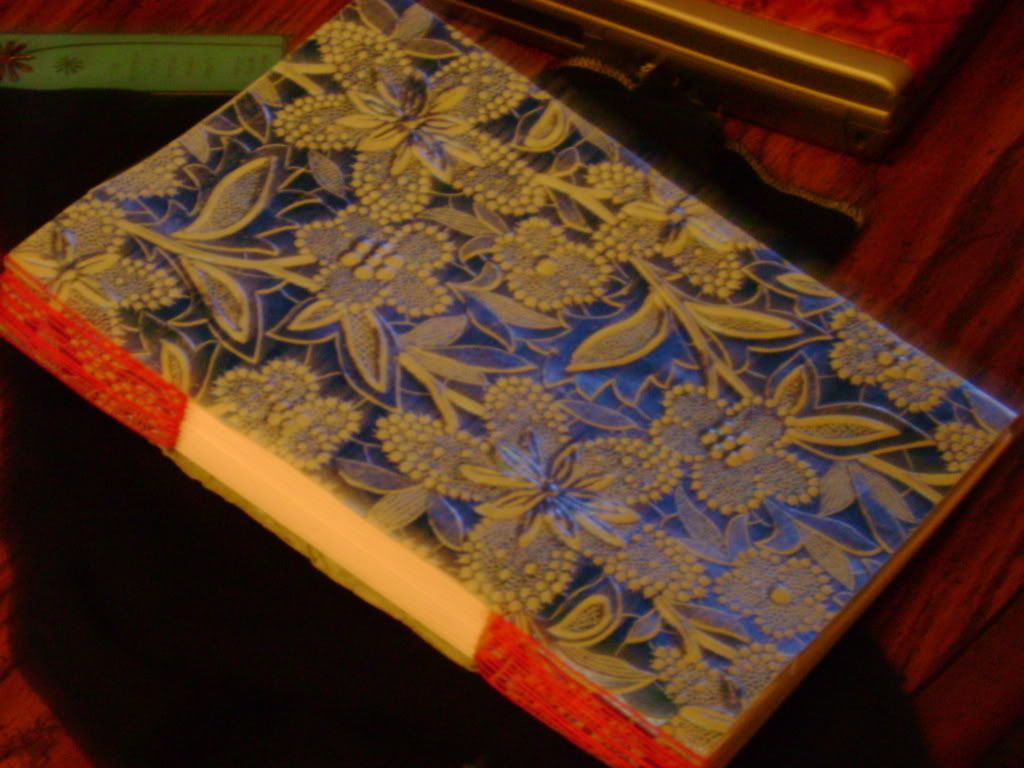
It's a buttonhole binding style--that red thread you see on the spine is how it's sewn together. I gave it to Lance's mom as a birthday gift--it's a simple but beautiful book.
Here's a close-up of the spine:

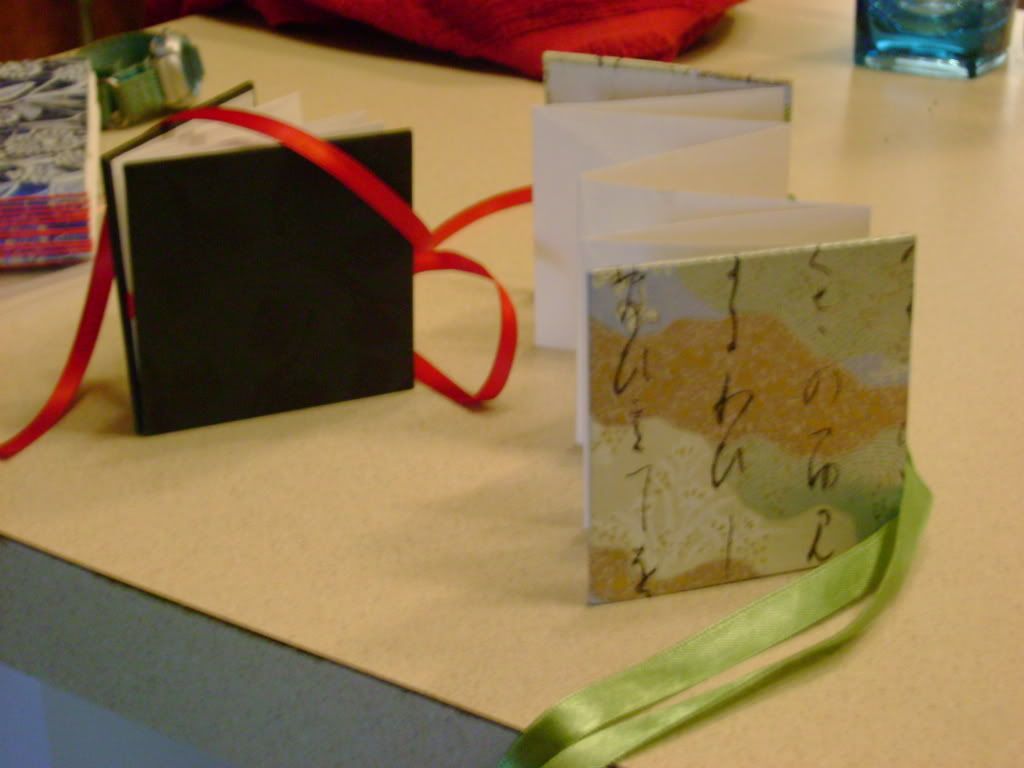
Here's some cute little accordion books--the book has no "spine", and the pages fan out like an accordion:
Here is the Japanese stab-binding, which I mentioned in an earlier post:
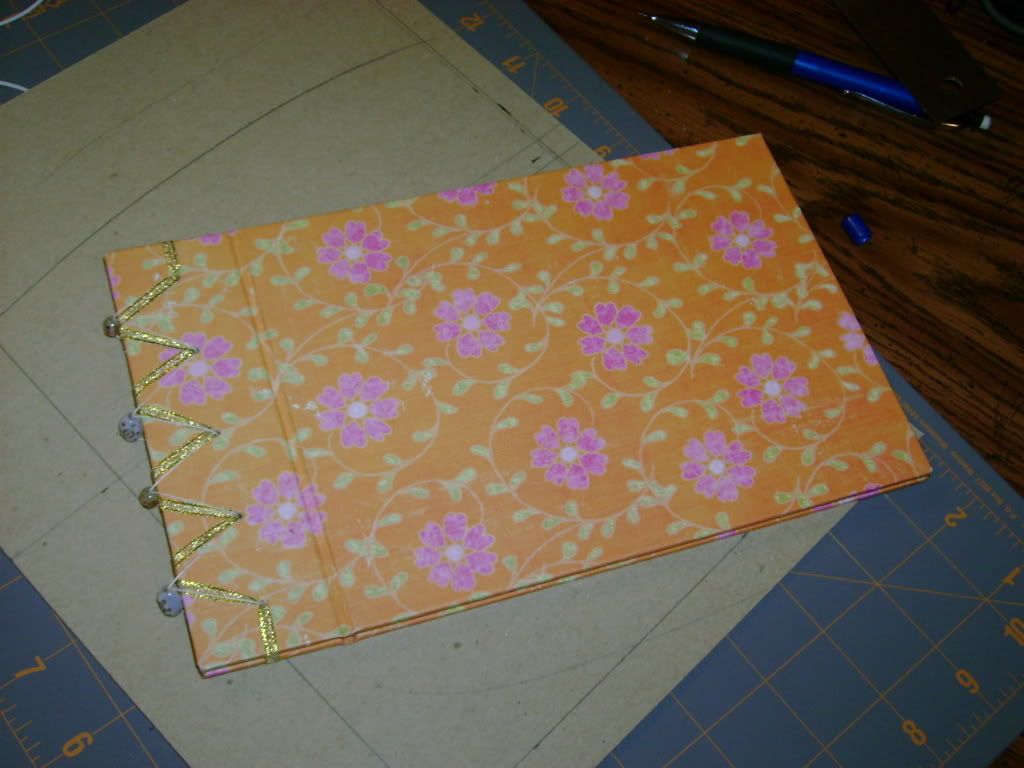
It's a neat book because you can use varied colored ribbons and cool beads on the spine:
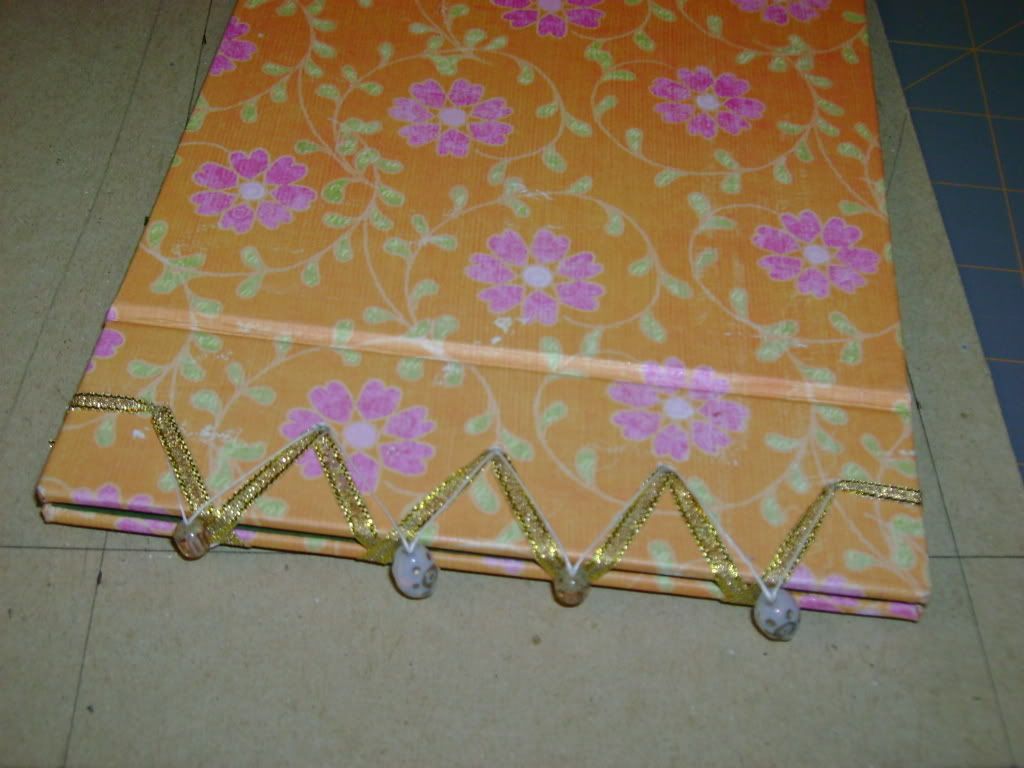
As you can see, there's a lot of versatility when it comes to bookmaking. I'm going to save some of the other books for another post.
Increasingly in the postmodern era (beginning in the modern), authors have started to think about that physical aspect: Joyce was concerned with how his words would look, physically, when laid out on a page for publication. Other authors were affected by the more concrete side of writing--getting paid--so they would write in such a way that would sell. For example, publishers liked to create books that were three volumes in length to get more money from both people who bought books and people who "rented" books through subscription libraries. Publishers would thus pay more for a book that could be three substantial volumes. Some authors would be paid per page, so they would either write more (like Dickens) or write huge amounts of short dialogue to have as much white space on a page as possible, like Edgar Rice Borroughs.
Thus, the physical form of the book can be just as interesting as what's inside. Those lovely leather bound editions of our favorite books appeal to that. Thus, my bookmaking.
Here is one of the first books I made:
It's a buttonhole binding style--that red thread you see on the spine is how it's sewn together. I gave it to Lance's mom as a birthday gift--it's a simple but beautiful book.
Here's a close-up of the spine:
Here's some cute little accordion books--the book has no "spine", and the pages fan out like an accordion:
Here is the Japanese stab-binding, which I mentioned in an earlier post:
It's a neat book because you can use varied colored ribbons and cool beads on the spine:
As you can see, there's a lot of versatility when it comes to bookmaking. I'm going to save some of the other books for another post.
Thursday, February 22, 2007
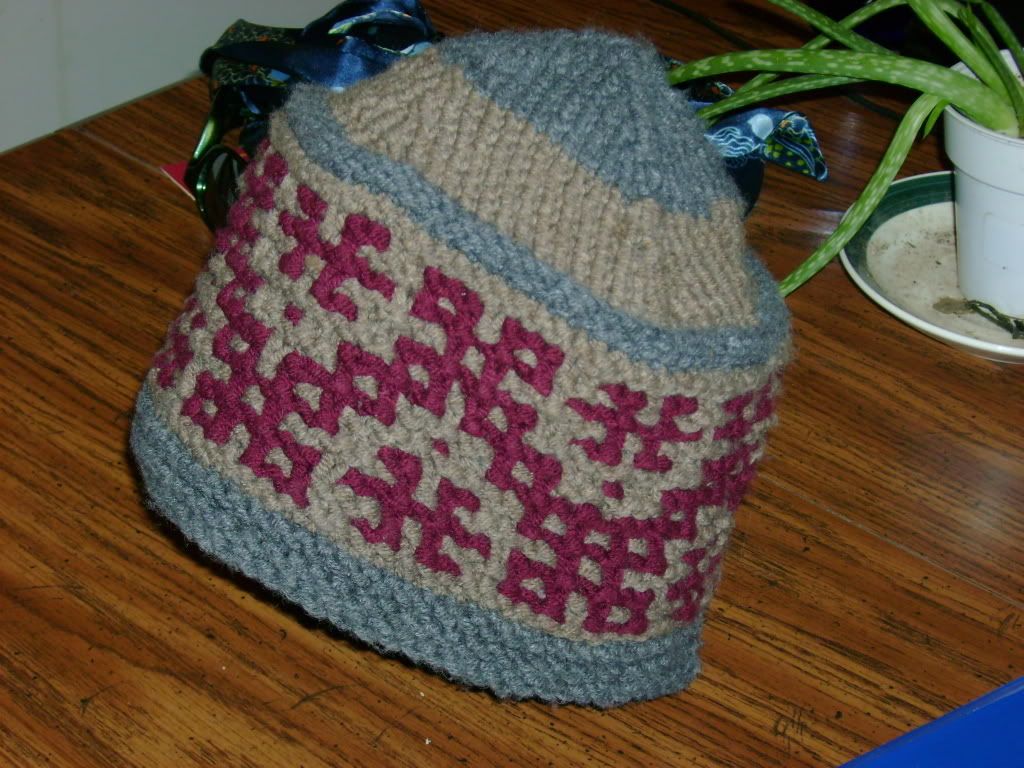
Poem: Oh, Hat
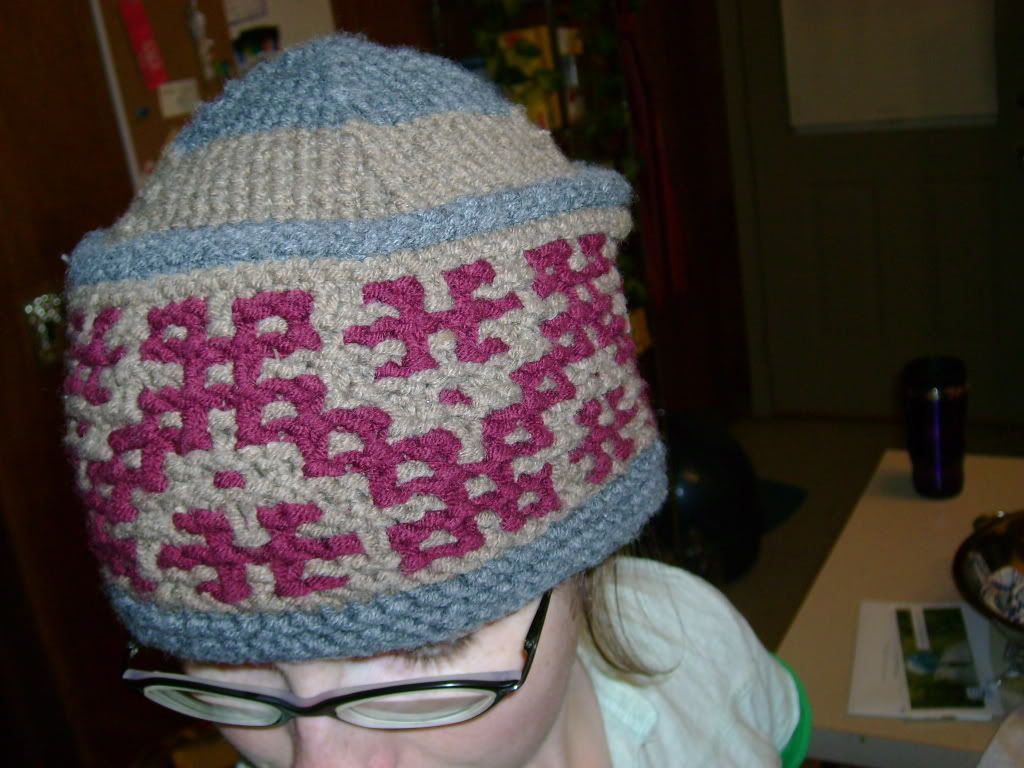
Oh, Hat.
You've plagued me longer than I like--
The child of a whimsy, flimsy promise
That returned to bite me for a year
(and a half).
Oh, Hat.
Look, you have been created,
The bastard child of circular needles,
wool yarn, online pattern, and my
Own imagination.
(And hands).
And there you are, your creation
Completed. You are warm, you are
handsome, you are a good Hat.
I take pride in you, pride in your
Workwomanship, Lovely Hat.
You are the first Hat,
Thus the best one always,
Bearing the fondness of
A First. And as a
Proudly-Worn Love-Gift.
Wednesday, February 21, 2007
Professing Literature: Poetry Lesson Plan
If I had to teach a poetry lesson, I'd teach John Donne. Partly because he's a wonderful writer, partly because he was the first poet I really "got", but mostly because he seems so teachable. I had fun picking out which poems I would teach--I selected "The Good Morrow" because it's one of my favorite poems ever, and two of the "Holy Sonnets" because they're a good mix of religious passion and the physical world. That's part of the beauty of Donne; he is able to use concrete, physical images to approach complex ideas, such as our relationship to the Divine, love, passion, etc.
Our assignment was to come up with a lesson plan on poetry for one class period. Without further ado, I present my lesson plan:
Jenn Miller
ENGL 5803
David Jolliffe
February 21, 2007
Our assignment was to come up with a lesson plan on poetry for one class period. Without further ado, I present my lesson plan:
Jenn Miller
ENGL 5803
David Jolliffe
February 21, 2007
Poetry Lesson Plan: John Donne
Prior to class: Students should have read the poems and responded to them in a journal. The journal is a one page piece of informal writing that asks the students to address the poems in terms of elements that struck them particularly, whether it interested, bored, called up strong emotions of love or distaste, etc. The point of the journal is for them to engage the text. Any lines or elements they did not understand are also good journal material. The journals are an out-of-class assignment to help generate discussion within class.
Focus: To begin class, I will recite “The Good Morrow” from memory, as dramatically as possible. I will briefly touch on personal experiences with the poem’s meaning, introducing the way poetry written almost four centuries ago can still be relevant to a reader, and the way elements in Donne’s poetry can capture a reader’s imagination, intellect, and emotions.
Purpose: By the end of class, students will recognize characteristic elements of Donne’s work: the “metaphysical conceits”, Donne’s use of metaphor (especially his use of concrete, physical images—the metaphysical aspect), his combinations of erotic love and religious passion, his complex and innovative structure, and the reflection of his personal circumstances on the nature of his poetry. Students should also be able to recognize poetic devices such as line breaks, pauses, word choice and other elements that are effective in enhancing the meaning in Donne’s work.
Overview: We’ll begin class with a discussion of journal writings. Afterwards, I’ll lecture briefly on Donne’s life and characteristic elements of his work, using “The Good Morrow” as an example. We’ll then break into groups to review the two remaining poems, and then come back together to discuss them.
Business: Class business, if any, conducted at this time. (Attendance, picking up journals).
Short discussion: what about the poems struck the students as being distinct from other poems they’ve read? Were there elements that confused the students? Did the poems elicit any strong emotions? Were the students able to identify with the speaker in any of the assigned poems?
Brief lecture: The purpose of the lecture is to give details of Donne’s biography and the time period that he lived in, placing him in his historical context (following Shakespeare, writing before Milton, etc) and alerting the students to certain historical conditions (the anti-Catholic nature of England in his life, etc). I’ll use “The Good Morrow” to help define certain terms (metaphysical conceits, etc) as well as demonstrate characteristics of Donne’s poetry, such as his use of broken lines, language, and metaphor. “The Good Morrow” uses the conceit of a world to describe the power of love, which helps the reader access the poem’s meaning.
Group work: Break the students into groups by poems, perhaps two groups to each poem, depending on the size of the class. They will be examining Donne’s use of language, the metaphors he uses in his religious poetry (the two Holy Sonnets), and other elements from the lecture earlier in class. Walk around as they discuss to monitor and offer assistance as needed. After sufficient time, ask each group to share with the class what they’ve discovered within their poem.
Closure: Review what I hope the students have learned about Donne’s work and poetic elements as a whole. Ask the students to continue to think about what makes effective poetry (for perhaps a creative writing assignment later, or an essay). Remind them of any work coming up for the next class period (including journals).
Assigned Poetry: John Donne[1]
“The Good Morrow” (1633)
I wonder, by my troth, what thou and I
Did, till we loved? Were we not weaned till then,
But sucked on country pleasures, childishly?
Or snorted we in the seven sleepers’ den?
‘Twas so; but this, all pleasures fancies be.
If ever any beauty did I see,
Which I desired, and got, ‘twas but a dream of thee.
And now good morrow to our waking souls,
Which watch not one another out of fear;
For love all love of other sights controls,
And makes one little room an everywhere.
Let sea-discoverers to new worlds have gone,
Let maps to others, worlds on worlds have shown:
Let us possess one world; each hath one, and is one.
My face in thine eye, thine in mine appears,
And true plain hearts do in the faces rest;
Where can we find two better hemispheres,
Without sharp North, without declining West?
Whatever dies was not mixed equally;
If our two loves be one, or thou and I
Love so alike that none do slacken, none can die.
From Holy Sonnets
14
Batter my heart, three-personed God; for you
As yet but knock, breathe, shine, and seek to mend;
That I may rise and stand, o’erthrow me, and bend
Your force to break, blow, burn, and make me new.
I, like an usurped town, to another due,
Labor to admit you, but O, to no end;
Reason, your viceroy in me, me should defend,
But is captivated, and proves weak or untrue.
But dearly I love you, and would be loved fain,
But am betrothed unto your enemy,
Divorce me, untie or break that knot again;
Take me to you, imprison me, for I,
Except you enthrall me, never shall be free,
Nor ever chaste, except you ravish me.
17
Since she whom I loved hath paid her last debt
To Nature, and to hers, and my good is dead,
And her soul early into heaven ravished,
Wholly on heavenly things my mind is set.
Here the admiring her my mind did whet
To seek thee, God; so streams do show the head;
But though I have found thee; and thou my thirst hast fed,
A holy thirsty dropsy melts me yet.
But why should I beg more love, whenas thou
Dost woo my soul, for hers offering all thine:
And dost not only fear lest I allow
My love to saints and angels, things divine,
But in they tender jealousy dost doubt
Let the world, flesh, yea, devil put thee out.
Monday, February 19, 2007
I'm Back!
After recovering from a bout of either the flu or the sinus infection (it was diagnosed as the flu, but I suspect that it might not have been), I've returned. Everyone else I read posts much more frequently than I do, so sometimes I feel pressured to put up a post, even if it's not talking about my self-proclaimed blog topics.
I sometimes feel the need to specialize and organize my life to the nth degree--I actually starting a crafting blog, and then decided that I was getting a little too neurotic about categorizing. So while this is still my "academic" space, I think I'm going to expand it to a bit more (so I have more to talk about).
I'm dreadfully behind in my studies: working full-time puts a damper on the amount of time I have to procrastinate before finally settling down to read. I'm taking two classes this semester, so if I relax a little after work or go for a run, then I don't have enough time to do my homework. Then I get stressed, and my boyfriend chides me for taking on too much, since that's what I do. But I also enjoy that other stuff, so I guess I should cut down on the procrastination time...
I'll post more soon about my next assignment in Professing Literature, the horrible book I'm slogging through for Literary Theory, the hat that I made, and bookmaking. That should give me a few posts...
I sometimes feel the need to specialize and organize my life to the nth degree--I actually starting a crafting blog, and then decided that I was getting a little too neurotic about categorizing. So while this is still my "academic" space, I think I'm going to expand it to a bit more (so I have more to talk about).
I'm dreadfully behind in my studies: working full-time puts a damper on the amount of time I have to procrastinate before finally settling down to read. I'm taking two classes this semester, so if I relax a little after work or go for a run, then I don't have enough time to do my homework. Then I get stressed, and my boyfriend chides me for taking on too much, since that's what I do. But I also enjoy that other stuff, so I guess I should cut down on the procrastination time...
I'll post more soon about my next assignment in Professing Literature, the horrible book I'm slogging through for Literary Theory, the hat that I made, and bookmaking. That should give me a few posts...
Thursday, February 08, 2007
Color Swap Questionnaire
Well, though I haven't heard from my pal yet, I've decided to go ahead and post the questionnaire...
Favorite Color Swap Questionnaire
1. What are your top three favorite colors?
Let's see...red is my top favorite color, but I love other bright colors too. The colors I wear a lot are in the pink family (anything from coral to magenta), green (not kelly green, but paler greens), and red.
2. What crafts do you really enjoy?
I LOVE to knit. But I've also recently taken up bookbinding and jewelry making. I'm really loving the bookbinding--its so much fun!
3. What products do you really covet?
Bamboo knitting needles under size 7. And bamboo circular needles...
4. What other activities do you enjoy besides your favorite crafty things?
I'm an avid runner, and I also enjoy yoga, reading books other than books for class (I'm a Masters student in English), and music. I'm always on the hunt for new music.
5. Is there anything you collect?
Ummm...not really...unless you count books.
6. What is your zodiac sign and/or Chinese zodiac symbol?
I'm a Leo/Dog
7.What are your favorite…
…scents/smells?
I like clean scents. Floral scents can be good. Fruits (Like citrus) are usually okay, but I really don't like overpowering smells or wearing things that smell like food. Strong perfumes or incense kinda make my nose itch, so...
…types of music and/or bands?
The Decemberists are currently my favorite band, though I also really enjoy Franz Ferdinand, Lucinda Williams, Phish, Jack Johnson...my tastes are pretty eclectic, and I always enjoy discovering new music.
…authors?
Ha! Can I sooner choose a favorite star from the heavens? Well, okay, if you insist...I enjoy J.R.R. Tolkien (I wrote my thesis on him), Jane Austen, Sir Walter Scott, Ursula LeGuin. See, I told you I can't really pick a favorite...
…animals?
I like all sorts of critters, though if pressed, I would have to say I love horses and cats.
…places to shop?
I really enjoy Target, but also local boutiques--they're so much fun, and you never know what you'll find!--thrift shops, and craft stores. Let us not forget the craft stores...
…season?
Fall. Definitely fall--the colors are gorgeous, the weather is lovely...
…yarn/fabric/paper/other craft supplies?
With the bookmaking, I've been building a good paper supply. I'm always on the outlook for new, cool papers, and also yarn. Can't get enough of that yarn.
…candies or goodies?
Dark chocolate (the good stuff!) and peanut butter M&Ms. Mmmmm. Ginger is pretty good, and I love cranberry. I'm a coffee and tea drinker too...
8. Do you have any wish lists?
Not at the moment...
9. Are you allergic to anything?
Ah, perhaps cigarette smoke and incense.
10. Do you have any pets? What are they?
One cat, Rory, who is a brown/black tabby kitten. I've had her for almost two months now.
11. Please include anything else you would like your secret pal to know about you- anything that would be helpful in finding you little gifts that you will really enjoy.
Mmm...it's always hard to think of things...I guess if you want to know anything, just let me know!
Favorite Color Swap Questionnaire
1. What are your top three favorite colors?
Let's see...red is my top favorite color, but I love other bright colors too. The colors I wear a lot are in the pink family (anything from coral to magenta), green (not kelly green, but paler greens), and red.
2. What crafts do you really enjoy?
I LOVE to knit. But I've also recently taken up bookbinding and jewelry making. I'm really loving the bookbinding--its so much fun!
3. What products do you really covet?
Bamboo knitting needles under size 7. And bamboo circular needles...
4. What other activities do you enjoy besides your favorite crafty things?
I'm an avid runner, and I also enjoy yoga, reading books other than books for class (I'm a Masters student in English), and music. I'm always on the hunt for new music.
5. Is there anything you collect?
Ummm...not really...unless you count books.
6. What is your zodiac sign and/or Chinese zodiac symbol?
I'm a Leo/Dog
7.What are your favorite…
…scents/smells?
I like clean scents. Floral scents can be good. Fruits (Like citrus) are usually okay, but I really don't like overpowering smells or wearing things that smell like food. Strong perfumes or incense kinda make my nose itch, so...
…types of music and/or bands?
The Decemberists are currently my favorite band, though I also really enjoy Franz Ferdinand, Lucinda Williams, Phish, Jack Johnson...my tastes are pretty eclectic, and I always enjoy discovering new music.
…authors?
Ha! Can I sooner choose a favorite star from the heavens? Well, okay, if you insist...I enjoy J.R.R. Tolkien (I wrote my thesis on him), Jane Austen, Sir Walter Scott, Ursula LeGuin. See, I told you I can't really pick a favorite...
…animals?
I like all sorts of critters, though if pressed, I would have to say I love horses and cats.
…places to shop?
I really enjoy Target, but also local boutiques--they're so much fun, and you never know what you'll find!--thrift shops, and craft stores. Let us not forget the craft stores...
…season?
Fall. Definitely fall--the colors are gorgeous, the weather is lovely...
…yarn/fabric/paper/other craft supplies?
With the bookmaking, I've been building a good paper supply. I'm always on the outlook for new, cool papers, and also yarn. Can't get enough of that yarn.
…candies or goodies?
Dark chocolate (the good stuff!) and peanut butter M&Ms. Mmmmm. Ginger is pretty good, and I love cranberry. I'm a coffee and tea drinker too...
8. Do you have any wish lists?
Not at the moment...
9. Are you allergic to anything?
Ah, perhaps cigarette smoke and incense.
10. Do you have any pets? What are they?
One cat, Rory, who is a brown/black tabby kitten. I've had her for almost two months now.
11. Please include anything else you would like your secret pal to know about you- anything that would be helpful in finding you little gifts that you will really enjoy.
Mmm...it's always hard to think of things...I guess if you want to know anything, just let me know!
Wednesday, February 07, 2007
Literary Missionary
This was an assignment for my Professing Literature class, the subject of which was "On Me as a Student of Literature."
I easily could have been a non-reader. After all books—through available in my home—were not cherished by anyone in my family. I was not read to, encouraged to read, or given books to promote a reading lifestyle; I was merely left alone with access to a shelf full of books that my parents had acquired with the vague notion that owning literature was good, similar to the concept that families should attend church or own a family Bible for their moral well-being. Out of five children, I alone read voraciously, wolfing down books as fast as I could gulp. I clearly remember my first reading experience: Morris Goes to School, a book about Morris the Moose, well, going to school. I was in kindergarten and not “supposed” to be reading yet, but there I was enjoying this book. My first chapter book was Charlotte’s Web, a book that we later read as a class in third grade, and a book that got me accused of not actually reading because I was able to read it so quickly.
I can’t remember a time when I wasn’t reading. I loved the feeling I got when I read a particularly captivating book, the feeling of being absorbed into the written page, the “willing suspension of disbelief” or being pulled into a “secondary world” as Tolkien describes in his beautiful essay “On Fairy Stories”. High points, low points, and silly points were bookmarked by some literary work. I empathized with Jane Eyre when I was childishly infatuated with an older man; conversely, I finally understood John Donne’s “The Good Morrow” when I fell in love and found myself loved in return. I trailed my self-conscious girl heroes in Robin McKinley’s The Blue Sword and The Hero and the Crown, and I grew up with Anne of Green Gables. I read great literature, mediocre literature, challenging literature, stupid literature, books that made me think, cry, hate, love, works that inspired anger and brought great joy. I always carried a book (or two) with me—I never knew when I’d need one—and my parents took away my books to punish me.
I drank in books in long draughts and thirsted for more, but interestingly I was a mediocre English student until my senior year of high school. I was one of those unexceptionally brilliant teenagers; you know, the ones who know how to take the tests and bother to do the assignments but are really only parroting. I excelled in science and wanted to teach biology or chemistry (or both), for studying literature was a dull, unending track of reading, writing, vocabulary and pointless sentences to copy down and correct in a notebook. Who cared? Certainly not my teachers.
Enter Mrs. Galligan, my senior AP English teacher. She taught me to love John Donne with unequivocal passion, delight in the beauties and intricacies of Shakespeare. She got me to read Shakespeare on my own—Twelfth Night, King Lear, A Midsummer Night’s Dream—and because of her guidance, I wrote an interesting paper (for a high-school student) about King Lear and Jane Smiley’s A Thousand Acres. That paper was my introduction to literary criticism and academic writing, and began teaching me a way of reading that extended beyond plot. She made me learn; she made me love, and I left to attend college as a chemistry/biology major.
Wait, as what? Yes, that’s right; Mrs. Galligan had only planted the seed of loving literary studies, but I still wanted science. (For one, it was so much more safe and certain than literature, and I was sure to get a job). It wasn’t until about half-way through my first semester that I discovered that I liked science well enough, but I loved English. I loved writing, I loved talking about literature, and I loved helping other people write better. My epiphany came, actually, while I was in the middle of peer-editing and I felt satisfaction deep in my spirit. I use the word epiphany carefully because the experience was akin to a religious moment. It was as though I was traveling down the road of Science, only to be struck blind with the light of all that English had to offer me. Like any new convert, I struggled at first with giving up the old ways—I couldn’t change my major!—but I soon settled into my new path with a contentment and passion I’d never had before.
I was therefore determined to become a literary missionary, and the goal of my outreach would be high school students. After all, had I not suffered at the hands of countless years of incompetent, uncaring English teachers? I would save others from that fate, and help them discover the truth and joy that literature could bring. Then I discovered that the majority of high school students didn’t care. Why should they? I went to my internship hours at various public schools with the growing feeling that I wouldn’t be happy teaching in a public school. There were restrictions on what you could teach; you had to teach grammar and other state-mandated curriculum topics. With a sinking feeling, as I continued on in my education classes, I realized that I would be an unhappy, potentially bored English teacher. I wanted my profession to be something that in which I could grow, develop into a better scholar, and fulfill my own needs as a passionate lover of literature, while also helping others.
I knew I was “good” at English; I made high grades in all of my classes and was praised by my professors. (I always had the vague anxiety that I was repeating the mistakes of my youth, however, simply parroting back to the teachers what they wanted to know, never creating anything new for myself). My honors thesis adviser encouraged me to think about graduate school. “You have the skills to be a good scholar,” he enthused as I shared insights on The Lord of the Rings with him each week, connecting Tolkien’s work with Aristotle, Hegel, Dostoevsky, and others I encountered. Other signs appeared before me in the forms of friends who thought I would be a miserable high school teacher, or the English department chair who listened to my passion for my studies and said, “You would be a very happy graduate student.” I scoffed; being a teacher was my calling after all, and who was I to oppose a divine injunction? Education was what I wanted to do because I could see myself doing nothing else.
Yes, I still believe it’s my calling, but I began to realize I clung to the hope of teaching high school English because it was secure. I knew that I could find a job somewhere, anywhere…but graduate school meant more years of moving, living as a student, the roaming scholar who relied on the bounty of others. In my heart, though, I realized it was what I wanted. I wanted to keep pursuing learning, grasping new knowledge with both hands, absorbing ideas and theories as I read those books so long ago. It appeared to me in another epiphany: I had registered for my first semester of practicum, when I’d be taking almost all education courses and interning at a public high school, and it clicked—I didn’t want that. My friend Shannon was the push I needed because as I was talking to her about my dilemma (to teach or not to teach—high school, anyway) I became increasingly convicted that my place was in higher education. I hoped so anyway, because part of me sniggered and accused myself of being too afraid to face the lion’s den of the public school system. I thought of the satisfaction of belonging to a profession that requires its members to be both scholars and teachers. The more I thought about it, the more I realized it was what I wanted to be—a professor of literature.
I’m on my way to becoming that literary missionary in both the capacity of the wise professor wielding knowledge and the eternal student questing to know more. Of late, I’ve begun to ask But to what purpose? but haven’t found the answer to that question. All I know is that I love studying, I love teaching, and I want to pursue a field that would allow me to do what I love in a way that can (maybe) bring joy to others. Perhaps the clues lie in Robert Scholes’ attempt to have us rethink the concept of English as a discipline; perhaps my place would be in helping the profession move forward in subtle ways. Ultimately, perhaps the answer is merely that by doing something that I’m wildly passionate about, I would be a small light to others on the value of literary studies and English as a whole.
Friday, February 02, 2007
Prose: Teaching Knitting
I began my boyfriend's hat yesterday, the one that's been looming before me as the penultimate goal of my knitting career. Penultimate because obviously there will be another knitting project that is more important and watched for with greater anticipation than his hat (I just don't know what it is yet).
So I begin the hat. It's my first project "knitting on the round" or rather, using circular needles. I already goofed the joining, but the rest looks good, so I suppose I got the knack of it. I may pull it all out, or use it to make sure I'm even making it close to the right size--the danger of using circular needles being the size is a secret until you've knit for quite some time. This hat has been bothering me in the form of my boyfriend for over a year now, when we bought some yarn and he jumped up and down with glee in the aisle of Hobby Lobby when I said I would make him a hat. Every time I'd start a new project, I'd hear about how his head was cold, how he wished he had a great wool hat to keep his curls warm...
But this is not a tale of the perpetually unknit knit hat: this is a story of how I taught my boyfriend to knit. It all began with my roommate holding a set of my needles curiously and looking through my handy-dandy knitting guide (I have a small spiral bound one that I whip out to learn all sorts of interesting things, like cable cast-on or how to do an increase or decrease). She wanted to learn, so I asked, "Do you want me to teach you how to knit?" "Yes!" she exclaimed, as she was looking for a way to escape her history texts and enjoy her snow day. Lance looked at me tellingly, so I asked him to, which made him say, "Yes, me too!"
Thus commenced the knitting lesson. I made them cast-on (over and over again) until they got it down. I had to get Sarah to reverse her hands (she apparently will knit "backwards" or left-handed), and Lance quickly progressed to purling. I swear, he is the best first-time knitter I've ever seen--his practice swatch was only a little crooked on his cast-on row. He's a mechanical engineer with an amazing ability for spatial orientation--and what is knitting but a spatial skill?--and he was able to capture the big picture of what knitting does in addition to being able to creatively add to what I taught him. The knitting circle has increased by two.
Lance started planning all his projects, and asking me questions about how things are done. I had the challenge of a bright student, and as a bright student, he of course tried to overstep what he knows by asserting he could knit a circle (not a tube like his hat, but an actual circle). Ah, haha, he will learn soon enough what he can and cannot do. I felt the slight tremor that a teacher can feel when faced with a particularly promising pupil that perhaps he'll soon overtake my skill--and I'll have nothing left to teach because he will be become better than me!--but I realized that for now, I have the advantage of several years of experience and knowing how to read the charts. So I have time to reconcile myself to the prospect of his surpassing my knowledge, and time to come around to the idea that it's okay if he does because I can then just learn from him.
I look forward to more cold afternoons and evenings with my knitting pupils and watching them grow in skill and confidence as they knit toward their first projects. I'm a teacher by nature, and I love being able to pass my passions along to those around me, whether it be literature and writing, or knitting.
So I begin the hat. It's my first project "knitting on the round" or rather, using circular needles. I already goofed the joining, but the rest looks good, so I suppose I got the knack of it. I may pull it all out, or use it to make sure I'm even making it close to the right size--the danger of using circular needles being the size is a secret until you've knit for quite some time. This hat has been bothering me in the form of my boyfriend for over a year now, when we bought some yarn and he jumped up and down with glee in the aisle of Hobby Lobby when I said I would make him a hat. Every time I'd start a new project, I'd hear about how his head was cold, how he wished he had a great wool hat to keep his curls warm...
But this is not a tale of the perpetually unknit knit hat: this is a story of how I taught my boyfriend to knit. It all began with my roommate holding a set of my needles curiously and looking through my handy-dandy knitting guide (I have a small spiral bound one that I whip out to learn all sorts of interesting things, like cable cast-on or how to do an increase or decrease). She wanted to learn, so I asked, "Do you want me to teach you how to knit?" "Yes!" she exclaimed, as she was looking for a way to escape her history texts and enjoy her snow day. Lance looked at me tellingly, so I asked him to, which made him say, "Yes, me too!"
Thus commenced the knitting lesson. I made them cast-on (over and over again) until they got it down. I had to get Sarah to reverse her hands (she apparently will knit "backwards" or left-handed), and Lance quickly progressed to purling. I swear, he is the best first-time knitter I've ever seen--his practice swatch was only a little crooked on his cast-on row. He's a mechanical engineer with an amazing ability for spatial orientation--and what is knitting but a spatial skill?--and he was able to capture the big picture of what knitting does in addition to being able to creatively add to what I taught him. The knitting circle has increased by two.
Lance started planning all his projects, and asking me questions about how things are done. I had the challenge of a bright student, and as a bright student, he of course tried to overstep what he knows by asserting he could knit a circle (not a tube like his hat, but an actual circle). Ah, haha, he will learn soon enough what he can and cannot do. I felt the slight tremor that a teacher can feel when faced with a particularly promising pupil that perhaps he'll soon overtake my skill--and I'll have nothing left to teach because he will be become better than me!--but I realized that for now, I have the advantage of several years of experience and knowing how to read the charts. So I have time to reconcile myself to the prospect of his surpassing my knowledge, and time to come around to the idea that it's okay if he does because I can then just learn from him.
I look forward to more cold afternoons and evenings with my knitting pupils and watching them grow in skill and confidence as they knit toward their first projects. I'm a teacher by nature, and I love being able to pass my passions along to those around me, whether it be literature and writing, or knitting.
Thursday, January 18, 2007
The Beauty of Writing on a Blog
Blogs get a lot of criticism, even from me who writes in several online spaces. It's easy to get sucked into the trap of almost unconscious writing, or worse: the sort of gibberish that I lament is killing the minds of teenagers everywhere, IM-lingo. (Uggh, I hate it). However, Donna's post from yesterday made me think about the purpose of blogging.
And I realized even when I'm being "intellectual", it's a release of pent-up word energy. It's a way for me to write in a forum where there are no critics (harsh ones anyway), no professors to grade what I write, and if someone disagrees with me, so what? I can alternate my roles from reader, creative writer, book critic, book lover, and thinker, switching from scholar to curious individual (or some combination therein) with each entry I form. I can hope that others read and enjoy my entries, but in the end it doesn't actually matter.
The beauty of writing on a blog--to play, to grow, to learn. It can be a lovely thing, this blogging on varied interests, developing a writing style. Those writing teachers always say "write everyday" (or something like that) and blogging provides an incentive to do so, with the added charm that an audience exists out there in the Interwebs to read, enjoy, and learn with me. My pent-up word energy is out, and I'm better for it because I'm making it available for other eyes, giving me an audience to write for, even if they are only in my mind.
And I realized even when I'm being "intellectual", it's a release of pent-up word energy. It's a way for me to write in a forum where there are no critics (harsh ones anyway), no professors to grade what I write, and if someone disagrees with me, so what? I can alternate my roles from reader, creative writer, book critic, book lover, and thinker, switching from scholar to curious individual (or some combination therein) with each entry I form. I can hope that others read and enjoy my entries, but in the end it doesn't actually matter.
The beauty of writing on a blog--to play, to grow, to learn. It can be a lovely thing, this blogging on varied interests, developing a writing style. Those writing teachers always say "write everyday" (or something like that) and blogging provides an incentive to do so, with the added charm that an audience exists out there in the Interwebs to read, enjoy, and learn with me. My pent-up word energy is out, and I'm better for it because I'm making it available for other eyes, giving me an audience to write for, even if they are only in my mind.
Wednesday, January 17, 2007
Fem Lit--or, The Only Place Feminist Criticism is Welcome
I've stated before that I dislike feminist criticism. It's not that I dislike feminism (I occasionally fancy myself a bit of a feminist--but wouldn't you, growing up in a conservative family with four brothers?) but rather their often over-reaching approaches and their snooty jargon. They always seem to be glaring at me, frowning at my knitting and domestic pride, and my lack of desire to read everything as men trying to screw me. It's just not how I think, okay?
However, feminist literature is certainly a valid field for feminist theory--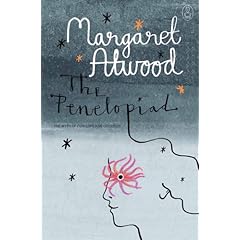 since it's feminist theory turned narrative. So, without further ado, I delve into an exploration of Margaret Atwood's The Penelopiad. It's a modern, feminist retelling of The Odyssey from the perspective of Penelope. But she's dead when she's telling it, which brings all sorts of interesting implications. She opens by declaring that's she's dead, and thus knows everything. If that's true, then why does she spend so much of her time wondering why her twelve maids were killed, why Eurycleia picked them to be hanged, and other incidents during her mortal existence.
The Penelopiad is written from women's voices, alternating between Penelope with the twelve hanged maid serving as a chorus. It also brings in the voice of Helen, her beauty queen cousin. The maids were hanged for certain sexual crimes and insolence against their master, and they are bent on avenging their deaths. Their chorus both supports the tale that Penelope spins, and undermines it until the reader is caught trying to figure out the truth along with Penelope--a truth that, in typically feminist, is never arrived at.
The feminism within the work is carefully plotted. Penelope occasionally mentions ideas from her Greek society that seem almost preposterous to us--the father "selling" his daughter to the man who can win the contest; the maids whose lot (if they are especially young and pretty) is to be raped and sexually used by their master and perhaps his guests; and the role of a young noblewoman in marriage. On her wedding night, Penelope has to pretend to scream like she's being raped to satisfy the ceremonial wedding rites. This is a story where women are property, their bodies are not their own, and men control them and their lives. In the case of the twelve maids, they are hung by Odysseus after he kills the suitors.
And yet, not quite. Atwood teases out another story through the chorus of maids, asserting that they are not the Twelve Maids, but the Twelve Maidens of the goddess Artemis, the feminine goddess of chastity, the moon, the huntress who takes no man. And as there are thirteen lunar months, Penelope is the Queen of them, which she indeed has claimed all throughout the book that these Twelve are her special, beautiful, chosen maids, trained by her and used by her to keep the Suitors at bay. Then the story becomes about the repression of the cult of the Moon-goddess and a further dominance of the patriarchy.
And then the further question--did Penelope sleep with any of the Suitors? It would be difficult to resist a little dalliance, Atwood seems subtly to assert, when her husband has been gone for twenty years. The maids declare outright that they helped her in her infidelity, while Penelope maintains that she was never unfaithful to her husband, even when she heard he was off sleeping with beautiful goddesses. Or whores, if you don't believe the "high" version of the tale. But then she undermines herself by linking herself with Odysseus, the honey-tongued liar. Does she lie, or tell the truth? Apparently even dead she still buries some of the voices of her tale.
The novella is a rich and imaginative creation by one of my favorite feminist authors (read The Handmaid's Tale). A modern feminist revision of an ancient patriarchal tale offers up the sort of ideas that are easily read using feminist theories, and the most productive.
However, feminist literature is certainly a valid field for feminist theory--
since it's feminist theory turned narrative. So, without further ado, I delve into an exploration of Margaret Atwood's The Penelopiad. It's a modern, feminist retelling of The Odyssey from the perspective of Penelope. But she's dead when she's telling it, which brings all sorts of interesting implications. She opens by declaring that's she's dead, and thus knows everything. If that's true, then why does she spend so much of her time wondering why her twelve maids were killed, why Eurycleia picked them to be hanged, and other incidents during her mortal existence.The Penelopiad is written from women's voices, alternating between Penelope with the twelve hanged maid serving as a chorus. It also brings in the voice of Helen, her beauty queen cousin. The maids were hanged for certain sexual crimes and insolence against their master, and they are bent on avenging their deaths. Their chorus both supports the tale that Penelope spins, and undermines it until the reader is caught trying to figure out the truth along with Penelope--a truth that, in typically feminist, is never arrived at.
The feminism within the work is carefully plotted. Penelope occasionally mentions ideas from her Greek society that seem almost preposterous to us--the father "selling" his daughter to the man who can win the contest; the maids whose lot (if they are especially young and pretty) is to be raped and sexually used by their master and perhaps his guests; and the role of a young noblewoman in marriage. On her wedding night, Penelope has to pretend to scream like she's being raped to satisfy the ceremonial wedding rites. This is a story where women are property, their bodies are not their own, and men control them and their lives. In the case of the twelve maids, they are hung by Odysseus after he kills the suitors.
And yet, not quite. Atwood teases out another story through the chorus of maids, asserting that they are not the Twelve Maids, but the Twelve Maidens of the goddess Artemis, the feminine goddess of chastity, the moon, the huntress who takes no man. And as there are thirteen lunar months, Penelope is the Queen of them, which she indeed has claimed all throughout the book that these Twelve are her special, beautiful, chosen maids, trained by her and used by her to keep the Suitors at bay. Then the story becomes about the repression of the cult of the Moon-goddess and a further dominance of the patriarchy.
And then the further question--did Penelope sleep with any of the Suitors? It would be difficult to resist a little dalliance, Atwood seems subtly to assert, when her husband has been gone for twenty years. The maids declare outright that they helped her in her infidelity, while Penelope maintains that she was never unfaithful to her husband, even when she heard he was off sleeping with beautiful goddesses. Or whores, if you don't believe the "high" version of the tale. But then she undermines herself by linking herself with Odysseus, the honey-tongued liar. Does she lie, or tell the truth? Apparently even dead she still buries some of the voices of her tale.
The novella is a rich and imaginative creation by one of my favorite feminist authors (read The Handmaid's Tale). A modern feminist revision of an ancient patriarchal tale offers up the sort of ideas that are easily read using feminist theories, and the most productive.
Friday, January 12, 2007
Knitting, Delurking, and other Non-Literature Things
So...
This is my "literature blog". However, I don't write on it unless I have something burning about books to talk about. So I think I'm going to make more use of that prose bit of my title and write about a variety of my interests. Because my interests are many.
Take knitting for example. I've recently been caught in a wave of knitting madness: Donna is learning (yay!), and she introduced me to the Secret Knitter, who recently decided to secretly knit scarves for his family, and has since been hooked on knitting. My own knitting history began when I taught myself how to knit my junior year of college, knit a bazillion garter-stitch scarves, got bored, made my first project from a pattern, and have been tinkering ever since (I love stitch patterns). Here is one product of my tinkering:
There's a feeling that emerges from designing and creating a new thing. This didn't exist before I made it (it may have been available in other forms, but this particular manifestation emerged from the fusion of my mind and my knitting needles). And the story behind it is fun: my friend and bookbinding teacher offered to swap one iPod cozy for a bookbinding class (Japanese stab-binding, which I'll be using for a wedding guest book for two of my friends). So, I thought of a design that would be useful and cute (I own an iPod nano, so that was pretty easy), and out it popped. I like it.
Incidentally, if I have any blog lurkers, it's National Delurking Week. So leave a message and say "hi!" Thanks!
This is my "literature blog". However, I don't write on it unless I have something burning about books to talk about. So I think I'm going to make more use of that prose bit of my title and write about a variety of my interests. Because my interests are many.
Take knitting for example. I've recently been caught in a wave of knitting madness: Donna is learning (yay!), and she introduced me to the Secret Knitter, who recently decided to secretly knit scarves for his family, and has since been hooked on knitting.
My own knitting history began when I taught myself how to knit my junior year of college, knit a bazillion garter-stitch scarves, got bored, made my first project from a pattern, and have been tinkering ever since (I love stitch patterns). Here is one product of my tinkering:There's a feeling that emerges from designing and creating a new thing. This didn't exist before I made it (it may have been available in other forms, but this particular manifestation emerged from the fusion of my mind and my knitting needles). And the story behind it is fun: my friend and bookbinding teacher offered to swap one iPod cozy for a bookbinding class (Japanese stab-binding, which I'll be using for a wedding guest book for two of my friends). So, I thought of a design that would be useful and cute (I own an iPod nano, so that was pretty easy), and out it popped. I like it.
Incidentally, if I have any blog lurkers, it's National Delurking Week. So leave a message and say "hi!" Thanks!
Tuesday, January 02, 2007
Weirdness
Donna, I suppose in an attempt to get me to post, has tagged Amanda and me to post six weird things. But these are not just any six weird things, but six weird things that relate to graduate school and English literature. So without further ado:
1.) When I'm reading something, I often talk out loud in order to think. However, I only do this when someone else is in the room; otherwise, my thoughts are written or kept internal. They often think I'm actually talking to them (and I usually direct my comments in their direction), but really I'm just thinking out loud.
2.) When I'm doing research, I attack books (especially ones I shouldn't write in) with tiny Post-it Notes. Sometimes the notes just mark a spot that I'll cite in my paper. Mostly, I scribble little notes on them. I do this a lot with each book, so when I'm done, the book has a zillion varied colored notes sticking out all over it.
3.) I'm obsessed with office supplies. I love Post-it Notes, pens, pencils, erasers, staplers, notebooks, and all forms of supplies. I especially love Post-it Notes. Every year, I have to resist buying spiral bound notebooks when they're on sale (10 for a dollar! Sweet!) since I have a plastic storage tub full of them. The Boyfriend mocks me for them, and for my office supply obsession. Luckily, being in graduate school means I have to buy office supplies every now and then...
4.) Whenever I find another person as obsessed as me about literature, I hop up and down and squeal. I get really excited about finding other literature lovers. In fact, I found one over Christmas, and he was as excited as me to find another English MA student, so perhaps that's not so weird after all...
5.) I HATE feminist criticism. I like feminists, though. Or feminism, at least. But feminist criticism? Drives me insane. I hate it. I hate how they ignore the text, skew everything to be about feminine oppression, and how they use terms like "the father", "phallocentric", etc. to interpret literature. Sometimes their points are valid, but for the most part, I have little use for them.
6.) I tend to relate things in real life to books I'm currently reading/obsessed with. Sometimes, it carries on to such a degree that those around me roll their eyes and wonder how they put up with my zaniness and nerdyness. I also tend to relate other books I'm reading to books I've just read, coming up with some odd connections that please me in an intangibly, indescribably satisfying way.
Now, who to tag? There are relatively few people, I believe, who read this blog, so...Michael, you're the only one. Do it. Do it now. And to take a page from Donna, you have to relate your six things to technologically based weirdness...
1.) When I'm reading something, I often talk out loud in order to think. However, I only do this when someone else is in the room; otherwise, my thoughts are written or kept internal. They often think I'm actually talking to them (and I usually direct my comments in their direction), but really I'm just thinking out loud.
2.) When I'm doing research, I attack books (especially ones I shouldn't write in) with tiny Post-it Notes. Sometimes the notes just mark a spot that I'll cite in my paper. Mostly, I scribble little notes on them. I do this a lot with each book, so when I'm done, the book has a zillion varied colored notes sticking out all over it.
3.) I'm obsessed with office supplies. I love Post-it Notes, pens, pencils, erasers, staplers, notebooks, and all forms of supplies. I especially love Post-it Notes. Every year, I have to resist buying spiral bound notebooks when they're on sale (10 for a dollar! Sweet!) since I have a plastic storage tub full of them. The Boyfriend mocks me for them, and for my office supply obsession. Luckily, being in graduate school means I have to buy office supplies every now and then...
4.) Whenever I find another person as obsessed as me about literature, I hop up and down and squeal. I get really excited about finding other literature lovers. In fact, I found one over Christmas, and he was as excited as me to find another English MA student, so perhaps that's not so weird after all...
5.) I HATE feminist criticism. I like feminists, though. Or feminism, at least. But feminist criticism? Drives me insane. I hate it. I hate how they ignore the text, skew everything to be about feminine oppression, and how they use terms like "the father", "phallocentric", etc. to interpret literature. Sometimes their points are valid, but for the most part, I have little use for them.
6.) I tend to relate things in real life to books I'm currently reading/obsessed with. Sometimes, it carries on to such a degree that those around me roll their eyes and wonder how they put up with my zaniness and nerdyness. I also tend to relate other books I'm reading to books I've just read, coming up with some odd connections that please me in an intangibly, indescribably satisfying way.
Now, who to tag? There are relatively few people, I believe, who read this blog, so...Michael, you're the only one. Do it. Do it now. And to take a page from Donna, you have to relate your six things to technologically based weirdness...
Wednesday, December 20, 2006
My Recent Reads--Jane Austen
As you know from my last post, school is done for the semester. As a habitual reader, I find it strange to not constantly have some book in my purse, so I borrowed Northanger Abbey (Jane Austen) from a friend and bought Persuasion. Yes, I'm going on a Jane Austen reading spree. I decided to go on the Austen-fest after reading both Sense and Sensibility and Emma one right after the other, and loving both immoderately.
Austen is stereotyped as a chick-lit writer, or as a writer who only talks about family and marriage and the troubles her characters get into because of both. However, I'm a firm believer that Austen is much smarter than that. Her books may appear to be books about young ladies getting married off to live in happiness and fortune, but they also contain so much more.
I'm in the middle of Northanger Abbey right now, and it's a witty, sarcastic, fantastic novel. Catherine Morland stars as the heroine of this not-so-Gothic Gothic novel. Austen plays on the conventions of the Gothic novel, dismantling them and exposing them as silly, irrational, though interesting . And when she launches into a several page defense of reading novels (those sensational things that most ladies of good breeding would never admit to reading), the reader and scholar in me admits that there is so much thematically to her writing.
I'll post again when I'm finished.
Austen is stereotyped as a chick-lit writer, or as a writer who only talks about family and marriage and the troubles her characters get into because of both. However, I'm a firm believer that Austen is much smarter than that. Her books may appear to be books about young ladies getting married off to live in happiness and fortune, but they also contain so much more.
I'm in the middle of Northanger Abbey right now, and it's a witty, sarcastic, fantastic novel. Catherine Morland stars as the heroine of this not-so-Gothic Gothic novel. Austen plays on the conventions of the Gothic novel, dismantling them and exposing them as silly, irrational, though interesting . And when she launches into a several page defense of reading novels (those sensational things that most ladies of good breeding would never admit to reading), the reader and scholar in me admits that there is so much thematically to her writing.
I'll post again when I'm finished.
Monday, December 11, 2006
An Excerpt of My Final Paper
Because I worked really hard on it, I wanted to share my favorite excerpts of my paper:
The Bride of Lammermoor: An Introduction
The Bride of Lammermoor: An Introduction
As with many of Scott’s novels, The Bride of Lammermoor begins not with the central story but with an introduction or a frame tale. Here, Peter Pattieson, the fictitious writer of The Tales of My Landlord tells the sad story of his friend, Dick Tinto. Tinto begins his artistic career as a sign painter (5-6). Following his aspirations, Tinto later attempts to enter the art scene but dies in obscurity as a failure (9-10). Following Tinto’s brief history, Pattieson describes a debate he had with Tinto about the representation in the novel—a theme that carries throughout The Bride. Tinto criticizes Pattieson for creating characters who “make too much use of the gob-box” (10) to which Pattieson retorts, “how is it possible for an author to introduce his personae dramatis to his readers in a more interesting and effectual manner…?” (11). He then follows with the argument that Tinto “confounded the operations of the pencil and the pen” (11) [1]. Following the debate, Tinto takes out a sketch, thinking that in a flash of insight Pattieson would immediately understand the story he tries to tell on canvas (12-3). Tinto is disappointed, declaring, “I would swear you had been born blind,” (13) and then reveals the subject to a tale told to him by an “aged goodwife” that Pattieson uses as the subject for The Bride (14).
The exchange between Pattieson and Tinto reveals concerns about oral history and modes of representation that Scott explores throughout the novel. The story of Edgar Ravenswood and Lucy Ashton comes to its audience through Pattieson, who in turn received it through Tinto, who got it from a local woman when he went to see the ruins of the castle that is part of the tale’s setting. The provenance of how the story gets to Pattieson connects the reader to the Scottish oral story-telling tradition that Scott was fascinated with as both a writer and historian. As the material for The Bride of Lammermoor was passed down orally to Scott, it was indebted to the Scottish story-telling tradition. Both before and after the publication of The Bride, he repeatedly told the story orally, as if to maintain a sense of the work as a story told not described (Lamont 117). The oral nature of the original tale weaves its way into the composition of The Bride in Scott’s use of dialogue: his characters tell us the story through their conversations, the act of speaking gesturing toward oral story-telling. He also incorporates moments of oral history through the characters of Caleb Balderstone, who refers to the family’s history and the prophesy about the last Ravenswood (139), old Alice Gray, who is “queen of gossips, so far as legendary lore is concerned” (30), and even Ailsie Gourlay who tells Lucy tales to further break her mind (240-1). When at one point the tale dips into a moment of irrationality, the narrator comments, “We are bound to tell the tale as we have received it” (187) further underscoring the tale’s origin as a passed down, oral tale. Scott concludes the penultimate chapter by referencing the source legend: “[T]hose who are read in the private family history of Scotland during the period in which the scene is laid, will readily discover, through the disguise of borrowed names and added incidents, the leading particulars of AN OWER TRUE TALE” (262).
Not only does the first chapter bring up oral history in relation to The Bride, but it also centers on the question of representation in a novel: should an author describe a tale pictorially (Tinto’s preferred method) or use dialogue to tell the story? Though Pattieson agrees to tell the story using Tinto’s mode, The Bride still contains scenes that consist mainly of dialogue. The frame tale sets up the scenes of description against the scenes of dialogue to call the reader’s attention to the contrast between the two forms of perception and representation. A pattern emerges as certain associations are attributed with images: paintings, people, and settings—static entities without dynamic qualities or capacity for change—while narrative implies action, ability to change, and come to terms with the shifting world. One scene that comically contrasts the image with speaking or doing occurs when Ravenswood and Bucklaw approach Wolfscrag, the Gothic tower, and attempt to gain entry from Caleb Balderstone:
The timorous glance which [Caleb] threw around him—the effect of the partial light upon his white hair and illuminated features, might have made a good painting; but our travelers were to impatient for security against the rising storm to permit them to indulge themselves in studying the picturesque. (61)
Scott implies that while there are many things in the world that might make a good painting, pictures are second in importance to acting or speaking; lines of dialogue immediately follow the example of the picturesque[2]. Several critics have explored the implications of Scott’s contrasting these two ways of representing the world:
Scott uses Lucy Ashton’s silence and its tragic outcome to demonstrate the inappropriateness of applying the methods of painting to narrative, and to show that the static, pictorial mode of perceiving and imaging constitutes a fatally isolating manner of private representation. (Butterworth 1).
Scott uses dialogue to produce a living scene, while the pictorial aspect is nothing more than a static frame that traps characters and readers in a dangerous mode of thinking (4). One example of the dangers of conceiving the world in terms of images is the perceptions Edgar Ravenswood and Lucy Ashton have of each other, which Scott carefully puts in pictorial terms.
Lucy Ashton and Edgar Ravenswood’s perceptions of each other are in terms of images: Lucy sees in Edgar Ravenswood the figure of the chivalrous knight who saved her life, a picture straight from her private romances (41-5), while Edgar perceives Lucy also as an image, his reflections on their meeting placing “before his imagination a picture of the most seducing sweetness (70). When he encounters her as the masked huntress, he is “struck…absolutely mute” by her graceful form (84). Lucy later is only able to speak “in broken accents, of the delight with which she beheld the complete reconciliation between her father and her deliverer” (136). When Ravenswood enters Ravenswood Castle as the guest of Sir William, he sees the portraits of Lucy’s dour, puritanical ancestors and begins to rethink his perception of Lucy; however, she later enters the room and chases away his gloomy thoughts with her image: “[Lucy] seemed to be an angel descended on earth, unallied to the coarser mortals among whom she deigned to dwell for a season. Such is the power of beauty over a youthful and enthusiastic fancy” (148). Perceptions thus based cannot last long, and as the two lovers spend more time with one another after becoming engaged, they realize the images they have of each other are flawed: Edgar fearing that Lucy is too easily influenced, and Lucy believing that Edgar might regret his attachment to her because of his pride (Scott 163-4). Scott demonstrates that an attachment formed by relying on ones perceptions or created fictions is dangerous, and in The Bride, it leads to tragedy.
In the end, the inability of Lucy to speak seals her fate and the tragic outcome of the story. “Lucy Ashton cannot function in the world and her inaction, her inability to become more than the image of light that she and others fancy her to be contributes materially to the tragic outcome” (Butterworth 6). Tinto’s sketch, a static image of failed communication, is the climactic moment when Ravenswood returns to determine Lucy’s constancy, and she, unable to articulate her desires and be more than a picture, is lost to her lover by her inability to speak out (Scott 252). Her madness upon stabbing Bucklaw is punctuated by her speech—“So, you have ta’en up your bonnie bridegroom” (260)—whereupon she falls into a state of insensibility and dies “without her being able to utter a word explanatory of the fatal scene” (261). Pattieson may have agreed to follow Tinto’s methods in the narration of The Bride of Lammermoor, but ultimately Tinto’s method of representation and perception is flawed and leads the lovers to destruction (Butterworth 5).
The first chapter certainly introduces themes about the completing forms of perception and representation; however, Pattieson (and most likely Scott) is also mocking Tinto and his position. Pattieson’s portrayal of their debate is ironic because Pattieson describes it using dialogue.[3] Pattieson undermines Tinto’s argument even as he asserts it, and Pattieson implies that the scene would be not be as effective (or interesting to a reader) written any other way. Additionally, when Pattieson does use descriptive language instead of dialogue, he paints a picture of Tinto’s contortions to show his sketch in various lights and distances, completing the description by commenting that Tinto “ended by spoiling a child’s copy-book which he rolled up so as to serve for a darkened tube of an amateur” (Scott 12). The image of Tinto is comic, and Pattieson seems to comment that there are better uses for a child’s copy-book then a tube for an amateur artist’s sketch for a painting that will never be realized. Pattieson further mocks Tinto by describing his life and subsequent failure as an artist (that would contribute to his early death) first, and then revealing to the reader why Tinto is even in the chapter, as the source of the story. Pattieson gently pokes fun at his friend and his friend’s flawed views on art, and he shares the joke with his audience: Tinto sought to be a great artist with his theories on art and failed, and Pattieson seeks to tell a story with his own dialogic mode of representation and succeeds. The unrealized, sketch version of the tale will remain rolled up in a child’s copy-book, but the fully realized, narrative version will be the one that is “seen”.
[1] Millgate comments, “Tinto has none of the instincts of a historian” (179).
[2] This moment is also ironic because, as a reader quickly learns, Caleb’s comical figure would not make a good painting.
[3] James Chandler also points out the irony of this moment: “It is a simple fact, but one strangely overlooked in the commentaries, that every point that Tinto registers is his critique of what might be called Pattieson’s dramatism is itself represented in the dramatic mode” (76). However,
Thursday, December 07, 2006
Random Facts: Sir Walter Scott
Did you know...
I think that's all the random facts about Walter Scott I have floating around in my head.
- ...that Walter Scott contracted polio when he was 18 months old? He walked with a limp for the rest of his life (probably one reason why the Romantics loved him--they loved people with limps).
- ...that Scott's great-aunt Margaret Swinton, a source for many of his stories including The Bride of Lammermoor was hacked to death by a crazed woman servant?
- ....that when Scott wrote The Bride of Lammermoor he thought he was dying, so the novel is uncharacteristically dark, pessimistic, and Gothic in nature.
- ...that Scott wrote The Bride of Lammermoor (and several other works) under the pseudonym Jedidiah Cleishbotham? (somehow, no one was fooled...)
- ...that Scott is considered the father of the historical novel?
- ...that Coleridge HATED Ivanhoe and The Bride of Lammermoor? He called them "wretched abortions", although he liked the witch women in The Bride.
- ...that Scott wrote 27 novels in about 15 years, writing 3 all in 1819 alone--also publishing other works and serving as a Clerk of Session for the Scottish Court, and as a Sheriff. Oh, he also literally worked himself to death, after continuing to write after suffering from 4 strokes.
- ...that he quit writing poetry after Lord Byron came on the scene and displaced him as the reigning top poet in England--seriously, he read Byron's work and decided that Byron was talented, so he turned to writing novels.
- ...that he loved and appreciated Jane Austen's work, unlike many contemporary male authors.
I think that's all the random facts about Walter Scott I have floating around in my head.
Monday, December 04, 2006
It's Been A While...
Ok, so I'm not so good with keeping this thing updated. But that's ok. I'm in the last push before the end of the semester, and I have in my head several good posts about writing academic papers, being an academic, and the fact that there are way too many crappy articles out there.
But those will be for another day. I just wanted to let you all know that I have not dropped this blog.
But those will be for another day. I just wanted to let you all know that I have not dropped this blog.
Subscribe to:
Posts (Atom)