Wednesday, September 29, 2021

learn something new

 I just finished Adam Grant's Think Again, and it was so interesting and so helpful for thinking about my own thinking--and how to have better conversations with people. He goes through research about what helps people change their minds and why it matters, and he offers tangible, actionable steps to think like a scientist. His goal is for us to be open and willing to update and revise our beliefs and to have better interactions with others on a variety of topics.

This book struck a chord with me, in part because of my own commitment to curiosity and learning. However, like anyone, I can get hung up on my own beliefs about what I think is right, despite evidence to the contrary, and I can react against what I see as "wrong" ideas or information without even pausing to assess the data. So I think one goal I have is to pick something I think is true and dig into it more at least once a week and reflect on what I learned here. Here are my results from Grant's quiz:


Pretty interesting, though I think my scores were swayed by reading the book and wanting to be a scientist--though, I have often said that I am a learner and am a curious person, so those traits come out here, I think.

Another thing Grant points out is not feeling tied to a predetermined path--we should stop to reassess whether our career is what we want it to be or other elements of our lives. I've been thinking about this a lot in reference to work, since the past year (but maybe more like past two years) have had a fair share of unhappiness and misery at work, in part because of relationship conflicts. I think Grant would say it's time to do a career check-up. 

Luckily, sabbatical is giving me life--like, I'm loving my job like never before. I'm excited to do my work, and it feels invigorating and engaging. Why? It's because I can focus on projects that are meaningful and important to me, I have a high degree of autonomy with my time, and I'm learning new things (both for my research and in my new role as a faculty associate with the Center for Teaching and Learning). So, for me, I'm definitely in the career I want to be in, but I'll have to think about how to move back into a "normal" academic year and maintain meaningful, autonomous work with an element of learning new things. Can that happen at my current institution, or should I look elsewhere? That, I suppose is what I'll have to answer next year.

Friday, September 10, 2021

oh, those goals

 We're closing in on three weeks of official sabbatical, and the time is glorious. I am reveling in the chance to be free, to think and to read, to write and to plan. I am finding my rhythm for each day, each week. I'm sloughing off the stresses of the past year, with apologies to my friends and colleagues still in the thick of it. I'm cherishing this time.

And I'm making stuff happen. While I don't want to bore you with all my amazing productivity (and, of course, we should always question the emphasis on productivity as a main goal for all things), I have been making steady progress on my goals, both personal and professional. So I decided to finally commit them to (virtual) paper, though it's a little scary to share them beyond the printed document stuck on my bulletin board.

Personally, some of my goals were to focus on my running and build up strength. I have been running steadily and consistently the last few months (and feel that I can run 5-6 comfortably and stretch to 7-8), though I have to be conscious of my healing foot. This week, I haven't been able to run as much because of the terrible air quality and smoke, but that's how it goes sometimes. The other part--strength--is being helped along by my participation in a strength conditioning group with a kinesiology student trainer. I volunteered myself as a participant, and in return, I get to try to work toward doing full push-ups. Yes!

Other personal goals are to make time for my hobbies, like reading lots of books and making macramé wall hangings and knitting and sewing stuff, so it's been fun to have time and energy to do those projects. Also, no pressure to do them--I'm fine with a slow and methodical approach.

Professionally, my goals are to work on my BIG SABBATCIAL project, or the thing I submitted as my project, which is to listen to stories of students' experiences with team writing in engineering. I'm making great progress on that, as I just submitted my IRB proposal and got permission to recruit students from three programs, so that's exciting.

My other projects involve written deliverables: a book chapter (due next week), finishing up an article draft I've been working on for a while, and finally FINALLY getting around to wrapping up an R&R on a project that I submitted two years ago (oops). I'd also like to get a grant application together to submit for my first NSF grant (based on my research). I'm also creating some faculty development for a program. Essentially, by the end of this year, I'd like to have four published/submitted things (articles and book chapters), a grant application, and materials related to faculty development, along with some conference presentations. I might stretch myself to a fifth article/chapter. It's ambitious, but I think I'll be able to accomplish most of it, even if it's getting a draft finished and submitted, or a draft planned and started.

Finally, I'm also reading--diving into the scholarship I haven't had time to read or stuff that's interesting to me. This is the part where I'm realizing the joy of sabbatical--the ability to sit and think and to explore. And I'm all for it.

Tuesday, August 31, 2021

managing distractions + taking time for relaxing

 A key strategy to maximizing my productivity is to not check email. And yet, the past week, I found myself jumping into my email immediately. Old habits are hard to break.

It's not surprising, though, given the past year and the massive increase in emails as a mode of communication. Given that I can't just pop down the hall to chat with a colleague, I send an email (though, lately, a text in order to set up a phone call). My brain has also come to associate email with doom--I literally opened my email inbox the other day with a sense of dread, and while that paricular moment was met with pleasant emails, a few hours later something terrible popped into my inbox. I tried to ignore it (chanting "I'm on sabbatical"), but it was still hard to deal with.

Anyway, I plan to return to my method of ignoring emails for the first half of the day in order (or even completely one or more days a week) to spend time on my writing and reading tasks. And since I paid for a Freedom subscription, I'll be using that in order to block what I need to block (phone apps, websites, email). If you try to go to your email when you have the block running, you get this pleasant screen:


Which, charming. I am free of the emails. I recommend buying this program if you're trying to find ways to block out the distractions--I know that they are to be avoided, and yet I still get sucked in. It's not my fault--it's all the habits, pressures, and design of technology working to disrupt my brain and steal my attention. So I've got to fight back with technology and the other tools I have access to. My next step will be to schedule my blocked times ahead of time.

Anyway, basically, I had a productive morning: I submitted my IRB (Institutional Review Board) application in order to begin my new research project. I reviewed a book chapter and figured out some recommendations for my team to revise. Mostly, I am wrapping up my deliverables from August, and I feel like I'm on track.

I'm also fully embracing the flexibility in my time to do other things besides work. After last year, I exited the spring semester bruised and feeling neglected, abused, and overworked. It was a rough year for a lot of reasons, and it continues to be rough for my colleagues, so I'm grateful for the chance to step away a little to shelter from the continued onslaughts. 

This morning, I read an article in Inside Higher Ed about using sabbatical for rest--and I agree with the points. We have so much pressure on us to do, do, do, and go, go, go, and produce allllll the things...well, it makes it hard to also see resting as a priority, even on sabbatical (which, by the way, the word sabbatical is related to "rest" or "break"). Thus, despite living in a culture that values giving all of yourself to your work and your productivity, rest is something I should be considering while on sabbatical. For me, this takes the form of playing with my kids, sleeping in a little, exercising, and reading many, many books. All awesome things.

And on that note, time to get up and move around and do a little exercise! I have to run later because the air quality is horrible at the moment, so I can stretch and counteract the sitting I'm doing with a little barre workout in my basement.


Thursday, August 19, 2021

where to work?

 When you tell people you're on sabbatical, and they sort of get what it means, it usually is followed by a question about travel--which, I wish I could move somewhere else for a year! However, given the continued pandemic and my need to protect my kiddos until they can be vaccinated, where I'm working is not as exotic or interesting as it could be. It mainly involves me considering whether it's tenable for me to continue working from home in the basement or finding ways to work on campus in my office without being seen, particularly as my department is dealing with some Major Shit and I'm mostly ignoring it to focus on my well-earned sabbatical that I'm taking a giant pay cut in order to be gone for a full year.

Anyway, WFH is not so bad: snacks and tea/coffee whenever I need it, no need to pack up my lunch, access to a good computer with big screens, etc. This, of course, was my reality last year, and WFH last year, while challenging, was not too bad, given my many, many privileges, mainly having someone else to wrangle small children. On the other hand, despite not having to worry about swapping back and forth on child care, I was still irreplaceable, as I was (and still) provide milk for the youngest human in the household. This means that even with the best intentions, my day is disrupted because if the little one sees my face, he charges me signing/saying "milk!" frantically and crying until I concede. Or, both kiddos meander in to check out what I'm doing. Or I get distracted by the laundry or other domestic tasks that are literally in my same space (I work in a messy laundry room, so I'm actually taking some time to tidy up to make it feel better).

All of this makes me think that while WFH can be useful for some of the time, I don't think it'll be productive for every day. This summer, I went up to campus a few times and found that it was a GAME CHANGER: the chance to just be my work self! The lack of tiny footsteps above me! No children demanding my time or forgetting that I'm trying to focus! No spouse trying to grind the rust off of an old cast iron pan! BUT, the challenges are that if people see me, will they ask me to do stuff? (Unfortunately, I've already committed to two things--one pays me nicely and aligns with my career/sabbatical goals, and the other is fun, but I have got to say NO from here on out). Will I get distracted by chit-chatting in the hall? Will I contract COVID and spread it to my family?

I thought about trying to work at a coffee shop on occasion or the library, but now I feel the need to minimize my time in public places until the kids are vaccinated and the variant spread is reduced in my community, so maybe (maybe?) in the spring.

Anyway, I think I'll wait until after Labor Day (when the rush of the first of the semester starts to calm down) and then attempt to work on campus a few days a week, during off-peak times (like Fridays or Monday mornings). I suspect that there will be fewer faculty on campus anyway, given COVID conditions. And I'll start trying to better enforce my work boundaries when I'm in my office at home (like shutting my office door if the other humans are downstairs or listening to music to tune out the footsteps).

Wednesday, August 18, 2021

sabbatical + tools I'm digging

 This week, my role as director of my graduate program ended (potentially temporarily or permanently, depending on how department stuff shakes out). So I'm starting to slide into my new existence as a tenured faculty who is on sabbatical. In the past, a year of unstructured time would have made me anxious or even terrified me...but, well, I've learned some things over the past six years, and the past year of working from home taught me A LOT about productivity and work time and focus.

This week's tasks have been focused on clarifying my goals, outlining my timeline/deliverables, and beginning to organize myself. One thing I just did was clear out all my open tabs of things I want to read, adding them to my Notion workspace. While similar to Trello, Notion offers the ability to create databases and some share features--and it's free for educators (and has a downloadable desktop app that syncs across devices), so I've been using it to help me organize the articles, links, and books I want to read.

A screenshot of my Notion application on the Citations + Notes page

As you can see, you can create a bunch of subpages (with various configurations), and you can actually include a Trello-like section with boards and things to create workflows. So it really has a lot of potential, though I'm mostly using it as my writing log, citation database, and faculty reporting log.

The other tool I've been using heavily this summer has been Trello. Before reading Cal Newport's books, I didn't fully grasp how to use Trello most effectively--but then he described how he used it for administrative work, and it clicked, and it's been helping me keep my information organized and track due dates.

A screenshot of my Trello research board with the columns to do, doing, and Elon Seminar

Essentially, here I have columns for to do/doing/done (a pretty common way to track workflows), but I've added a few columns for specific projects, such as a research seminar I'm participating in (with lots of projects/tasks to organize), a column for presentations/publications, and a column for a grant I'm applying for (also with many components). Each card has information, weblinks, tasks, and deadlines, so I can consult them as needed to see what I need to do--without going on my email or looking in a bunch of different places. And because I have a Rocketbook, I can upload a PDF of handwritten notes to the appropriate card. So far, it's working pretty well for me!

Right now, I'm excited and confident that I can manage my time and have an invigorating and productive sabbatical year. I'll share my goals and what I hope to accomplish both professionally and personally in my next post!

Monday, June 14, 2021

healing and renewal

 In my last post, I talked about a digital declutter--and indeed, it was worth doing. I realized I didn't much care for how anxious Twitter makes me, particularly given that it's become the site where someone maligns my reputation; I'm tired of being advertised at all the time on Instagram; I don't really care about Facebook at all. So currently, I've limited my time to 30 minutes of Instagram on Sundays and Twitter only during conferences, though I may cut it off completely at some point.

Instead, I'm spending my time thinking and reading and doing stuff and reflecting. We took a trip, and I realized that one thing I was working on (and doing to my kid) was cultivating boredom. It seems silly--like, doesn't boredom just happen? But really, by cultivating boredom, I'm purposefully letting myself experience boredom, or at least a state of not being occupied on my phone if I'm waiting in line or otherwise not busy. In this state, however, I don't really find myself bored as in antsy and itchy and waiting to do something--instead, I'm contented. I've reconnected with my ability to just sit and observe and be in my mind, to rest and relax without being constantly occupied. On our 8 hour drive, I was more patient with the act of driving (not my favorite thing) because I wasn't thinking about what I could do instead; I was just focused on driving and observing. I also ended up just sitting and looking out the window on the drive. We let the preschooler get good and bored before we let him have at the iPad, and he actually was able to occupy himself a lot and only wanted to watch videos for a little bit.

The other part of this experimentation has been reading Cal Newport's other books (Deep Work and A World Without Email), which gave me some refreshing perspectives on my workflow and work habits, so I've been playing with those. One thing I'd like to do is focus more on the kinds of efforts that require uninterrupted time and energy, and those books made me understand my tendencies better to accomplish those goals (eventually--I'm still working on it).

Finally, all this experimentation and thinking has come with a dose of reflection. Along with reading Newport's books, I've picked up Jenny Odell's How to Do Nothing and Katherine May's Wintering, both of which are ruminations on slowing down and disconnecting--or really, reconnecting into different inputs. Similar to my reaction to when I read a book about the ways something like Doritos have been engineered to be delicious (and thus I was no longer interested in them because they weren't really delicious--they were just tricking me into believing they were), I am seeing our current hyper-connectedness for what it is: media companies trying to monetize my time and attention. Furthermore, I'm also seeing in that the ways that work culture focuses on output and productivity with no goal for living a good life. I like my job (mostly, though this year has tested that a lot), but my goal isn't to be constantly productive, and while doing nothing (or pursuing meaningful leisure, to use Cal Newport's argument) actually does help with productivity, it's ok if that isn't my end goal.

Sometimes doing nothing is enough in itself, and I find myself happier after this month of reflection and connecting differently. I feel healed (or at least, that I'm healing) from the traumas of the past year, the stresses of my job, and the other negative things that have been flung my way. I'm prioritizing rest, fun, learning, and things I love and connecting with people I love. And this is a fantastic way to kick off my summer leading into my sabbatical year, and I'm excited to keep learning and exploring in order to come back from sabbatical energized and happy to engage with the full flow of academic life (I hope) with better habits and mindsets.

Meanwhile, back to reading and being outside and other activities--we bought pool passes and I bought a new swimsuit, so I'll be trying to swim laps a few times a week and take the kids to the pool!

Friday, April 16, 2021

examining the digital clutter

Last summer, in the depths of the pandemic isolation, I found myself struggling with my eyesight. I realized, in part, it was due to more screen usage--we got a Switch; I was scrolling through social media more in an attempt to distract myself/connect with people; I was on the computer constantly once I started back to work fully in August. I also realized that (with an infant), I would stumble awake and immediately stare down at my phone. I also had issues with my hands/wrists.

One thing that began to help with my eyesight (until I finally went to the eye doctor in March and got the right prescription--one eye had changed slightly) was to not start the day by staring at the phone. So I made coffee and breakfast for the family. Or I stared out the window for a while. Basically, immediately opening my phone and staring at the screen was clearly detrimental to my health. In switching up these habits, I also deleted Twitter and Facebook off the phone and later decided to put a time limit on Instagram.

All this leads up to me thinking about how I use digital technology, some of which is to my detriment, though some is good too. In preparation for my sabbatical, I wanted to reconsider my use of technology and set myself up for success for this next year. I want to be able to work productively and intentionally--but also enjoy the time available to pursue my own interests and spend time with my family and dedicate to relationships. What I don't want is to end the year with the sense that I wasted time on social media and watching too many movies or just not engaging.

But mostly, what I want is a sense that I'm being more intentional overall, and that my use of technology is aligned with my values, a philosophy of technology use that Cal Newport argues for in his book, Digital Minimalism. I encountered a bit about that here in this article about doing a digital declutter, and now I'm reading his book to think about what I want from this experience (e.g. change my actions, not just "take a break").

So, May will be spent opting out of optional technologies, and then June will be reintroducing those things that work in a way that supports what I want. And I'm excited to continue to think and reflect and consider how I can continue to identify my values and continue to be intentional with my actions.

Thursday, April 15, 2021

musical self, circa 2004

 Recently, we bought a CD player because I'm old school and like playing CDs still. In this process, I also organized CDs and have a small case with a bunch of burned CDs, one of which was labeled something like "Jenn's Favorites Mix." So I popped it into the CD player to see what Jenn, circa 2004, was into.

A little history: I was an active member of a church all through college, and faith was something important to me. In a way, it still is--I just have mixed feelings about Christianity and the many ways its been coopted for such evil ends. I also came to see the ways faith was twisted to manipulate and to suppress and subdue. So while I don't really claim to be a person of faith anymore, it is something that's a part of me and likely still influences my actions in subtle ways.

Anyway, this history means that a LOT of my CD was Christian pop music, things I found lyrical and lovely at the time, though many of the songs didn't really hold up over the past decade or so. The CD also had a bunch of songs that I liked from Top 40 music at the time, as when I started college, I started listening to a broader range of music (before college, we only could listen to Christian artists at home, and I was too goody-goody to sneak other music).

It was fascinating because I clearly loved those songs at the time--and many of them took me back to the early 20s self who was navigating burgeoning identities and new experiences and was obsessed with music (still am, honestly). Of course, others I barely remembered, and I wonder why I put them on there. The flashback to 2004 was an interesting one, and made me feel a little old because it 16 years ago...but it doesn't feel that long ago all at the same time.

Thursday, March 25, 2021

thinking about the rest

 Last December, I applied for sabbatical, which meant that I was planning to be gone for Fall 2021-Spring 2022, hopefully as funded by a grant. Then the grant window closed because I had no time to work on it (see: raising small children and working from home and a heap of workplace stress), so I thought that I'd just push it to Fall 2022.

But then I chatted with some folks and it swung me back to going for it...and as soon as I confirmed that I indeed would be on sabbatical, I felt an enormous weight lift. L got excited too because my sabbatical gives him flexibility to do some things that he wouldn't be able to do normally (see raising two small children while working from home).

Now, I'm thinking about my projects and plans. I know what I'll be doing research-wise, but I also want to set out some personal plans, like training for a marathon for early 2022 (I haven't run one in 10 years and also haven't been able to train for one). I also think I'd like to spend some of my time volunteering, though I'm not sure what for yet. Perhaps a range of local organizations supporting women and environmental causes.

Anyway, now I'm trying to hold off until Spring Break (2 more weeks to go, agggh) to launch into full-scale planning, but I'm excited about the chance to just think and read and write and talk to people without getting bogged down by the day-to-day emails and the other parts of my job that while enjoyable (like teaching) also demand a lot of my creative energy and brainpower.

Monday, March 15, 2021

slogging on through

 It is the doldrums, the bitter dregs, the dreary sighs. Nothing is specifically awful; everything is specifically shitty. I'm finding ways to distract, deflect, and disrupt, but sometimes, it's just a suck-fest. On the one hand: the weather is improving, I'm able to get out and run and bask in sunshine, the kids are adorable, and I got new glasses so I can see well again. Today, I cleaned my desk off; I ordered a new keyboard. I'm getting a kneeling chair to change up how I sit occasionally (and provide fun for the kids). I'm baking delicious cakes and amazing bread (seriously--I got some amazing height and crumb on my latest one).

On the other hand: work. It sucks. Communication is thwarted, people are seething, nothing is getting done and yet the demands to do more continue to roll in. I'm working all the time and not getting anywhere. I'm behind on getting back student work, and yet I have to take a furlough day this week. Lies are being spread about me. I miss humans, human contact, human faces, feeding my humans, hugging my humans. I hate Zoom; I hate email. I wake up each day to more Zoom meetings and yet more email anyway. Vaccines are coming, but seem so far away, given that university faculty and employees are not in the essential worker list and have to wait for the general group to open. It feels never ending.

I know the pandemic is making everything worse, but I really am unhappy in a job that I typically love. I have some high points--like thinking about offering a new class in a year! working with students!--but a whole lot more low. I respond to one email to have ten more take its place. People ignore my expertise. I try to get things done and nothing moves forward.

So I try to get outside, breathe some fresh air, bake a cake, read a book, and hope that some day soon, I can get a vaccine and hold my friends again.

Wednesday, February 24, 2021

cakes I have baked

 I snagged myself a copy of Snacking Cakes by Yossy Arefi, and it's so much fun! The cakes are so cute and delicious and easily converted to gluten free. 


Here is a list of cakes I have baked the last few weeks:

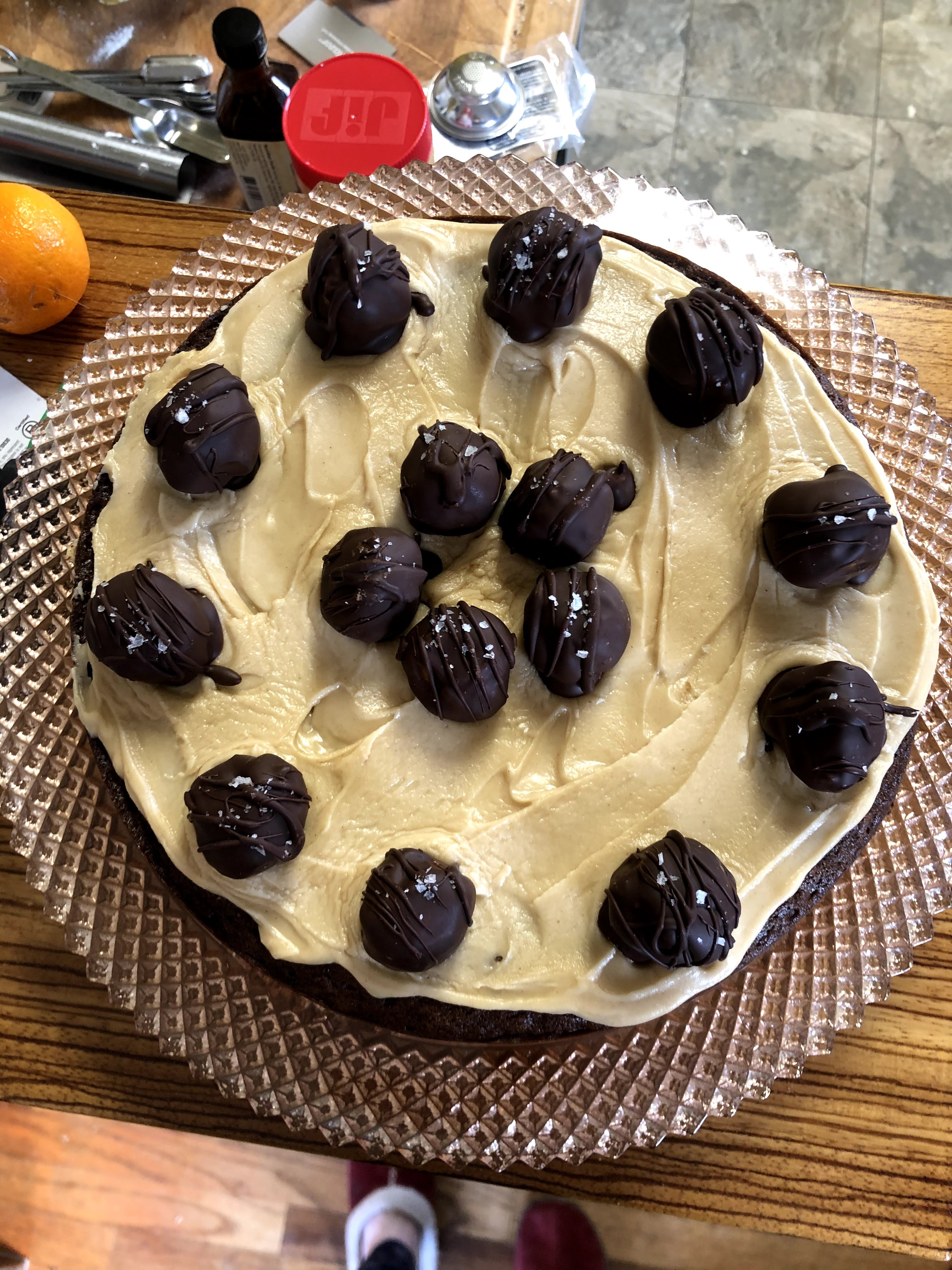
Chocolate peanut butter with peanut butter glaze with chocolate peanut butter balls (for our anniversary)


Coconut lime


Banana peanut butter with cocoa glaze


Apple with salted caramel glaze


Two cakes I didn't get pictures of but were delicious:

  • Spiced honey with almonds
  • Oatmeal cookie with chocolate chips

Not to mention the birthday cake I baked for the not-so-baby small human (a hazelnut meringue with whipped cream and mandarin orange segments in the middle)

In many ways, I'm clearly using baking to deal with my stress and things going on that are challenging, and that's not a bad thing. I'm also having fun and baking in a way that's manageable this time of the semester--small cakes that are whipped up with minimal dishes needed (and can be done by hand). And while I still love making gluten-free sourdough, I'm also just not able to commit as much time to baking bread, except on the weekends, so the cake baking has been good for getting a baking-fix in on more limited time scales. And the elder child is pretty happy with this arrangement.

By the way, if you're a cake-baker and use 9" round pans, get yourself some precut parchment--it makes baking cakes (or other round things) sooooo much easier.

Tuesday, February 23, 2021

can't I logic my way out?

 My friends, I have procured yet another type of planner--this one a Panda Planner from Rocketbook. I was curious about it, and I've been enjoying my Rocketbooks that I got for Christmas from a friend, so I figured, eh, why not. I'm not sure it's the planner I want, particularly when the example gave a goal (get in shape) and then the target metric was weight-based, and it triggered my rage at diet culture. So maybe Panda Planner should not be so fat-phobic in its examples, and besides, weight shouldn't be a target metric for "get in shape" but instead something like "lift X lbs" or "do plank for 1 minute" or something. Gahhhh.

Anyway, I digress.

Another friend mentioned something their therapist told them, which is that you can't logic your way out of situations (not an exact quote, but the gist). And I come back to that idea time and time again--I often think if I can just plan it out, then I can eliminate all of my woes. I empathized with Courtney Milan's character in The Duke Who Didn't because she loved making lists and always aimed for perfection on completing the list--but always failed. The point there is that the character purposefully made the lists impossible to accomplish because she was aiming at a standard of perfection that seemly wasn't attainable as a way of coping with the chaos of the world. And I do that a lot.

My calendars and planning systems are all an attempt to obtain some perfection, to use my formidable organization skills to impose order on a world that simply cannot be ordered. I know this. And yet, here I am, with a new sleek planner and the promise that I can try a new way to organize things to make the world fit into orderly patterns.

Ultimately, though, my systems are useful: I'm using them to realize what I can accomplish in a week and to plan out my days. I'm getting a clearer sense of what is feasible in a day--and also considering how I can shift things if I need to take a break, like I did last week after an exhausting day that followed a few hectic weeks. So, perhaps the planner obsession is useful in helping me reach some clarity about working as much as I need to work and letting everything else go--something I am working toward much more consciously this year.

Friday, February 19, 2021

mothers and babies

 Lately, I've been thinking a lot about how mothers and babies are portrayed in literature and film. Particularly, the ways babies are often snatched from their mothers, while the mother lies helpless on the birthing bed. Most recently, it was in Bridgerton, where the duchess was left with her arms reaching for her son, while the duke held him for all to see his triumph--only for the duchess to die without even getting to see her baby. In Jane the Virgin, Jane's baby is kidnapped shortly after she gives birth, leading to a wild chase while she is still sore and raw and needing to feed him. In a fantastic book I recently read, The Empress of Salt and Fortune, the baby was snatched from his mother. And in one of my favorite books, The Girl Who Drank the Moon, the baby is torn from her mother's breast, and it drives the mother mad. I like all these stories as a whole, but I wonder at this repeated narrative and how hard it is for me to read it.

I'm aware that my thoughts and feelings are because I am a mother--I got to immediately hold both of my babies on my chest and then keep them tucked close to me for much of their newborn days. My body made these tiny creatures, and my body (and hormones) demanded that I keep them close. My body was this baby's first home, and the baby wants to stay close to it. In some of the books I've read about birth and midwifery, they refer to the mother-baby dyad, which is a way of capturing the relationship that makes sense to me: the baby is a separate being but also not, and together, the mother and baby make something else, and you have to care for both mother and baby to ensure health and well-being for the whole. So I have a visceral reaction--and not a positive one--at the narratives that cast mothers as weak or helpless or exploit them after they have given birth to steal their babies.

It reminds me too of the arguments around reproductive justice. The ways that controlling women's bodies become a way to subjugate women and remove their agency--both in preventing them access to birth control and abortion as well as taking their children from them. Forcing women to have children but then taking those children away for a range of reasons. Taking children from birth mothers as a so-called deterrent to illegal immigration but really just an exercise in exploitation and inhuman cruelty. Denying nursing mothers access to their babies. Incarcerating mothers for being poor. These are real stories, stories that happen daily.

It also makes me want to write a story about a powerful mother whose baby isn't taken, who is able to fight the powers that want to steal her baby. A story where a mother isn't weak or passive but uses her ferocity to destroy the entities that would control her body and rob her child of their first home. A story where women band together to protect and support each other and take down the patriarchy.

Monday, February 15, 2021

capsule creation

 I follow some folks on Instagram who talk about dressing minimally, others who advocate for conscious consumption and purchases of clothing (the fashion industry is an ecological disaster that exploits humans to make sure you can buy a cheap t-shirt). I also follow Dacy Gillespie of Mindful Closet, who is a stylist whose mission is to help women spend less time getting dressed by helping them find their style. These have had me thinking about clothes, my body, and using clothes to suit the life I have rather than some vague self I might want to be.

Thus, over the past few years, I've been trying to reduce my consumption, consciously donate or give away clothes I no longer need, and mend/renew clothes that need repair. All of this is caught up in my growing desire for body acceptance in light of the inevitable body changes that come with age, children, and living--I no longer want to rely on chasing the whims of fashion for how I feel about my body. I want clothes that work with the life I have now. I want to wear soft, comfortable clothes that are durable and work for the life I lead--a mix of professional and active, whimsical/fun and durable, natural fibers that are also nice to wear.

Anyway, so in all of this thinking about clothes and making more of my own and buying pieces from sustainable makers (who also pay their employees living wages), I had another baby, which meant that some of my wardrobe no longer fits, some of it no longer suits me, and some of it I no longer like. After reading about Project 333, where you whittle your wardrobe down to 33 items for 3 months, I figured I'd use my furlough day to clean out my closet and see if I could build a capsule.

So on Friday, I pulled out every article of clothing I owned and dumped it on my bed. Then I began to sort, pulling out the stuff I've been happily wearing over the last year and putting it back in the closet/drawers, and then considering all the other stuff. Obviously, I have a lot of dresses and things I can't wear (or don't need to) because pandemic (and also breastfeeding--all my clothes have to be easily adjusted to feed my chunky milk-hungry baby). Some of these items I want to still wear, like the awesome Pyne and Smith black dress that is one of those wardrobe workhorses--great for traveling, able to be styled a zillion ways, etc (again, can't wear it because I'd have to pull it allllll the way up to feed a baby and I don't have time for that). But a lot didn't fit or didn't feel good or just didn't work for me anymore--so it got washed and will be sent out of the house.

I found that the act of pulling all of my clothes out and touching them and having to really just understand why they are in my closet was enormously helpful. I also listened to my immediate gut reaction when I picked up an item or tried it on. I also paid attention to what I was drawn to and what I reacted against. I also noticed a color palette emerging--definitely heavy on the reds/rusts. And in the end, I piled up quite a few items that were in good condition to sell on ThredUP or give away or send to a friend, but I still have lots of clothes in my closet, but all things I love and will make the most of.

Ultimately, I decided I didn't need a capsule, though I did create a "highlight" section of the closet for clothes I'm currently wearing in heavy rotation (the snuggly cardigans, the soft flannels, the cheerful or the cozy shirts). It means I can just zoom (haha) into my closet and snag what I need, so hopefully will reduce the time I might spend picking an outfit (though, let's be real: these days, it's usually a pretty quick process anyway). My goal, though, is when we do go back that I'm able to just rotate through those pieces, shifting the highlight section as seasons change. So it turns out the capsule isn't really useful for me--but the process of thinking about what I would pick for a capsule wardrobe really helped me appreciate the clothing I have.

I'm planning to avoid buying clothes anytime soon (I really have enough of what I need), though I am planning to make things I have fabric and patterns for, so that will be a fun way to mindfully and carefully add new items to my closet that fit me well and serve my needs. And that's all I really need right now, even if all the ads on Instagram are telling me to buy buy buy.

Tuesday, January 12, 2021

a calendar here, a planner there

 I think my desire to schedule and plan has gotten a bit out of control.

As I'm sitting in my office, I see my Google calendar I use for work on my screen. I look up at the wall, where I have a monthly calendar with stickers and labels and my running schedule marked. Next to my left hand is my Passion Planner, and on my iPad is a Passion Planner digital. Yes, my calendaring has gotten a bit intense.

I typically rely on my Google calendar and a paper calendar to manage my time. But I think the pandemic lured me into thinking if I could just organize things fully, if I could just make sure I plan enough, then I can make everything a bit better. And in some ways, I'm right--we have been falling into some good rhythms with cleaning and work; this semester, I'm prioritizing not working late at night (typing on this blog withstanding); I'm working out more and sticking with my running/barre schedule; I feel organized and like I know what's going on in a day and that I have a sense of what I can feasibly get done.

However, I really don't need all these calendars and planners around because I'm spending too much time updating all of them instead of just the typical paper calendar and Google calendar instead of actually doing the things I need to get done. It's like my habit of writing out to-do lists instead of, say, doing things.

Monday, January 11, 2021

a candy bowl

 It was Christmas, and the candy abounded, from stocking stuffers to presents sent. As I gathered up all the candy, I grabbed a bowl and put it all in one place and set it out where it was easily accessible, even for a preschooler who really, really loves candy.

But then a funny thing happened--after a few days, the novelty wore off, and the candy has just continued to sit there. Partly because all the really good candy got eaten, but also because it's just there. It's not novel. If the kid asks for candy, we let him, but he really only goes after a piece every now and then, even his chocolate money. I suspected this might be the impact--which is why I set the candy out in the first place--but I was curious to see what would happen when I did it.

I was influenced by a memory of another time where candy was freely available. One of my good friends always had candy laying around (maybe still has--I haven't seen her in a while)--in bowls on coffee tables and countertops. I used to be so surprised and often had a hard time not wanting to eat all the candy, particularly the chocolates: I'd never had unfettered access to sweets in all my life, and at that time as an adult definitely believed that I couldn't keep sweets in the house because I couldn't "control" myself.

But, this was all before I started learning about intuitive eating and coming to trust myself around food. Learning that it's less about control and more about not restricting access or labeling foods as off limits. Now, we can have ice cream in the freezer and it's not devoured immediately, chocolate bars will remain in the house for longer than a day, and I will eat something sweet if I want it, but not to the point of being obsessive or eating it until I don't feel well. It feels like magic sometimes, but it's really self-trust and self-care.

And I want to make sure my kid has that experience, and that we trust him to eat the food he wants to eat, and, for the most part, he does. And the candy bowl can stay out, and he's not in it all the time because he's kind of forgotten it's there until he remembers, and then he fishes out a sour gummy or a sucker and that's that.

Tuesday, December 22, 2020

el fin

 It's the end of the semester, hell yes. Normally, I'm excited, but this semester was a slog and was grueling. However, I don't want to just focus on how tough the semester was--I had awesome students, and many of them were kind and supportive of me and let me know that they appreciated me. In my new engineering communication class, I heard positive things from all of them about the class and about how much they learned. So, definitely some successes amidst the pain.

I'm trying not to fall into the trap where a new semester means everything will be magically better because it won't. In therapy terms, it's like "pulling a local," or the wishful thinking that some have about starting over in a new place. The new year/semester won't be the end of the challenges, due to COVID, and there'll be lots of work to do with the new administration. As far as COVID goes, the end is in sight, but it will be some time before we all have access to the vaccine and can begin resuming normal lives, so I'm bracing for a rough winter. We are being furloughed, so I'll be dealing with that in the spring.

But, I'm cautiously optimistic. I'm teaching fewer students and teaching classes I know well. I'm likely going to be on sabbatical next year, and I hope to have space to work on new research projects and apply for funding to support my sabbatical project. I hope to travel next summer/fall. I am involved in a research-support group that is intended to help me develop myself professionally and to make connections with influencers on campus. So, I have lots to look forward to, even while still working from my basement and trying to balance all the things.

But, for now, a celebration to being done and time to start doing some fun Christmas projects, self-care focused tasks, and other fun things.

Thursday, December 17, 2020

therapy

 I found a therapist, made the call, and got scheduled. All of this was fairly low work, but it required multiple steps, which made me wonder how people who are struggling with executive function ever manage to do it, particularly for therapists who do not return calls or who do not have openings. Luckily, the one I picked was able to schedule me quickly, and we met for the first time, and I sobbed my eyes out and proceeded to feel really exhausted for a day and a half.

In the past, I knew therapy would be helpful, but I never fully pursued it because I had enough coping mechanisms and people to talk to, but this time...well, too many things were happening and I felt too isolated. I'm glad I finally scheduled a session, but the therapist is determined to poke at childhood memories and traumas, which is uncomfortable, to say the least. But important, if I want to be conscious of where my reactions emerge from--and be a better parent to my kids.

The other thing I've been processing has been how I hold emotions in my body. The therapist mentioned something about ways of venting anger (or moving it out instead of shoving it down or suppressing it), and the idea of violently whacking a pole with a tennis racket (her suggestion) made me really anxious. She then suggested that I'm afraid of my own anger, and I think that's accurate.

So I've been thinking on that and asking myself how I'm handling emotions: am I moving it out of my body, or am I shoving it down and holding onto it? Can I accept my anger and be ok with it? Can I use my anger to do something and not shy away from it? How is my anger emerging from fear? How is my fear of my own anger related to my childhood? All fun questions to ask and explore, as I will continue to do.

Last note: the one reason therapy is a bit more accessible/feasible right now is through my employers Employee Assistance Program, so if your employer has one, I highly recommend using it to access mental health services. It's getting me started with 5 sessions with no cost to me, so it removed a barrier to (finally) working with a therapist.

Wednesday, November 18, 2020

we're all mad

 I think this is the week that all the academics and teachers (many of whom are also wrangling childcare and other responsibilities while trying to work) have collectively agreed to be done. Like, end the semester now, whatever. I've seen multiple posts from friends and on social media where everyone is just basically so over this semester.

This, my friends, is burnout. Welcome. We are all here with you.

With burnout comes potential grumpiness and bad decision making (or both). I sent out a grumpy email and am now dealing with the fallout, which is real fun, especially when it elicited anger back, etc etc. We're all mad, and I'm mad at myself, mad at being expected to manage other people's emotions, and just mad at the circumstances that are making it more and more challenging to work without overwhelming amounts of stress and anxiety.

Which reminds me, I need to call that therapist. I've picked one, though! So, progress.

So, I'm just trying to manage what I can control for now and be chill and exercise and play with my kids. Today, the baby fell asleep like this in the crib, which is hilarious:


I suspect he was sitting up jabbering and just fell asleep. He's like that--note the tiny foot poking out of the crib bars. He often falls asleep wedged in a corner, but I'm grateful that he sleeps significantly better than the first kid--and he's started sleeping very long stretches at night, including one night where he slept straight until nearly 6am without waking up to nurse. I think, I hope, a pattern is emerging and that by the time he's one, he's sleeping through the night (and maybe we can move him into brother's room and get our room back!).

I also am in the process of baking a chocolate pear cake and am about to go run. I've also even, magically, made some progress on writing this week, and am planning to try to catch up a bit before next week to be able to take a break. Luckily, for me, the end of the semester is always a bit easier than the middle, so most of my time is being spent doing what I enjoy: working with students on their writing and learning. (Admin tasks, on the other hand...)

Anyway, so that's what's going on--I'm grumpy and trying to manage it because we've got a lot more of this to go.


Sunday, November 15, 2020

(re)learning spanish

I'm falling into several pandemic stereotypes (ahem, all the pandemic baking), but the latest is starting to learn Spanish. Well, relearn, since I have a BA in Spanish, but I could probably barely survive if I was dropped into a country where only Spanish was spoken. I have the base skills, but they are rusty, rusty, rusty. So, to the free language learning software!

Ideally, I'd find several native speakers and practice with them. I've always been a shy Spanish speaker, however, likely because I don't like failing at things, and learning a language requires you to make lots and lots of mistakes. And speaking a language means you don't get to revise what you say, and as a fast speaker of English, I don't like that very much--my Spanish language skills would never allow me to speak or write as easily and fully as I could in English. However, it's something I'm working on (purposefully doing things I'm not very good at), and I really would like to feel more comfortable with speaking Spanish if I needed to or wanted to. And just remember what it's like to be a learner.

Perhaps in some future semester, I'll sign up for a language class, though I'm not sure what language class I'd choose, and they'd probably be annoyed with me if I signed up for a beginning level class only to discover that I'm not precisely a beginner. So, if I can refresh my skills to a certain level, then perhaps I can sign up for a conversation class at some point and immerse myself in that learning experience. 

I wonder if they'd let me skip the placement tests if I showed them my undergraduate transcript? Or perhaps I should just find a conversation group that happens on campus, once we are free to leave our homes without fear of adding to the massive spike in COVID cases in our area...like, when there's a vaccine. I have an eye doctor appointment in a few days, but I'll probably cancel it because I can make do with what I've got. I'm just too nervous, and there's way too many people not wearing masks.