Wednesday, February 07, 2007

Literary Missionary

This was an assignment for my Professing Literature class, the subject of which was "On Me as a Student of Literature."

I easily could have been a non-reader. After all books—through available in my home—were not cherished by anyone in my family. I was not read to, encouraged to read, or given books to promote a reading lifestyle; I was merely left alone with access to a shelf full of books that my parents had acquired with the vague notion that owning literature was good, similar to the concept that families should attend church or own a family Bible for their moral well-being. Out of five children, I alone read voraciously, wolfing down books as fast as I could gulp. I clearly remember my first reading experience: Morris Goes to School, a book about Morris the Moose, well, going to school. I was in kindergarten and not “supposed” to be reading yet, but there I was enjoying this book. My first chapter book was Charlotte’s Web, a book that we later read as a class in third grade, and a book that got me accused of not actually reading because I was able to read it so quickly.

I can’t remember a time when I wasn’t reading. I loved the feeling I got when I read a particularly captivating book, the feeling of being absorbed into the written page, the “willing suspension of disbelief” or being pulled into a “secondary world” as Tolkien describes in his beautiful essay “On Fairy Stories”. High points, low points, and silly points were bookmarked by some literary work. I empathized with Jane Eyre when I was childishly infatuated with an older man; conversely, I finally understood John Donne’s “The Good Morrow” when I fell in love and found myself loved in return. I trailed my self-conscious girl heroes in Robin McKinley’s The Blue Sword and The Hero and the Crown, and I grew up with Anne of Green Gables. I read great literature, mediocre literature, challenging literature, stupid literature, books that made me think, cry, hate, love, works that inspired anger and brought great joy. I always carried a book (or two) with me—I never knew when I’d need one—and my parents took away my books to punish me.

I drank in books in long draughts and thirsted for more, but interestingly I was a mediocre English student until my senior year of high school. I was one of those unexceptionally brilliant teenagers; you know, the ones who know how to take the tests and bother to do the assignments but are really only parroting. I excelled in science and wanted to teach biology or chemistry (or both), for studying literature was a dull, unending track of reading, writing, vocabulary and pointless sentences to copy down and correct in a notebook. Who cared? Certainly not my teachers.

Enter Mrs. Galligan, my senior AP English teacher. She taught me to love John Donne with unequivocal passion, delight in the beauties and intricacies of Shakespeare. She got me to read Shakespeare on my own—Twelfth Night, King Lear, A Midsummer Night’s Dream—and because of her guidance, I wrote an interesting paper (for a high-school student) about King Lear and Jane Smiley’s A Thousand Acres. That paper was my introduction to literary criticism and academic writing, and began teaching me a way of reading that extended beyond plot. She made me learn; she made me love, and I left to attend college as a chemistry/biology major.

Wait, as what? Yes, that’s right; Mrs. Galligan had only planted the seed of loving literary studies, but I still wanted science. (For one, it was so much more safe and certain than literature, and I was sure to get a job). It wasn’t until about half-way through my first semester that I discovered that I liked science well enough, but I loved English. I loved writing, I loved talking about literature, and I loved helping other people write better. My epiphany came, actually, while I was in the middle of peer-editing and I felt satisfaction deep in my spirit. I use the word epiphany carefully because the experience was akin to a religious moment. It was as though I was traveling down the road of Science, only to be struck blind with the light of all that English had to offer me. Like any new convert, I struggled at first with giving up the old ways—I couldn’t change my major!—but I soon settled into my new path with a contentment and passion I’d never had before.

I was therefore determined to become a literary missionary, and the goal of my outreach would be high school students. After all, had I not suffered at the hands of countless years of incompetent, uncaring English teachers? I would save others from that fate, and help them discover the truth and joy that literature could bring. Then I discovered that the majority of high school students didn’t care. Why should they? I went to my internship hours at various public schools with the growing feeling that I wouldn’t be happy teaching in a public school. There were restrictions on what you could teach; you had to teach grammar and other state-mandated curriculum topics. With a sinking feeling, as I continued on in my education classes, I realized that I would be an unhappy, potentially bored English teacher. I wanted my profession to be something that in which I could grow, develop into a better scholar, and fulfill my own needs as a passionate lover of literature, while also helping others.

I knew I was “good” at English; I made high grades in all of my classes and was praised by my professors. (I always had the vague anxiety that I was repeating the mistakes of my youth, however, simply parroting back to the teachers what they wanted to know, never creating anything new for myself). My honors thesis adviser encouraged me to think about graduate school. “You have the skills to be a good scholar,” he enthused as I shared insights on The Lord of the Rings with him each week, connecting Tolkien’s work with Aristotle, Hegel, Dostoevsky, and others I encountered. Other signs appeared before me in the forms of friends who thought I would be a miserable high school teacher, or the English department chair who listened to my passion for my studies and said, “You would be a very happy graduate student.” I scoffed; being a teacher was my calling after all, and who was I to oppose a divine injunction? Education was what I wanted to do because I could see myself doing nothing else.

Yes, I still believe it’s my calling, but I began to realize I clung to the hope of teaching high school English because it was secure. I knew that I could find a job somewhere, anywhere…but graduate school meant more years of moving, living as a student, the roaming scholar who relied on the bounty of others. In my heart, though, I realized it was what I wanted. I wanted to keep pursuing learning, grasping new knowledge with both hands, absorbing ideas and theories as I read those books so long ago. It appeared to me in another epiphany: I had registered for my first semester of practicum, when I’d be taking almost all education courses and interning at a public high school, and it clicked—I didn’t want that. My friend Shannon was the push I needed because as I was talking to her about my dilemma (to teach or not to teach—high school, anyway) I became increasingly convicted that my place was in higher education. I hoped so anyway, because part of me sniggered and accused myself of being too afraid to face the lion’s den of the public school system. I thought of the satisfaction of belonging to a profession that requires its members to be both scholars and teachers. The more I thought about it, the more I realized it was what I wanted to be—a professor of literature.

I’m on my way to becoming that literary missionary in both the capacity of the wise professor wielding knowledge and the eternal student questing to know more. Of late, I’ve begun to ask But to what purpose? but haven’t found the answer to that question. All I know is that I love studying, I love teaching, and I want to pursue a field that would allow me to do what I love in a way that can (maybe) bring joy to others. Perhaps the clues lie in Robert Scholes’ attempt to have us rethink the concept of English as a discipline; perhaps my place would be in helping the profession move forward in subtle ways. Ultimately, perhaps the answer is merely that by doing something that I’m wildly passionate about, I would be a small light to others on the value of literary studies and English as a whole.

Friday, February 02, 2007

Prose: Teaching Knitting

I began my boyfriend's hat yesterday, the one that's been looming before me as the penultimate goal of my knitting career. Penultimate because obviously there will be another knitting project that is more important and watched for with greater anticipation than his hat (I just don't know what it is yet).

So I begin the hat. It's my first project "knitting on the round" or rather, using circular needles. I already goofed the joining, but the rest looks good, so I suppose I got the knack of it. I may pull it all out, or use it to make sure I'm even making it close to the right size--the danger of using circular needles being the size is a secret until you've knit for quite some time. This hat has been bothering me in the form of my boyfriend for over a year now, when we bought some yarn and he jumped up and down with glee in the aisle of Hobby Lobby when I said I would make him a hat. Every time I'd start a new project, I'd hear about how his head was cold, how he wished he had a great wool hat to keep his curls warm...

But this is not a tale of the perpetually unknit knit hat: this is a story of how I taught my boyfriend to knit. It all began with my roommate holding a set of my needles curiously and looking through my handy-dandy knitting guide (I have a small spiral bound one that I whip out to learn all sorts of interesting things, like cable cast-on or how to do an increase or decrease). She wanted to learn, so I asked, "Do you want me to teach you how to knit?" "Yes!" she exclaimed, as she was looking for a way to escape her history texts and enjoy her snow day. Lance looked at me tellingly, so I asked him to, which made him say, "Yes, me too!"

Thus commenced the knitting lesson. I made them cast-on (over and over again) until they got it down. I had to get Sarah to reverse her hands (she apparently will knit "backwards" or left-handed), and Lance quickly progressed to purling. I swear, he is the best first-time knitter I've ever seen--his practice swatch was only a little crooked on his cast-on row. He's a mechanical engineer with an amazing ability for spatial orientation--and what is knitting but a spatial skill?--and he was able to capture the big picture of what knitting does in addition to being able to creatively add to what I taught him. The knitting circle has increased by two.

Lance started planning all his projects, and asking me questions about how things are done. I had the challenge of a bright student, and as a bright student, he of course tried to overstep what he knows by asserting he could knit a circle (not a tube like his hat, but an actual circle). Ah, haha, he will learn soon enough what he can and cannot do. I felt the slight tremor that a teacher can feel when faced with a particularly promising pupil that perhaps he'll soon overtake my skill--and I'll have nothing left to teach because he will be become better than me!--but I realized that for now, I have the advantage of several years of experience and knowing how to read the charts. So I have time to reconcile myself to the prospect of his surpassing my knowledge, and time to come around to the idea that it's okay if he does because I can then just learn from him.

I look forward to more cold afternoons and evenings with my knitting pupils and watching them grow in skill and confidence as they knit toward their first projects. I'm a teacher by nature, and I love being able to pass my passions along to those around me, whether it be literature and writing, or knitting.

Thursday, January 18, 2007

The Beauty of Writing on a Blog

Blogs get a lot of criticism, even from me who writes in several online spaces. It's easy to get sucked into the trap of almost unconscious writing, or worse: the sort of gibberish that I lament is killing the minds of teenagers everywhere, IM-lingo. (Uggh, I hate it). However, Donna's post from yesterday made me think about the purpose of blogging.

And I realized even when I'm being "intellectual", it's a release of pent-up word energy. It's a way for me to write in a forum where there are no critics (harsh ones anyway), no professors to grade what I write, and if someone disagrees with me, so what? I can alternate my roles from reader, creative writer, book critic, book lover, and thinker, switching from scholar to curious individual (or some combination therein) with each entry I form. I can hope that others read and enjoy my entries, but in the end it doesn't actually matter.

The beauty of writing on a blog--to play, to grow, to learn. It can be a lovely thing, this blogging on varied interests, developing a writing style. Those writing teachers always say "write everyday" (or something like that) and blogging provides an incentive to do so, with the added charm that an audience exists out there in the Interwebs to read, enjoy, and learn with me. My pent-up word energy is out, and I'm better for it because I'm making it available for other eyes, giving me an audience to write for, even if they are only in my mind.

Wednesday, January 17, 2007

Fem Lit--or, The Only Place Feminist Criticism is Welcome

I've stated before that I dislike feminist criticism. It's not that I dislike feminism (I occasionally fancy myself a bit of a feminist--but wouldn't you, growing up in a conservative family with four brothers?) but rather their often over-reaching approaches and their snooty jargon. They always seem to be glaring at me, frowning at my knitting and domestic pride, and my lack of desire to read everything as men trying to screw me. It's just not how I think, okay?

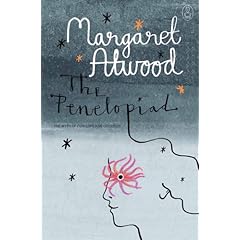
However, feminist literature is certainly a valid field for feminist theory--since it's feminist theory turned narrative. So, without further ado, I delve into an exploration of Margaret Atwood's The Penelopiad. It's a modern, feminist retelling of The Odyssey from the perspective of Penelope. But she's dead when she's telling it, which brings all sorts of interesting implications. She opens by declaring that's she's dead, and thus knows everything. If that's true, then why does she spend so much of her time wondering why her twelve maids were killed, why Eurycleia picked them to be hanged, and other incidents during her mortal existence.

The Penelopiad is written from women's voices, alternating between Penelope with the twelve hanged maid serving as a chorus. It also brings in the voice of Helen, her beauty queen cousin. The maids were hanged for certain sexual crimes and insolence against their master, and they are bent on avenging their deaths. Their chorus both supports the tale that Penelope spins, and undermines it until the reader is caught trying to figure out the truth along with Penelope--a truth that, in typically feminist, is never arrived at.

The feminism within the work is carefully plotted. Penelope occasionally mentions ideas from her Greek society that seem almost preposterous to us--the father "selling" his daughter to the man who can win the contest; the maids whose lot (if they are especially young and pretty) is to be raped and sexually used by their master and perhaps his guests; and the role of a young noblewoman in marriage. On her wedding night, Penelope has to pretend to scream like she's being raped to satisfy the ceremonial wedding rites. This is a story where women are property, their bodies are not their own, and men control them and their lives. In the case of the twelve maids, they are hung by Odysseus after he kills the suitors.

And yet, not quite. Atwood teases out another story through the chorus of maids, asserting that they are not the Twelve Maids, but the Twelve Maidens of the goddess Artemis, the feminine goddess of chastity, the moon, the huntress who takes no man. And as there are thirteen lunar months, Penelope is the Queen of them, which she indeed has claimed all throughout the book that these Twelve are her special, beautiful, chosen maids, trained by her and used by her to keep the Suitors at bay. Then the story becomes about the repression of the cult of the Moon-goddess and a further dominance of the patriarchy.

And then the further question--did Penelope sleep with any of the Suitors? It would be difficult to resist a little dalliance, Atwood seems subtly to assert, when her husband has been gone for twenty years. The maids declare outright that they helped her in her infidelity, while Penelope maintains that she was never unfaithful to her husband, even when she heard he was off sleeping with beautiful goddesses. Or whores, if you don't believe the "high" version of the tale. But then she undermines herself by linking herself with Odysseus, the honey-tongued liar. Does she lie, or tell the truth? Apparently even dead she still buries some of the voices of her tale.

The novella is a rich and imaginative creation by one of my favorite feminist authors (read The Handmaid's Tale). A modern feminist revision of an ancient patriarchal tale offers up the sort of ideas that are easily read using feminist theories, and the most productive.

Friday, January 12, 2007

Knitting, Delurking, and other Non-Literature Things

So...

This is my "literature blog". However, I don't write on it unless I have something burning about books to talk about. So I think I'm going to make more use of that prose bit of my title and write about a variety of my interests. Because my interests are many.

Take knitting for example. I've recently been caught in a wave of knitting madness: Donna is learning (yay!), and she introduced me to the Secret Knitter, who recently decided to secretly knit scarves for his family, and has since been hooked on knitting. My own knitting history began when I taught myself how to knit my junior year of college, knit a bazillion garter-stitch scarves, got bored, made my first project from a pattern, and have been tinkering ever since (I love stitch patterns). Here is one product of my tinkering:

There's a feeling that emerges from designing and creating a new thing. This didn't exist before I made it (it may have been available in other forms, but this particular manifestation emerged from the fusion of my mind and my knitting needles). And the story behind it is fun: my friend and bookbinding teacher offered to swap one iPod cozy for a bookbinding class (Japanese stab-binding, which I'll be using for a wedding guest book for two of my friends). So, I thought of a design that would be useful and cute (I own an iPod nano, so that was pretty easy), and out it popped. I like it.

Incidentally, if I have any blog lurkers, it's National Delurking Week. So leave a message and say "hi!" Thanks!

Tuesday, January 02, 2007

Weirdness

Donna, I suppose in an attempt to get me to post, has tagged Amanda and me to post six weird things. But these are not just any six weird things, but six weird things that relate to graduate school and English literature. So without further ado:

1.) When I'm reading something, I often talk out loud in order to think. However, I only do this when someone else is in the room; otherwise, my thoughts are written or kept internal. They often think I'm actually talking to them (and I usually direct my comments in their direction), but really I'm just thinking out loud.

2.) When I'm doing research, I attack books (especially ones I shouldn't write in) with tiny Post-it Notes. Sometimes the notes just mark a spot that I'll cite in my paper. Mostly, I scribble little notes on them. I do this a lot with each book, so when I'm done, the book has a zillion varied colored notes sticking out all over it.

3.) I'm obsessed with office supplies. I love Post-it Notes, pens, pencils, erasers, staplers, notebooks, and all forms of supplies. I especially love Post-it Notes. Every year, I have to resist buying spiral bound notebooks when they're on sale (10 for a dollar! Sweet!) since I have a plastic storage tub full of them. The Boyfriend mocks me for them, and for my office supply obsession. Luckily, being in graduate school means I have to buy office supplies every now and then...

4.) Whenever I find another person as obsessed as me about literature, I hop up and down and squeal. I get really excited about finding other literature lovers. In fact, I found one over Christmas, and he was as excited as me to find another English MA student, so perhaps that's not so weird after all...

5.) I HATE feminist criticism. I like feminists, though. Or feminism, at least. But feminist criticism? Drives me insane. I hate it. I hate how they ignore the text, skew everything to be about feminine oppression, and how they use terms like "the father", "phallocentric", etc. to interpret literature. Sometimes their points are valid, but for the most part, I have little use for them.

6.) I tend to relate things in real life to books I'm currently reading/obsessed with. Sometimes, it carries on to such a degree that those around me roll their eyes and wonder how they put up with my zaniness and nerdyness. I also tend to relate other books I'm reading to books I've just read, coming up with some odd connections that please me in an intangibly, indescribably satisfying way.

Now, who to tag? There are relatively few people, I believe, who read this blog, so...Michael, you're the only one. Do it. Do it now. And to take a page from Donna, you have to relate your six things to technologically based weirdness...

Wednesday, December 20, 2006

My Recent Reads--Jane Austen

As you know from my last post, school is done for the semester. As a habitual reader, I find it strange to not constantly have some book in my purse, so I borrowed Northanger Abbey (Jane Austen) from a friend and bought Persuasion. Yes, I'm going on a Jane Austen reading spree. I decided to go on the Austen-fest after reading both Sense and Sensibility and Emma one right after the other, and loving both immoderately.

Austen is stereotyped as a chick-lit writer, or as a writer who only talks about family and marriage and the troubles her characters get into because of both. However, I'm a firm believer that Austen is much smarter than that. Her books may appear to be books about young ladies getting married off to live in happiness and fortune, but they also contain so much more.

I'm in the middle of Northanger Abbey right now, and it's a witty, sarcastic, fantastic novel. Catherine Morland stars as the heroine of this not-so-Gothic Gothic novel. Austen plays on the conventions of the Gothic novel, dismantling them and exposing them as silly, irrational, though interesting . And when she launches into a several page defense of reading novels (those sensational things that most ladies of good breeding would never admit to reading), the reader and scholar in me admits that there is so much thematically to her writing.

I'll post again when I'm finished.

Monday, December 11, 2006

An Excerpt of My Final Paper

Because I worked really hard on it, I wanted to share my favorite excerpts of my paper:

The Bride of Lammermoor: An Introduction

As with many of Scott’s novels, The Bride of Lammermoor begins not with the central story but with an introduction or a frame tale. Here, Peter Pattieson, the fictitious writer of The Tales of My Landlord tells the sad story of his friend, Dick Tinto. Tinto begins his artistic career as a sign painter (5-6). Following his aspirations, Tinto later attempts to enter the art scene but dies in obscurity as a failure (9-10). Following Tinto’s brief history, Pattieson describes a debate he had with Tinto about the representation in the novel—a theme that carries throughout The Bride. Tinto criticizes Pattieson for creating characters who “make too much use of the gob-box” (10) to which Pattieson retorts, “how is it possible for an author to introduce his personae dramatis to his readers in a more interesting and effectual manner…?” (11). He then follows with the argument that Tinto “confounded the operations of the pencil and the pen” (11) [1]. Following the debate, Tinto takes out a sketch, thinking that in a flash of insight Pattieson would immediately understand the story he tries to tell on canvas (12-3). Tinto is disappointed, declaring, “I would swear you had been born blind,” (13) and then reveals the subject to a tale told to him by an “aged goodwife” that Pattieson uses as the subject for The Bride (14).

The exchange between Pattieson and Tinto reveals concerns about oral history and modes of representation that Scott explores throughout the novel. The story of Edgar Ravenswood and Lucy Ashton comes to its audience through Pattieson, who in turn received it through Tinto, who got it from a local woman when he went to see the ruins of the castle that is part of the tale’s setting. The provenance of how the story gets to Pattieson connects the reader to the Scottish oral story-telling tradition that Scott was fascinated with as both a writer and historian. As the material for The Bride of Lammermoor was passed down orally to Scott, it was indebted to the Scottish story-telling tradition. Both before and after the publication of The Bride, he repeatedly told the story orally, as if to maintain a sense of the work as a story told not described (Lamont 117). The oral nature of the original tale weaves its way into the composition of The Bride in Scott’s use of dialogue: his characters tell us the story through their conversations, the act of speaking gesturing toward oral story-telling. He also incorporates moments of oral history through the characters of Caleb Balderstone, who refers to the family’s history and the prophesy about the last Ravenswood (139), old Alice Gray, who is “queen of gossips, so far as legendary lore is concerned” (30), and even Ailsie Gourlay who tells Lucy tales to further break her mind (240-1). When at one point the tale dips into a moment of irrationality, the narrator comments, “We are bound to tell the tale as we have received it” (187) further underscoring the tale’s origin as a passed down, oral tale. Scott concludes the penultimate chapter by referencing the source legend: “[T]hose who are read in the private family history of Scotland during the period in which the scene is laid, will readily discover, through the disguise of borrowed names and added incidents, the leading particulars of AN OWER TRUE TALE” (262).

Not only does the first chapter bring up oral history in relation to The Bride, but it also centers on the question of representation in a novel: should an author describe a tale pictorially (Tinto’s preferred method) or use dialogue to tell the story? Though Pattieson agrees to tell the story using Tinto’s mode, The Bride still contains scenes that consist mainly of dialogue. The frame tale sets up the scenes of description against the scenes of dialogue to call the reader’s attention to the contrast between the two forms of perception and representation. A pattern emerges as certain associations are attributed with images: paintings, people, and settings—static entities without dynamic qualities or capacity for change—while narrative implies action, ability to change, and come to terms with the shifting world. One scene that comically contrasts the image with speaking or doing occurs when Ravenswood and Bucklaw approach Wolfscrag, the Gothic tower, and attempt to gain entry from Caleb Balderstone:

The timorous glance which [Caleb] threw around him—the effect of the partial light upon his white hair and illuminated features, might have made a good painting; but our travelers were to impatient for security against the rising storm to permit them to indulge themselves in studying the picturesque. (61)

Scott implies that while there are many things in the world that might make a good painting, pictures are second in importance to acting or speaking; lines of dialogue immediately follow the example of the picturesque[2]. Several critics have explored the implications of Scott’s contrasting these two ways of representing the world:

Scott uses Lucy Ashton’s silence and its tragic outcome to demonstrate the inappropriateness of applying the methods of painting to narrative, and to show that the static, pictorial mode of perceiving and imaging constitutes a fatally isolating manner of private representation. (Butterworth 1).

Scott uses dialogue to produce a living scene, while the pictorial aspect is nothing more than a static frame that traps characters and readers in a dangerous mode of thinking (4). One example of the dangers of conceiving the world in terms of images is the perceptions Edgar Ravenswood and Lucy Ashton have of each other, which Scott carefully puts in pictorial terms.

Lucy Ashton and Edgar Ravenswood’s perceptions of each other are in terms of images: Lucy sees in Edgar Ravenswood the figure of the chivalrous knight who saved her life, a picture straight from her private romances (41-5), while Edgar perceives Lucy also as an image, his reflections on their meeting placing “before his imagination a picture of the most seducing sweetness (70). When he encounters her as the masked huntress, he is “struck…absolutely mute” by her graceful form (84). Lucy later is only able to speak “in broken accents, of the delight with which she beheld the complete reconciliation between her father and her deliverer” (136). When Ravenswood enters Ravenswood Castle as the guest of Sir William, he sees the portraits of Lucy’s dour, puritanical ancestors and begins to rethink his perception of Lucy; however, she later enters the room and chases away his gloomy thoughts with her image: “[Lucy] seemed to be an angel descended on earth, unallied to the coarser mortals among whom she deigned to dwell for a season. Such is the power of beauty over a youthful and enthusiastic fancy” (148). Perceptions thus based cannot last long, and as the two lovers spend more time with one another after becoming engaged, they realize the images they have of each other are flawed: Edgar fearing that Lucy is too easily influenced, and Lucy believing that Edgar might regret his attachment to her because of his pride (Scott 163-4). Scott demonstrates that an attachment formed by relying on ones perceptions or created fictions is dangerous, and in The Bride, it leads to tragedy.

In the end, the inability of Lucy to speak seals her fate and the tragic outcome of the story. “Lucy Ashton cannot function in the world and her inaction, her inability to become more than the image of light that she and others fancy her to be contributes materially to the tragic outcome” (Butterworth 6). Tinto’s sketch, a static image of failed communication, is the climactic moment when Ravenswood returns to determine Lucy’s constancy, and she, unable to articulate her desires and be more than a picture, is lost to her lover by her inability to speak out (Scott 252). Her madness upon stabbing Bucklaw is punctuated by her speech—“So, you have ta’en up your bonnie bridegroom” (260)—whereupon she falls into a state of insensibility and dies “without her being able to utter a word explanatory of the fatal scene” (261). Pattieson may have agreed to follow Tinto’s methods in the narration of The Bride of Lammermoor, but ultimately Tinto’s method of representation and perception is flawed and leads the lovers to destruction (Butterworth 5).

The first chapter certainly introduces themes about the completing forms of perception and representation; however, Pattieson (and most likely Scott) is also mocking Tinto and his position. Pattieson’s portrayal of their debate is ironic because Pattieson describes it using dialogue.[3] Pattieson undermines Tinto’s argument even as he asserts it, and Pattieson implies that the scene would be not be as effective (or interesting to a reader) written any other way. Additionally, when Pattieson does use descriptive language instead of dialogue, he paints a picture of Tinto’s contortions to show his sketch in various lights and distances, completing the description by commenting that Tinto “ended by spoiling a child’s copy-book which he rolled up so as to serve for a darkened tube of an amateur” (Scott 12). The image of Tinto is comic, and Pattieson seems to comment that there are better uses for a child’s copy-book then a tube for an amateur artist’s sketch for a painting that will never be realized. Pattieson further mocks Tinto by describing his life and subsequent failure as an artist (that would contribute to his early death) first, and then revealing to the reader why Tinto is even in the chapter, as the source of the story. Pattieson gently pokes fun at his friend and his friend’s flawed views on art, and he shares the joke with his audience: Tinto sought to be a great artist with his theories on art and failed, and Pattieson seeks to tell a story with his own dialogic mode of representation and succeeds. The unrealized, sketch version of the tale will remain rolled up in a child’s copy-book, but the fully realized, narrative version will be the one that is “seen”.


[1] Millgate comments, “Tinto has none of the instincts of a historian” (179).

[2] This moment is also ironic because, as a reader quickly learns, Caleb’s comical figure would not make a good painting.

[3] James Chandler also points out the irony of this moment: “It is a simple fact, but one strangely overlooked in the commentaries, that every point that Tinto registers is his critique of what might be called Pattieson’s dramatism is itself represented in the dramatic mode” (76). However, Chandler goes on to discuss the dialogue in terms of captions and scenes and doesn’t seem to attribute any thematic significance to the irony that he notes.

Thursday, December 07, 2006

Random Facts: Sir Walter Scott

Did you know...
  • ...that Walter Scott contracted polio when he was 18 months old? He walked with a limp for the rest of his life (probably one reason why the Romantics loved him--they loved people with limps).
  • ...that Scott's great-aunt Margaret Swinton, a source for many of his stories including The Bride of Lammermoor was hacked to death by a crazed woman servant?
  • ....that when Scott wrote The Bride of Lammermoor he thought he was dying, so the novel is uncharacteristically dark, pessimistic, and Gothic in nature.
  • ...that Scott wrote The Bride of Lammermoor (and several other works) under the pseudonym Jedidiah Cleishbotham? (somehow, no one was fooled...)
  • ...that Scott is considered the father of the historical novel?
  • ...that Coleridge HATED Ivanhoe and The Bride of Lammermoor? He called them "wretched abortions", although he liked the witch women in The Bride.
  • ...that Scott wrote 27 novels in about 15 years, writing 3 all in 1819 alone--also publishing other works and serving as a Clerk of Session for the Scottish Court, and as a Sheriff. Oh, he also literally worked himself to death, after continuing to write after suffering from 4 strokes.
  • ...that he quit writing poetry after Lord Byron came on the scene and displaced him as the reigning top poet in England--seriously, he read Byron's work and decided that Byron was talented, so he turned to writing novels.
  • ...that he loved and appreciated Jane Austen's work, unlike many contemporary male authors.

I think that's all the random facts about Walter Scott I have floating around in my head.

Monday, December 04, 2006

It's Been A While...

Ok, so I'm not so good with keeping this thing updated. But that's ok. I'm in the last push before the end of the semester, and I have in my head several good posts about writing academic papers, being an academic, and the fact that there are way too many crappy articles out there.

But those will be for another day. I just wanted to let you all know that I have not dropped this blog.

Monday, November 13, 2006

Gettin' Behind

So, I'm a little behind on my NaNoWriMo. But the boyfriend is leaving town on Wednesday, I feel like I'm on the ball with my homework/big grad school project of the semester, so hopefully I can use the wealth of time wisely and get caught up.

The novel writing experience is actually great. I know that a lot of what I'm writing is crap, but I also see some glimmering jewels. I think I understand now why they say "just write"; it helps you process ideas and find that one sparkling idea that can be polished into something nice.

The grad school project is to write an introduction to a book, an assignment I find wonderfully planned and designed. My professor's reasoning is that many beginning scholars do work of this nature, thus it is not only a research project, but it helps us develop our skills of scholarship that we can use when we are fledgling academics. I like it. I'm writing on Sir Walter Scott's The Bride of Lammermoor, which I read and delighted in. I think I may take a perspective of the role of dialogue in the novel and tie into Scott's fascination with storytelling/oral history or something like that. I've got to get cracking though--less than a month until it's due!

Monday, November 06, 2006

Scribbling Away!

I just finished the Day 6 chapter of my novel. It's really becoming sentimental, but I'm going to keep trudging ahead, garnering all bits of knowledge. Once it's complete, and I've finished the challenge AND accomplished something I've always wanted to do, I'll steal the better bits, or maybe make it into something worth reading.

My word count at the moment is 8898. Which means I have about another 1000 words or so to type on Day 5's chapter (I didn't work too much on it this weekend, with homework and all), and I'll be caught up. And pleased because I've managed to stick it out for 6 days so far.

It's actually going a little easier than I thought. I basically just sit down and write, having held the editor in me hostage. If your goal is to write 50,000 words in 30 days (an average of 1666 words a day), then the editor has to go. At least until December 1st. I like the editor in me, but there's something nice about not worrying too much if the writing is very polished and just sitting and letting the words flow. I keep getting advice on writing that consists of "Just sit down and write a little every day," and it's true; the exercise of writing something out, be it a blog, a journal, creative writing or academic, seems to keep the creative flow going.

Onward, to writing! (And my grad school project of the semester...More on that tomorrow.)

Wednesday, November 01, 2006

November 1: Writing Away

“I have always thought that an idea sprang like Athena from the head of Zeus,” declared Nina one afternoon. I looked at her across the table and sipped my latte. Seeing me waiting expectantly for an explanation, she continued, “You know, like authors just sit down and write. Their characters burst forth from the pen and they walk and talk. The hard part is getting it all down before Athena dissolves—and then making sure it’s actually any good.”

I had to laugh at Nina’s writing theory. She really wasn’t much of an author herself; she scribbled poems here and there, started perpetually unfinished short stories, and dreamed of novelty. Nor was I what you could consider as a writer, unless you count the essays and papers I occasionally wrote as a doctorate student in literature. The dreaded dissertation would probably be my greatest writing attempt yet, though inevitably all sorts of academic books (or at least one) should feasibly follow. Nina, however, was partially right.

“So, you don’t think authors have to work at writing something? That they should just sit down as soon as the Muse strikes and scribble away?”

“Oh, silly Beth, of course they do. But those ideas, aren’t they spontaneous? Shouldn’t they just burst forth one day? At least the best ones, the ones that make really good books…” She trailed off, a note of uncertainty in her voice, “Right?”

I smiled and shrugged. “You know better than I do. I only seem to be able to manage academic stuff, not the sort of thing that you’re talking about.” She rolled her eyes at me. I despaired of writing anything that was actually any good, let alone outside the realm of academia, and told her so on many occasions. Nina usually retorted that she despaired of writing anything at all, and at least I was able to spit out twenty-five to forty-five pages of intelligent pontificating. I took another sip of my latte and sat in silence, considering her words. The sounds of the coffee shop wrapped around us: clinking of spoons, the squeal of the steam heating up milk, chatting couples all around us, and the voice of Dylan—our barista’s favorite—on the speakers overhead. We mulled over our individual thoughts for some time. I finally continued, “Maybe ideas are partly like that. A writer may just be sitting around, drinking coffee, and then lightning bolt style an idea hits. Or maybe not so sudden, but a little inkling stirs in a corner of her brain, a ‘what if’. The writer—or writer-to-be—catches hold of it and examines it. But it’s unformed, and she’s got to stick some more stuff on it to make it something worth writing about. It seems like good writing’s a mixture of the spontaneous Athena leaping from Zeus’s forehead and actual work.”

Nina smiled and nodded. “But what about Samuel Taylor Coleridge? Didn’t he spontaneously create Kubla Khan?

‘In Xanadu did Kubla Khan

A stately pleasure-dome decree:

Where Alph, the sacred river, ran

Through caverns measureless to man

Down to a sunless sea’”

Nina quoted the first lines of the poem with delight. “Didn’t he just wake up from a dream and scribble it down? Until some dolt came by and he forgot the rest of it?”

“Perhaps,” I replied, “And I think that most people believe his story, but the Romantic idea of authorship is similar to your own. They thought of it as a divine gift, like Plato’s Ion suggests, simply bursting forth without expectation. Beckford claimed that he wrote Vathek in a short, furious burst when evidence suggests that its composition was much longer and actually jointly with his friend Samuel Henley. Matthew Lewis also stated that he wrote The Monk in an incredibly small period of time, but some letters to his mother and other bits show that he didn’t just sit down one day and start writing. He toyed with the idea for a while, and maybe even started a work that resembled The Monk until he finally sat down and wrote it.”

Nina waved a hand at me, “Don’t be dragging all of your superior literary knowledge stuff in.”

“You started it.” She opened her mouth and then closed it again, twisting her mouth into a bemused half-smile. “Anyway, my point was just that sometimes authors tell stories to make their great and wonderful works seem spontaneous while in reality they had to work hard on it. The initial idea might not be so difficult, but the actual output of a story—the getting the idea down on paper—is what gives writers the most trouble. Take you, for instance,” I said winking. Nina playfully threw a napkin toward me. “Barthes, or someone like him, wrote about that problem, that writing is never what you really mean to say, since you can’t translate thoughts to words properly and certainly can’t spit them out on a printed page. All you can do is get sort of close, but then your words to another person are not perhaps your thoughts…”

“Stop! Please!” laughed Nina. “You’re getting all theoretical and learned on me.” We laughed merrily. “Why is it our conversations always descend into this academic jabbering?”

“Descend? I’m offended that you think…”

“Not descend! That’s not what I meant!” Nina panicked, but then glared at me when she saw me suppressing a smile. “Uggh, you’re so obnoxious sometimes.” We grinned at each other. Nina had been my friend and coffee-drinking buddy since I moved to a new town to attend graduate school. She was a rather well-read English teacher who was working on her ESL certification at the university. She saw me reading The Lord of the Rings while drinking a massive cup of coffee and ignoring a pile of papers to grade, struck up a conversation, and we’ve been pals ever since. Nina was one of those rare people who can teach and love it, even with all the annoying teenagers who would rather be text-messaging their classmates than reading John Donne. I liked her because she was intelligent, liked to read, but preferred to do without much of the academic mumbo-jumbo that I waded through daily, even though she could be both understand and converse in it. She kept a check on that bit of myself which tended to ooze out; she also was able to provide me an outlet from the daily drudgery of school and reading.

“Ok, so new topic,” Nina declared, “How’s Natasha?” Natasha was my five-year old niece who I was guardian for. I had taken her on when she was just three years old and her parents were no longer able to care for her properly. My parents were too old to tend a toddler, and I couldn’t bear the thought of the silent, scared little girl being shuffled from home to home. So with a declaration, I had claimed her as my charge. It was stressful with graduate school, but I haven’t looked back.

“Natasha’s a darling, as usual,” I said with a proud grin. “Kindergarten posed some challenges when they asked her to finger-paint. She very primly asked for a brush because she does not approve of slimy substances on her fingers”. We both laughed. Nina was convinced that I was bringing up Natasha to simply be another literature student, which I vehemently denied, though secretly hoped to at least inspire an avid love of reading. “I want her to grow up as an artist or a writer or at least a lover of good art, good books, and good food,” I’d stated to Nina when pressed.

“Well, speaking of Natasha, I guess it’s about time for me to head home,” I sighed to my friend.

“Yeah, me too. I have about 300 essays to look over, and I’ll hopefully get to spend some time with my husband. I’ll give you a call later and see if you want to get together this weekend.”

“Okay. Talk to you later!”

I walked home, musing over our conversation. Writing, the creative impulse, the inception of art was always something that fascinated me. Maybe it was because I felt that though I could study it, I could never create it. I’d start to write—a poem, a short story, a few failed attempts at varied novels, but then I’d stop. I’d go back, re-read what I’d written and become convinced something was lacking. Writing, to me, was something that you had to strive for; it was a thing to work toward, grasp, fight with, and inevitably conquer when you eventually produced something that wasn’t half-bad. That’s my writing—not half-bad. But never good enough to been seen by anything other than friendly and familiar eyes.

But maybe Nina hit on something, that ideas do often spring like little Athenas from the Zeus-like writer, fully formed and ready to be inscribed. However, perhaps they were more often a synthesis, like Edgar Allen Poe’s The Raven crossed with Samuel Taylor Coleridge’s Kubla Khan. Both fantastic works—but Poe was frank about the care and tedious nature of his own approach to writing, or at least is in his essay, “The Philosophy of Composition.” The idea has to emerge from somewhere. And I too have had the wonderful sensation of having an interesting idea suddenly occur to me, the force of which normally knocks me down and forces me to at least scribble a note or a few lines on a scrap piece of paper. But those ideas were never fully formed, and I always had to shape them beyond the initial inspiration, push them around with my pen until finally it resembled something respectable.

I sighed into the autumn air and looked at the trees glowing brightly in their autumn colors. A small contentment stole over me as all the poetry swirled around in my head. I loved autumn and was often inspired to write about it—the colors, the sharp tang in the air that threatened the chill of winter, but still held the possibility of pleasantries. The world was rich and full and the promise of good writings to come held out its hand to me. Okay, I thought to myself, I’ll go home and keep writing. Isn’t that what all the writers say? No matter what, you’ve got to keep writing. I may die inconspicuously with nothing published, with a stack of moldering spiral-bound notebooks, but at least I’ll have kept writing.

Friday, October 27, 2006

NaNoWriMo

So, in spite of grad school and working full time, I decided to participate in NaNoWriMo--National Novel Writing Month--and write a 50,000 word novel in a month. They are also pretty nifty because they sponsor a Young Writer's Program (yay!) and half their proceeds from their store and donations go to support the building of libraries in Vietnam. Pretty cool program.

Anyway, any of you all who are on the HCOL will have seen the thread that created the madness. I've decided on the format of my novel--30 chapters, one for each day in November. I think I'll call it A Novel November mostly because I doubt I'll ever publish it, and I thought the title clever. But it is one of my life goals to write a novel, and I think with some support and encouragement, I can do it.

Thus, throughout the month of November, I shall post excerpts/chapters of my novel for you all to comment/encourage me/critique, whatever floats your boat. As Donna said, it's the prose part of my title!

Grad school update--my paper that I turned in? I got an A on it, making me feel confident in my abilities. Hoorah! But it wasn't the A that most impressed me--it was the comments that my professor wrote, comments about how much she enjoyed reading it, and how my writing is good (though in need of polish still). This is both encouraging and helps me to feel that I am transitioning from the world of undergraduate learning to the pursuits of an academic.

Wednesday, October 18, 2006

From the Grad School Files

(Oh, maybe I should change the title of my blog, since it's becoming increasingly about grad school.)

Remember that article I ranted about last time (oh, all 3 of my readers)? Anyway, I went to class to vent about it, and my professor loved it! It took away a lot of my steam, so I ended up just grumbling about the ghost. I still assert that the article was terrible, and her point was poorly defended.

Anyway, I haven't updated recently because I've been writing a paper. About what? you ask. Well, I was interested in male homosocial relationships in The Monk. So my thesis was that Lewis establishes the definitions of masculinity and femininity through those male relationships, gets them all mixed up in the middle in true Gothic fashion, just to use male homosocial relationships in the end to put everything back. I was actually really excited about it, even though I'm usually not all about gender/gay criticism.

So there's an update. I think I am going to change the name of my site, if I continue to talk about my graduate school experiences. Any suggestions for a new title?

Thursday, October 05, 2006

How Did THAT Get Published?

My Romantic Novel class has us read a secondary article with each of our books. The secondary novel is selected by a classmate who in turn is supposed to present on it in class.

Well, I have to say that the article selected for The Wild Irish Girl (Syndey Owenson, Lady Morgan) was a GREAT selection. I mean, really. What article could take arbitrary points and expound on them in pointless and meaningless ways? And what article could constantly contradict her own assertions?

The article that I refer to is "Gothic Excess and Political Anxiety: Lady Morgan's The Wild Irish Girl", published in Gothic Studies by Bridget Matthews-Kane (I'm telling you all this so you can avoid using this terrible article, reading this terrible article, or in anyway writing anything that resembles this terrible article.) First, The Wild Irish Girl does not qualify under the genre of the Gothic. It has a castle and talks about the past, but it does not have the other customary trademarks of the supernatural, a menaced maiden, incest, etc. Yet, the unfortunate author bases her entire paper around the assumption that The Wild Irish Girl is a Gothic work, though she admits, "...the Gothic elements disappear from the text and Horatio's quest to gain her love, a traditional, sentimental marriage plot dominates the novel." However, the author persists in her assertion that the novel is Gothic in nature.

Here are some gems of her logic:
  • There's a ghost mentioned. That makes it Gothic, right? Maybe, if the ghost actually appeared in the novel proper, instead of being restrained to a mention by an old Irishman who tells the story of why the Prince of Innismore and his family left the castle, which was because his wife thought it haunted by the ghost of the murdered Prince. Other than that? No ghost.
  • Owenson, Lady Morgan quotes a Gothic source. "In making this explicit reference to the genre, Morgan not only displays that she is consciously aware of the Gothic elements of her text..." So? The author quotes about a billion sources. The novel is full of quotations, references, etc. to other works. That doesn't mean she's consciously aware of whatever elements those selections might reflect.
  • Horatio talks about love in terms of magic. And this is new and/or Gothic how? I think that literature long before Lady Morgan talked about love in terms of being bewitched, falling in love, etc. Thus, not a convention of the Gothic, but of romantic love.
  • The sublime is not an element of the Gothic but of Romantic literature. So saying that the presence of sublime in a work makes it Gothic is flawed.
  • Matthews-Kane asserts that there is incest in the novel, similar to the type in The Castle of Otranto, the first Gothic work. There is no incest. Horatio and his father both want to marry the same woman, which is slightly incestuous in a non-incestuous sort of way. And it is nothing like The Castle of Otranto situation.
I could go on and on, but it just depresses me. I could also talk about her bad writing style--she has no organization, gives me a lot of pointless information, makes an assertion without going anywhere, doesn't support her assertions with textual evidence, not to mention that her prose style is terrible too. If it hadn't made me so mad, I would have quit reading it. The conclusion she draws is also faulty, and she blantantly ignores textual evidence that clearly states otherwise.

Welcome to academia.

Monday, September 25, 2006

English Majors Are People Too!

I love being a literature student. I love reading books, I love writing about them, and I love talking about them. However, there is one thing I don't love about being a literature major: everyone expects you to use perfect grammar when talking or writing. Always.

Now, I usually make sure to edit my posts. But sometimes, I can't help but miss an error. Especially when a post is a rant, and I've typed it at top speed and put it out for the world to see on a PERSONAL blog. If the only comment a reader can make is to point out my use of the wrong "their" (I used "there"), then I'm going to be a little frustrated.

Just because I've made it my life to study literature (and inadvertently the inner-workings of the English language) does not mean that I am beyond making a minor typo every now and then. It happens. I understand that I often mock bad grammar and writing, but it's not because they make an honest mistake in usage or spelling; it's because the writing is bad and the grammar makes the writer sound like an idiot.

I suppose it's a weird line I toe. I want to point out good writing, mock bad writing, and all the while not make mistakes of my own, but it's inevitable that I will make mistakes and people will point them out to me, which will make me mad. Hopefully it's not hubris for me to hope that people will be lenient on my errors, especially on a personal website. I just don't want to feel like I must scrutinize every piece of writing that comes through my hands. That wouldn't be fun, and a good deal of the reason I blog is because it's fun.

Lesson learned: please don't be an ass to an English major when she makes a tiny error. (You can point it out politely if you want, but don't be an ass.)

Friday, September 22, 2006

Now Presenting...

Thursday was my presentation. Actually, it was the first presentation that I've had to do since my thesis a year and a half ago, but luckily I didn't think about that, or I'd have been nervous.

Anyway, I chose a deconstructionist article on Vathek (curse you, Derrida, Barthes! I'll never escape you!) I chose it partly becuase it was really interesting, partly because it was short (my classmates would appreciate that), and partly because it was the only thing I could find solely on Vathek (see prior post). It basically argued that Vathek undoes itself because it's an English translation of a French original that uses Arabic for its roots--hence the deconstructionist interpretation. The article made some interesting points, but instead of talking about them, went on forever about how it's impossible to truly translate a name. How silly.

The presentation itself went really well and my classmates discussed the work. It was supposed to be only 20 minutes, but I think we all got to talking and it took up more like 40 instead. (Not my fault--my professor jumped in a lot to discuss points).

A side note:
A fairy-story (or fairy tale) does not equal a children's story. I'm sure this will come up in class on Tuesday, so I'm ready to jump down someone's throat (nicely, I hope). I said that Vathek was an oriental fairy-tale, and one of my classmates said "Yeah, it did make me think of a child's story..." I didn't have a chance to clarify because the discussion swept into another direction (I had to start my presentation), but what I meant by fairy tale is a story that creates its own believable world outside that of the reader. For 19th century readers, the Orient was so different then their own (at least the Orient of Western imagination) that literature about the East tends toward the fairy-story anyway. And Beckford certainly crafted it that way.

For a really interesting essay on the fairy-story, please read "On Fairy Stories" by J.R.R. Tolkien. This essay changed my life when I read it and was highly influential on my thinking of the world of Faerie and stories.

Monday, September 18, 2006

Researchin' Blues

After reading the delightful novella Vathek (William Beckford), I set it aside to find an article expounding on all the thoughts of violence, kicking, eating, etc that I encountered in the strange little work of Orientalist British literature. I thought that surely with an hour or two I could turn up several possibilities that I could read and then pick one for my presentation later this week.

No such luck. I spent a frustrating two hours in front of laptop, turning up articles that mentioned Beckford and Vathek in passing, articles that were not what I wanted to talk about, or articles that were much too long to be used for the project. I'd find something that sounded good--only to discover with increasing despair its true nature. In desperation, I e-mailed my professor (a move that stung my pride) and wrote down some possibilities to take to the library the next morning before work.

Why did I have so much trouble finding a decent article on Vathek? Most likely because it is short, not that well known to scholars outside of the niche of British Romanticism, and usually no one wants to write purely on that work alone--they want to talk about it in reference to other works. So in the end, I did find a few articles that would "work", just not what I wanted.

Lesson: researchin' ain't easy. With that in mind, I decided that I needed to begin working on the research for my papers due later this semester (one next month...) and choose a work that was not so obscure, like Lewis' The Monk. Though I'm tempted to write an essay on all the things that I wanted to find in a nice scholarly essay on Vathek...

Friday, September 15, 2006

Literature Recipe--One Gothic Novel

For Donna.

Ok. So for all you literature fans out there that are also aspiring writers, listen up! I hold, in my possession, the secret recipe for a absolutely thrilling novel. The Gothic novel, in fact. If you've ever wanted to create something that would chill the blood, cause ladies to faint, cause a stir in your ever-so-carefully classed society, then this is the novel for you! When Horace Walpole wrote The Castle of Otranto, little did he realize what he'd be starting--I mean, what other genre offers so much excitement?

Here are your requirements:
  • A castle. Of course, some of the action can take place elsewhere, but a castle must be somehow involved. You can also substitute monastery. (See Lewis' The Monk).
  • A subterranean cavern. I.e. a cave, a cavern, or some other creepy, underground sort of space. You see, caverns cause chills to run up and down your spine. To various philosophers, caves are hidden desire and death and hell. You can take your pick or use all three meanings.
  • The Devil. Oh, but of course! Have we learned nothing from The Monk? If you're not too fond of Satan among your characters, you can put some sort of supernatural figure, like a monster (see Frankenstein) or a giant ghost (see The Castle of Otranto).
  • A strippling. For some reason or another, all Gothic tales have a least one fine young strippling running around and eliciting homoerotic feelings from other male characters, carefully disguised as a sort of protection or homosocial friendship. We're not fooled, though, we wily modern readers. Your strippling can either feature as a main character or as an entertaining minor character.
  • A fair maiden. Perferably blonde, wispy, innocent, and otherwise contemptuous to empowered women everywhere because she's always the victim of a man's desire and will usually end up raped or imprisoned in the suterranean vault/cavern. Or both. And she should be an orphan.
  • Mountains with crags. Don't question the crags. The whole mountain thing adds to the sublime as handed down by Edmund Burke and Kant. It's even better if someone ends up tossed off the mountain at the end of the book.
  • The Villian! Let us not forget the most important part of ANY Gothic work--a villian. He's (or she--see Zofloya) the one who seduces, entrapts, menaces (oh definitely menaces), or threatens our fair maiden. He can be a monk. He also could have a mustache. If the villian is a woman, she should be opposite in features from the fair maiden--tall and dark. Oh, I just get shivers down my spine thinking about the villian!
  • A setting outside of Britian (with the exception of Austen's Northanger Abbey.) Helps with the whole Other-ing process--you know, where you put all the aspects about your culture on another to make yours seem better, like the East as full of individuals that are irrational, lazy, and un-Enlightened.
Often included, but not strictly necessary:
  • Strong, sexual women. (also known as a villianess). These are always bad.
  • A moral. Hey, you have to at least attempt to keep your novel from being classified as pornography. The moral can be flimsy.
  • Target audience: women. For some reason, those middle-class and upper-class ladies just love the Gothic novel! Could it be repression and boredom? No, probably not.
  • Violent anti-Catholic tendencies. Matthew Lewis is a prime example of this, though sources seem to indicate that not only was he anti-Catholic, he also hated women and some other groups. Well!
  • Orientalism. This was a tendency to create an Other in the peoples of, well, basically anyone not European and, specifically, British. Orientalism refers specifically to the study of the Romantics to those of Eastern descent (Asians/Arabs/Indians).
  • Excess of style. Exclamation points are highly encouraged, as are flowery sentences, verbosity, big words, and other sorts of stylistic markers that cause most good editors to scream and whip out a red pen.
Those are your ingredients. To structure your plot, you should have it start out as somewhat normal, and then add plot twist after plot twist that makes the audience gasp. Usually the most horrible things happen toward the end, like a selling of a soul, a rape, etc. If you put the worst at the beginning, the auidence will only expect something worse and then be disappointed.

If you've never experienced the genre of the Gothic novel, you should. I hope you find it as ravishingly delightful as I have. Even when it's sorta bad (or cheesy) there's just something interesting in it, especially if you remember that it was new to the readers of the 19th century. I'd recommend The Castle of Otranto, which is just entertaining, not to mention the first of our genre, The Monk (which is actually quite complex and requires much intellecutal interaction), and any others that you might stumble across. Zofloya (by Charlotte Dacre) is a good example of the feminine Gothic with its persistent moral to be a good mother. Some will be marvelously wonderful, some extremely bad. But don't forget to have fun reading and exploring a fascinating genre!

Friday, September 08, 2006

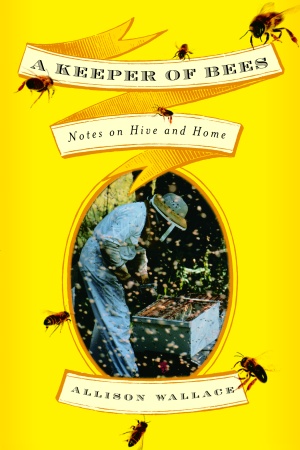
Bees and Home--A Keeper of Bees


I had the good fortune of receiving Allison Wallace's, A Keeper of Bees for my birthday. As Wallace was one of my professors during my undergraduate days at the University of Central Arkansas (less than two years ago), I was interested in her new book, if anything, simply to read a published work by someone I knew. Especially since Barnes & Noble (I know, enemy to small booksellers everywhere, but I promise I visit Nightbird too!) also carried it, thus meaning that they thought it would appeal to someone, somewhere.

So, I sat down with A Keeper of Bees, having just finished my first summer as a grad student and needing to read something to keep my mind off my recent wisdom teeth removal. The book was intriguing and delightful. As someone who ravenously reads Michael Pollan, Wallace's book fell within writing that interested me. Much like Pollan, Wallace intertwines describing the bee-world--and keeping them--with her own life in such away that enriches what bees are. I enjoyed the style of the book; it was short and to the point, but infused with humor and personality that I could almost see her eye twinkle with enjoyment as she relates, for example, her first encounter with the bees while trying to plant her broccoli a little too close to their hive or her hive swarms.

The ultimate question, though, is why should you read it? After all, if you wanted information about bees, couldn't you just read a book on beekeeping? Perhaps my own enjoyment was a result of knowing Wallace, but the work is genuinely worth the read. It is well crafted, carefully written, and an illuminating expression of the connection between our life's circumstances and that of the "four-footers" (to use a phrase from Wallace). If you are interested in bees, nature, or just on the hunt for a good book, I'd highly recommend A Keeper of Bees.

(See the Random House site for a blurb on the book, or visit Amazon).

Tuesday, September 05, 2006

Rapturous Delight...

To use a 19th C. phrase, straight from the world of British Romanticism. I simply want to express the joy and passion with which I regard my wonderful grad class this semester. Simply put, it excels my expectations. Not only do I feel like we're reading great books and learning about a formative period of literature, but also I feel like I'm acquiring more (and improving) skills I'll need to be a successful academic.

The class is difficult and challenging, but that's partly why I love it. It forces me to be prepared to engage in meaningful discussion (and back up my points), and really strive for excellence. And not only is the material interesting (literature, criticism, history), but the professor is also wonderful. She's charming, intelligent, and a great teacher--she's one of those that will look at you and ask "Why?" after you say something, so you'd better be ready to back yourself up. It's an all around great class...and here's a reading list :)
  • The Castle of Otranto by Horace Walpole
  • The Monk by Matthew Lewis
  • Zofloya by Charlotte Darce
  • Frankenstein by Mary Shelley
  • Vathek by William Beckford
  • The Bride of Lammermoor by Sir Walter Scott
  • Emma by Jane Austen
And some other very intriguing works to be later discussed, I'm sure. After this moment of rapturous delight in the beauties of my lit class, we can now return to the regularly scheduled posting of things pertaining to books. (Though this does technically...)

Thursday, August 31, 2006

The Inner Devils of Both Print and Man

"Books have the same enemies as people: fire, humidity, animals, weather, and their own content." --Paul Valery

I stumbled across this quotation randomly, and it struck me with a good deal of complexity and sense, the last word being the added complexity. Of course, neither people nor books like (or can tolerate in certain conditions) fire, humidity, animals, and weather. That's common sense, and frankly not very interesting. We all know that, who cares, and why is this quotation being tossed around in one of my daily e-mails?

But the last bit, the "their own content" creates a new level of meaning that made me pause. Both books (and us, by extention) are our own enemies by our very content. Is it because our content causes strife with others? Or because we somehow struggle with it as an enemy, even though it is us? Or a mixture of the both?

I'm going to go with a mixture, I suppose. With a book, it's content both creates enemies and is its enemy because ideas can enflame. If you look here, you'll see the chroncles of young adult authors fighting the constant barage of censorship because their works contain themes of sexuality, violence, or just kids trying to grow up in an increasingly difficult world. Parents get the banning bug easily when it comes to "protecting" their children (though I'll leave my censorship rant for another post). Historically, books have had the power, through their content, to spark debate, controversy, passion, outrage, and even action. But it's bad for the books because sometimes they end up locked away, attacked with a Sharpie, or burned.

And while the content has the power to create enemies, it is also the enemy itself--it leads to a threat of life and well-being (at least the ability to exist unhindered). People, and the books they right, struggle with ideas and aspects about themselves that are difficult to overcome. They have to reconcile themselves with themselves. Sometimes it's about not struggling against that content, but coming to understand it as an aspect of who you are and an attribute that has shaped you to be the person you should be. Sometimes it is an obstacle, a personal battle that must be fought all throughout one brief lifetime, and gives birth do a sense of meaning, which in turn leads to art in the form of literature. Books are often about those "inner devils" and thus possess them and struggle with them as well, even if they are not precisely a living entity.

So, I just wanted to share that quotation and my thoughts about it. We'll see what you think.

Wednesday, August 09, 2006

Picky Punctuation

English teachers might be picky about punctuation, but it never cost a student 2.13-million dollars for a misplaced comma. One company was able to get out of a contract due to one pesky little extra comma that changed the implication of the terms of the contract.

Basically, the additional comma changed the meaning of the sentence that instead of locking the contract for five years, after which it could be cancelled with a one year notice, to saying that the contract could be terminated at any time with a one-year notice. A bit of an error on the part of someone's lawyer.

I just wanted to reiterate the importance of using punctuation properly. While it might not cost you 2.13 million for a mistake, using it correctly will save on potential embarrassment and misunderstanding. Let us recall the Shakespeare passage from a previous post where punctuation made all the difference (and knowing about punctuation makes the passage hilarious).

At least in the legal world punctuation is taken seriously.

Monday, July 31, 2006

Recent Studies...

University of Toronto linguists have demonstrated that the influx of IM lingo does not actually affect the syntax of teenagers. I have before argued against the use of shorthand language such as LOL, c-ya, etc, though not because it affects syntax or spoken language but because it demonstrates a degradation in written forms of speech.

I actually have no problem with the use of the IM lingo, usually. I use it occasionally as well. When texting on a cell phone, it is actually quite handy to get a message across to reduce it to a shorthand that everyone seems to agree on. It even shows an innovation among the younger generation with language. I like all of these traits. Language is alive. It grows, it changes, it evolves to fit the needs of the culture in which it is spoken.

My worry (and complaint against the IM shorthand) is the degradation of the artform of writing. Fewer and fewer among us are able to write coherently, let alone concisely and well. It's becoming increasingly rare to run across a blog that doesn't employ the shorthand and general disregard for the rules of writing. And no one seems to mind.

Of course, I'm exaggerating somewhat. One of my daily sites, A Dress A Day, regularly employs great writing. I'm entertained and inspired, and especially amused when she points out bad grammar and poor writing. Yay, Erin. Appreciation for good writing is certainly not dead.

I just look at these teenagers running around and think--do they appreciate good writing? If they grow up writing with a bastardized language, will they ever be able to value the beauty of a well-written work? Will literature die at their hands? Will they gasp at the wonder that is Emily Dickinson's poetry, Shakespeare's plays, or even beautifully written, beautifully illustrated graphic novels such as Astro City and others? I have to wonder if they'll even be able to sense the pulse in John Donne's art or the wicked wit of John Dryden and Alexander Pope. It requires a precision in writing and an awareness of language that this IM shorthand does not seem capable of. Not being able to fully comprehend the methods and creativity it takes to write like the great masters, will our literature simply descend into a chaos of jumbled language, misspelled words and shorted phrases?

I hope not. Perhaps teenagers will be able to effortlessly write in both forms, and our future literary masterpieces will be saved. Or perhaps we'll get used to reading a chopped up, horrible scribble and come to think of it as art.

As for me, I'll be the old crotchety English professor in the corner that the kids roll their eyes at when I start fussing about the days when writing was actually a long, creative process instead of hastily jotted down words and thoughts, so hasty that spelling and capitalization, forget about syntax, are lost in the dust.

Wednesday, July 26, 2006

Postmodernism and Me

I came to the startling conclusion the other day--I enjoy learning about Postmodernism. Yes, that's right, the dreaded Po'Mo' (as the boyfriend calls it) has found a place in my heart. Perhaps most of my distaste stemmed from only knowing a minute bit about the subject and knowing all the critiques of it (relativism, etc.), but now that I've read some theory and books and discussed it in class, I've come to see it differently.

You see, according to Fredric Jameson, there is the Postmodern culture and then there is the style known as Postmodernism. (It's often distinguished by using Postmodernity to refer to the historical period). Postmodernity is the era that we now live in, and the marks of it are all around us and evident in our cultural consciousness. The continued trend of urbanization, the effects of consumerist capitalism, and our attitudes toward the world around us emerge from living in Postmodernity. This point is what resonated with me--examining our own culture and analyzing the traits of the world currently around us as a historical movement.

Of course, that idea of history is one that Jameson seems to think we've lost our ability to comprehend. The rise of the bourgeoisie brought with it the idea of a historical narrative--that history is the result of a process, and the present is connected with past events leading toward a future. It helped them demonstrate that their rise to power was not an aberration, but rather part of the inevitable flow of history. Before, history simply chronicled events instead of trying to make sense of them as a connected narrative. Thus, along with this idea of history, the idea of the realist novel was born. Postmodernism rejects the idea of one historical narrative to demonstrate that the dominant, "grand metanarrative" is simply one discourse among many. This leads to a fracturing of the historical sense, a schizophrenia, according to Jameson, because we can no longer see history as a flow of connected realities. The idea of the novel also shifts along with it until it resembles works such as Beckett's Malloy or Pynchon's The Crying of Lot 49, which are fragmented, end without closure, and do not operate under the rules of the realist work.

Postmodernity should be distinguished from Postmodernism, which is the artistic style that most people critique and attack or the ideas that some possess, such as the infamous relativism. This is open to the possibility of criticism and moral judgment unlike Postmodernity, or so Jameson notes.

For some reason, this distinction that emerged for me while I read Jameson's Postmodernism: or, The Cultural Logic of Late Capitalism was the turning point in my attitude toward it. I enjoy reading about it now and delving into it, looking for traits of it in all around me. Especially the discourse of captialism that was drilled into me through the public education system since I was small.

Look forward to a post coming soon on Postmodernism and the graphic novel. Or perhaps more reflections on the subjects touched on in this one.

Friday, July 14, 2006

Why Do I Read?

As I'm typing this, Jameson's rather daunting Postmodernism: Or, the Cultural Logic of Late Capitalism weighs heavily in my bookbag, asking me to abandon my chosen career. You see, as a literature graduate student, I'm setting myself up for a lifetime of reading. And sometimes that reading will be difficult and not exactly enjoyable.

But, still. I love to read, even if it's something less than thrilling. I like diving into a book and feeling the texture of the words, hearing the sounds of the language wash over me. It's like finding a place where words become more--together, a coherent whole, they create something tangible. Even reading Jameson, I still enjoy the process of reading, whether it's actively trying to figure out what the hell he means, or deciphering it as a postmodern (poststructuralist) work--sign, signifier, signed...

Novels are where my heart really is, however, when it comes to reading. Whether it's a really bad novel that I can mock, or even one I don't much care for, I still read. For example, I once read Beckett's Malloy. If you've ever read this work, you'll understand, perhaps, where I'm coming from. I hated that work. But I plowed through, finished, and realized...I liked it. It was an interesting, intriguing work. The process of reading changed me, in some small, subtle way. Each work becomes a person that I encounter, interact with, and walk away altered. Reading a book can change your life.

There's an emotional response, often, to what I read. I pick up a poem by Emily Dickinson, and everytime I read those words--be they for the first time or fifth time--I'm struck by something in those brief lines. She's put something in her poetry that cannot be dissected, explained, or even analyzed. All I know is that it speaks to me in a way that makes my breath catch a little in my throat.

I realize that I'm painting some idealized picture of my life as a reader. Perhaps I am, but I always return to my favorites when I'm tired out. Reading is a process of growth and rejuvenation, of exploration, of longing, of love. Picking up a new book is like meeting a new friend, even if they may betray or anger you, ultimately you walk away with something, as from any relationship. Perhaps that's why I dislike the postmodern idea of text--it makes a novel seem so impersonal, so dead. Or maybe it imbues it with a life of its own; I never can decide.

Why do you read?

Friday, July 07, 2006

Newsprint Follies

You'd think if you worked for some sort of publication, that'd you at least know how to spell things properly. Or know grammar.

But I am, as usual, overly optimistic of the intelligence of other people. And once again, I'm proven wrong.

Every Wednesday, we receive via mail a small newspaper publication. It contains various bits of entertainment news and classified ads, etc. Well, I've decided to quit reading it since every time I do, I find some grievous error. For example, on the front page, is a headline for an article about that lovable character, Winnie the Pooh. Except that apparently it is "Winnie the Poo". Slightly below that misspelling was a misuse of the word "less". They should have used "fewer". Inside the publication are more errors and bad writing. Out of rage, I attacked it with a pen and felt immediately better.

Come on, people. It's not an online blog; it's a printed publication. Errors on paper in print are so much worse because most of us have a trust in the credibility of the printed word. If anything, you sure as hell should make sure your cover page is properly spelled, is grammatical, etc. You can still have bad writing for me to laugh at, but at least use your copy editor. Or hire a better one.

And take some pride in your work. I hate sending out e-mails, posting, or writing anything that contains errors. Why shouldn't a publication (which inevitably is someone's job and a business--there are advertisements) have a desire to create something good?

I sense that my idealism is getting in my way again.

Thursday, July 06, 2006

Shakespeare on Love

Of the Bard's many themes, connection is one that occurs through many of his plays. The concept of love, connection, community, and friendship is one that apparently fascinated Shakespeare--it threads through most of his plays, and "What is love?" is a question that he returns to again and again, most notably (at least for this post) in Twelfth Night and King Lear.

Twelfth Night has been called an essay on love because of the many forms love takes throughout the play. There is the love of Orsino and Olivia, which is self-gratifying. Olivia goes into mourning for her brother, shunning the company of men--an action that Feste declares as foolish. Why should a sister so mourn a brother, if he's in Heaven? he argues. Olivia cuts herself off, indulging in mourning as a selfish action. Orsino loves Olivia in the same way; when he speaks of his love for her, it is all about how he feels, how he appears, and how he will be loved in return: when he hears of Olivia's mourning, he doesn't express sympathy for her, he declares, "O, she that hath a heart of that fine frame/To pay this debt of love but to a brother,/How will she love when the rich golden shaft/Hath killed the flock of all affections else/That live in her" (1.1.32-6). Malvolio, "sick with self-love" loves Olivia because of what it will bring him, not for her. He is another variation on the self-gratifying lover.

Self-gratifying love in Twelfth Night serves a comic rather than tragic function in that the characters who indulge in it learn from their errors. Neither Olivia nor Orsino get to be with the ones they originally desire, though they do get to love someone--Olivia, Sebastian (since she cannot have Viola) and Orsino, Viola (since she is his friend, Cessario in a maiden form). However in King Lear, the results are drastically different. Lear indulges in a form of self-gratification when he asks his daughters to tell him how much they love him. This desire for affirmation of love leads to the tragic consequences at the end of the play; he rejects Cordelia, the one daughter who did love him, because she said "Nothing" instead of the over-done language Reagan and Goneril employ. However, Reagan and Goneril really do not love their father, and drive him mad.

Self-indulgent love is offset by the pure and selfless love of characters like Antonio in Twelfth Night and Cordelia and Kent in King Lear. All three characters are willing to sacrifice everything for their loved one. Anotonio risks his life for his friend Sebastian by entering Illyria. He gives him spending money and jumps to his defense in a fight (though it was really Viola he defended). Cordelia and Kent give up their social places out of the love for Lear. Cordelia wants to show her father what love truly is--it is not words and measurements, as he perceives--and for it, she is banished, and loses her inheritance and eventually her life. Kent is also banished for speaking up to Lear and trying to show him the folly of his actions, for he acts out of love for Lear. He then disguises himself and returns, risking his life, in order to serve the much abused king. These characters represent Shakespeare's vision of selfless love.

However, most of us fall somewhere in the middle. We love truly, but it is usually don't love purely or completely without motive. Viola shows great love toward Orsino and Sebastian, but she doesn't risk anything, really, when it comes to demonstrating her love. Until she is revealed at the end of the play, she takes no action if it involves revealing her disguise. Thus, Antonio is arrested saving her (thinking her to be Sebastian). Her love is tinged with self-preservation.

These are just a few examples of the visions of love that Shakespeare gives us in these two plays. He demonstrates that love is a complex but vital emotion that we need as human beings; those who do not demonstrate it are somehow less than human, like Goneril and Reagan. And Macbeth, when he begins down the road of evil, loses his capacity to love and his once strong connection to wife as he is dehumanized. Love comes in varied forms, and Shakespeare explores it with complexity and insight into the inner workings of the human mind and heart.